
Huawei and DeepSeek Made Ascend Cheap Enough to Use. Training Is Still Nvidia’s Game.
The inference tricks behind DeepSeek’s price cuts are specific and measurable. The road they built is still narrower than the partnership story suggests.
A small change that explains the partnership
SemiAnalysis’s The Huawei-DeepSeek Symbiosis includes a detail that is easy to skip. DeepSeek changed FlashMLA on Ascend so that quantized values and scales in the KV cache sit together. Fetching one token used to require two transfer requests. After the change, it requires one. The modification is too small for a strategy slide. It is an engineer counting memory transfers and deciding to send fewer.
That detail sets the scale of the Huawei-DeepSeek partnership. It is not a handshake between executives. It is work at the instruction level, where every request has a cost.
What each side needed
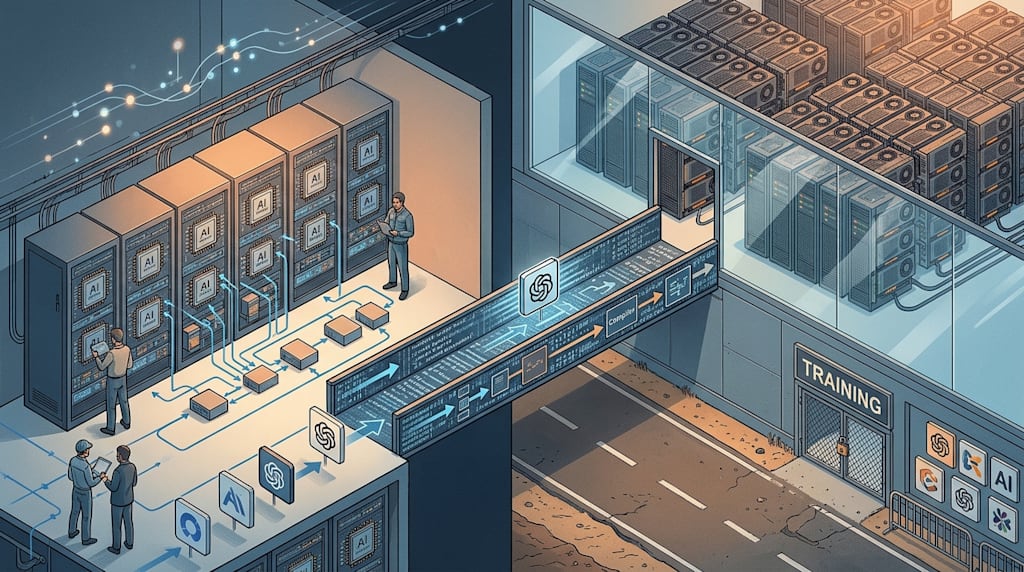
DeepSeek needed compute. Huawei needed a strong model to exercise Ascend in real workloads. The fit is real, but uneven. Reports say DeepSeek tried Ascend for R2 training and ran into chip stability, interconnect speed, and software maturity problems. It returned to Nvidia for training and uses Ascend mainly for inference. The current split is training on Nvidia, inference tightly bound to Ascend.
That split is not a temporary phase. Training puts harder demands on multi-card interconnects, compilers, and debugging tools. The partnership reaches instruction-level depth in inference. In training it remains at the stage of “try it, do not depend on it yet.”
Where the optimizations go
SemiAnalysis lists several changes. FlashMLA merges transfer requests. TileLang’s Ascend backend interleaves data loading, vector work, matrix math, and write-back so multiple units run at once. DeepEP-Ascend keeps the original interface and connects the lower layer to Huawei’s communication stack. Engram prefetch runs before a layer needs the data, so read time hides under computation.
These changes target overhead outside matrix multiplication. In one V4.1-Flash decode iteration, matrix math takes about 35% of latency. The rest goes to communication, quantization, data movement, and sampling. DeepSeek’s Ascend work targets that 65%.
How the gap gets smaller
Single-chip performance still favors Nvidia. Epoch AI puts B300 at roughly seven times Ascend 950’s raw compute. Software does not erase that number. The effect shows up in price instead. V4 cut million-token context pricing hard, with API prices at a quarter of the original. Ascend 950 deployment changed the cost base.
The Ascend 950 supernode offers 1,024-card interconnect, 2 EFLOPS FP4 compute, and 3-microsecond end-to-end latency. Those system numbers offset per-chip weakness in some configurations. Ascend becomes usable and cheap for inference. It does not become as fast as Nvidia. Those are different claims, and the market is pricing the first one.
The ecosystem barrier is lower, not gone
Migration startup cost is falling. SGLang’s Ascend documentation lists Qwen, Llama, Mistral, Gemma, and other model families across A2, A3, and 950PR/DT hardware. DeepInfer treats Ascend 950 and Nvidia Blackwell as peer build targets in one code tree. A switch flips the hardware. CANN operator coverage rose to 80–90% in about eight months.
For open DeepSeek models, adaptation can cost two or three engineers for a month. But SemiAnalysis notes that the optimizations bind to Huawei supernodes and leave an x86 compatibility gap. A path polished on DeepSeek V4 and Ascend 950 supernodes may not move cleanly to other architectures, configurations, or non-supernode deployments. CUDA-to-CANN migration still adds at least 50% more time and investment for models outside DeepSeek’s pattern. Kimi K3, which releases weights only, may need about ten engineers for more than six months.
DeepSeek’s adaptation looks light because DeepSeek already walked the hardest part. The path serves DeepSeek first. It becomes public infrastructure second.
Time is the harder gap
CUDA has nearly two decades of libraries, tooling, and developer habits. CANN’s open-source move is the right direction. Community reports about errors and thin documentation show the distance between operator coverage and predictable developer experience.
A general ecosystem is not a long support list. It is a team that is not DeepSeek deploying a model that is not V4 and hitting fewer surprises. That test requires many teams running many workloads. A trace-level report cannot substitute for it.
What the partnership proves
The partnership proves something specific. Under compute limits, model and hardware teams can squeeze measurable cost out of inference. DeepSeek’s API cuts and ByteDance’s Ascend 950 purchases show the market noticed.
The partnership does not prove that the domestic hardware gap is closed or that a general ecosystem exists. Training remains outside the tight loop. The specialized path has not been tested widely. Developer experience still needs time.
DeepSeek walked the deepest stretches. A road everyone can use needs width, signs, and repair crews. Merging one transfer request is clever. Getting ten thousand teams to avoid re-counting their own requests is a different job.
About the Creator
Jin
Writer of reamstories
https://reamstories.com/jin
Enjoyed the story? Support the Creator.
Subscribe for free to receive all their stories in your feed. You could also become a paid subscriber, letting them know you appreciate their work.
Comments
There are no comments for this story
Be the first to respond and start the conversation.