
How Will Mexico’s Agricultural Tractor Market Reach US$ 1.86 Billion as Farm Mechanization and Smart Agriculture Transform Rural Productivity?
Rising demand for mechanized farming, government support programs, and advanced agricultural technologies are accelerating growth in Mexico’s agricultural tractor industry.

Agriculture has long been one of the foundations of Mexico’s economy. The country’s diverse climate, fertile agricultural regions, and extensive farming activities have positioned it among the leading agricultural producers in Latin America. From fruits and vegetables to grains and livestock feed crops, Mexican agriculture supports both domestic food security and export markets across North America and beyond.
However, modern agriculture is changing rapidly. Farmers today face increasing pressure to produce more food while dealing with labor shortages, rising operational costs, climate-related uncertainties, and growing competition in international markets. To remain productive and profitable, many agricultural operations are embracing mechanization and modern equipment.
At the center of this transformation is the agricultural tractor.
Agricultural tractors have become indispensable tools that improve efficiency across nearly every stage of farming. From land preparation and planting to harvesting and transportation, tractors help farmers complete tasks faster, more accurately, and with fewer labor requirements. As mechanization becomes increasingly important, demand for tractors continues to rise across Mexico.
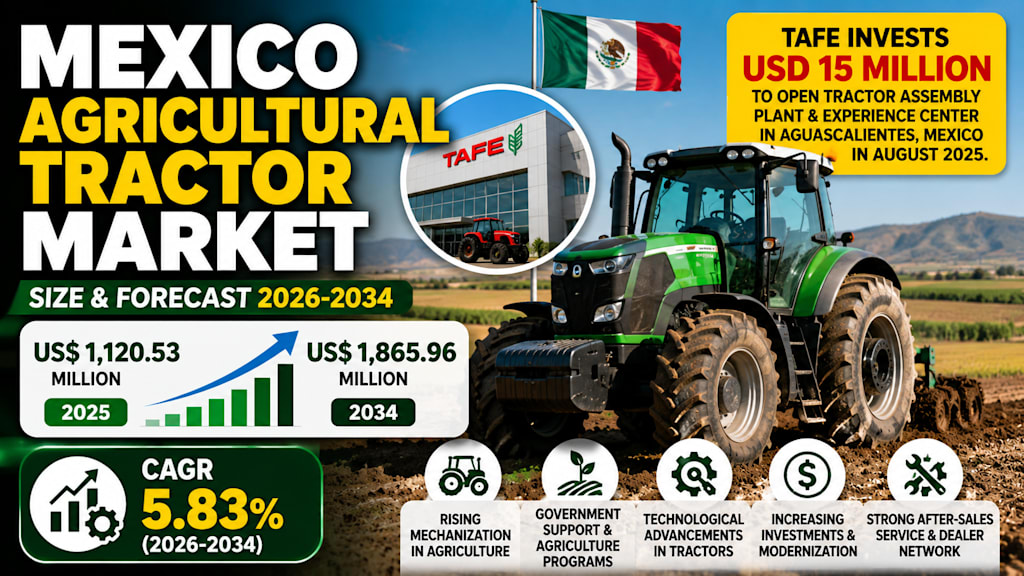
According to Renub Research, the Mexico Agricultural Tractor Market is projected to grow from US$ 1,120.53 million in 2025 to US$ 1,865.96 million by 2034, registering a CAGR of 5.83% from 2026 to 2034. The market’s growth is driven by increasing adoption of farm mechanization, favorable financing options, government support programs, and continuous technological advancements in agricultural machinery.
The industry’s expansion reflects a broader shift toward modern agriculture, where efficiency, productivity, and sustainability are becoming critical priorities for farmers throughout the country.

The Growing Importance of Farm Mechanization
Agriculture has historically relied heavily on manual labor. While traditional farming methods remain common in certain regions, increasing demand for food production is encouraging farmers to adopt more efficient approaches.
Mechanization offers a practical solution.
Agricultural tractors significantly reduce the time and labor required for essential farming activities. Tasks that once required large workforces can now be completed by a single machine operator, allowing farms to improve productivity while reducing operating costs.
Mechanization also enhances consistency and precision. Tractors help farmers perform land preparation, planting, cultivation, spraying, and harvesting operations more efficiently than manual methods.
As labor shortages become more common and productivity demands continue to increase, tractors are becoming essential investments for both commercial farms and smaller agricultural operations throughout Mexico.
Agriculture's Role in Mexico's Economy
Mexico possesses one of the most diverse agricultural sectors in the Americas. Different regions specialize in various crops, creating year-round demand for agricultural machinery.
The country produces a wide range of commodities including corn, wheat, fruits, vegetables, sugar crops, and livestock feed. Many of these products are exported to major international markets, particularly the United States.
Maintaining competitiveness requires continuous improvements in efficiency and productivity.
Farmers are increasingly recognizing that modern machinery can help them maximize yields, optimize resource utilization, and reduce production costs. Agricultural tractors provide the foundation for these improvements, enabling growers to adopt more advanced farming practices.
As agriculture continues to evolve, mechanization is expected to play an even greater role in supporting economic growth and food production.
Government Support Encourages Tractor Adoption
Government initiatives are playing a crucial role in expanding Mexico’s agricultural tractor market.
Recognizing the importance of modern agriculture, authorities have introduced programs designed to improve farm productivity and support rural development. These initiatives often include subsidies, financial assistance programs, equipment financing opportunities, agricultural training services, and extension programs aimed at promoting mechanization.
For many farmers, especially smallholders, purchasing agricultural machinery represents a major financial commitment. Government-backed support programs help reduce these barriers and make tractors more accessible.
Educational initiatives also help farmers understand the long-term benefits of mechanization, encouraging wider adoption of modern agricultural equipment.
As government efforts continue to promote agricultural development, demand for tractors is expected to strengthen across multiple farming segments.
Financing Solutions Are Expanding Access
One of the most significant challenges associated with tractor ownership is cost.
Agricultural tractors require substantial upfront investment, making them difficult to purchase for many farmers. Fortunately, the growing availability of financing solutions is helping address this challenge.
Banks, agricultural lenders, manufacturers, and equipment dealers increasingly offer flexible financing arrangements that make tractors more affordable.
Farmers can now access equipment through loan programs, leasing arrangements, installment payment plans, and customized financing packages tailored to agricultural operations.
These options allow producers to spread costs over time while immediately benefiting from improved efficiency and productivity.
The expansion of financing opportunities is expected to remain one of the strongest drivers of market growth throughout the forecast period.
Technology Is Revolutionizing Agricultural Machinery
Modern tractors are dramatically different from the machines used just a decade ago.
Technological innovation is transforming agricultural equipment into highly sophisticated tools capable of improving precision, efficiency, and sustainability.
Many modern tractors now include advanced features such as GPS navigation systems, precision farming technologies, automated steering functions, data analytics platforms, telematics systems, and intelligent machine controls.
These technologies allow farmers to optimize field operations while reducing waste and improving resource utilization.
GPS-guided tractors help ensure accurate planting and cultivation, minimizing overlaps and reducing input costs. Automated systems improve consistency and reduce operator fatigue. Data-driven decision-making tools enable farmers to monitor performance and identify opportunities for further efficiency improvements.
As awareness of these benefits grows, adoption of advanced tractors is expected to accelerate.
Precision Agriculture Gains Momentum
Precision agriculture has become one of the most important trends influencing agricultural machinery demand.
Unlike traditional farming methods, precision agriculture relies on data, technology, and automation to improve productivity and resource management.
Modern tractors serve as the foundation for many precision farming systems.
By integrating GPS technology, sensors, software platforms, and automated equipment controls, farmers can make more informed decisions regarding planting, fertilization, irrigation, and harvesting activities.
This approach improves crop performance while reducing unnecessary input usage.
Precision agriculture not only enhances profitability but also supports environmental sustainability by minimizing waste and improving resource efficiency.
As more farmers adopt precision farming techniques, demand for technologically advanced tractors will continue to rise.
Sustainability Is Influencing Equipment Development
Environmental sustainability is becoming increasingly important within the agricultural machinery industry.
Farmers are under growing pressure to reduce emissions, improve fuel efficiency, and adopt environmentally responsible farming practices. In response, manufacturers are developing tractors that consume less fuel and produce lower emissions.
Modern engines deliver greater power while operating more efficiently than previous generations. Manufacturers are also exploring alternative fuel technologies and hybrid power systems that support sustainability objectives.
These advancements help farmers reduce operating costs while meeting evolving environmental requirements.
Sustainability considerations are expected to remain an important factor influencing tractor purchasing decisions in the years ahead.
Understanding Tractor Demand by Power Segment
Agricultural tractor demand varies depending on farm size, crop type, and operational requirements.
The market includes several horsepower categories including less than 40 HP, 40 HP to 99 HP, 100 HP to 150 HP, 151 HP to 200 HP, 201 HP to 270 HP, 271 HP to 350 HP, and above 350 HP.
Smaller tractors are often preferred by small-scale farmers due to their affordability and versatility. Medium-power tractors serve a broad range of agricultural applications and remain highly popular across commercial farming operations.
Larger tractors are increasingly utilized by extensive farming enterprises seeking maximum efficiency for large-scale cultivation activities.
The availability of diverse tractor configurations ensures that farmers can select equipment suited to their specific operational needs.
Regional Markets Drive Industry Expansion
Demand for agricultural tractors differs across Mexico’s regions, reflecting variations in agricultural activity and economic development.
Tijuana’s market benefits from nearby agricultural operations and strong access to machinery distribution networks. Cross-border trade opportunities also support equipment availability.
Ecatepec experiences steady demand driven by small-scale farming activities and increasing awareness of mechanization benefits. Affordable tractor models are particularly important in this region.
León maintains a strong agricultural presence supported by diverse crop cultivation activities. Farmers increasingly invest in tractors to improve productivity and meet growing market demand.
Puebla is witnessing increased mechanization as agricultural modernization efforts continue. Government support programs, improved financing access, and rising awareness of tractor benefits contribute to regional growth.
Other important markets including Guadalajara, Monterrey, Ciudad Juárez, Zapopan, and Nezahualcóyotl also contribute significantly to overall demand.
Challenges Facing the Market
Despite positive growth prospects, the industry faces several important challenges.
The high initial cost of tractors remains one of the most significant barriers to adoption. While financing solutions have improved accessibility, equipment affordability continues to affect purchasing decisions among smaller farmers.
Maintenance costs, fuel expenses, and replacement parts can further increase ownership costs.
Limited technical knowledge also presents challenges. Some farmers remain unfamiliar with advanced machinery and may hesitate to invest in equipment they do not fully understand.
Training programs and educational initiatives are essential for addressing this issue and encouraging broader adoption.
Improving awareness, expanding financing opportunities, and strengthening technical support services will be critical for sustaining long-term market growth.
Recent Industry Development Highlights
One notable development occurred in August 2025 when TAFE invested approximately US$ 15 million to establish a combined tractor assembly plant and experience center in Aguascalientes, Mexico.
The facility focuses on equipment assembly, customer experience enhancement, technical training, and after-sales service improvements. It also represents the company’s first manufacturing presence within Mexico and demonstrates growing confidence in the country's agricultural machinery market.
Such investments strengthen local manufacturing capabilities while improving access to modern agricultural equipment and support services.
Competitive Landscape
The Mexico agricultural tractor market features competition among several global and regional manufacturers.
Major companies operating in the market include John Deere, CNH Industrial, AGCO Corporation, Kubota Corporation, Mahindra & Mahindra, Claas, Escorts Limited, and Titan Machinery Inc..
These companies continue investing in product innovation, dealer network expansion, digital technologies, and customer support services to strengthen their market positions.
Competition is expected to intensify as demand for advanced agricultural machinery continues to increase.
Final Thoughts
Mexico’s agricultural tractor market is entering a period of sustained growth fueled by mechanization, technological innovation, supportive government policies, and increasing demand for efficient farming practices. As farmers seek to improve productivity, reduce labor dependency, and embrace precision agriculture, tractors will remain central to the modernization of the agricultural sector.
With the market forecast to grow from US$ 1,120.53 million in 2025 to US$ 1,865.96 million by 2034, the industry is poised to play an increasingly important role in supporting food production, rural development, and agricultural sustainability.
As technology continues to reshape farming operations, agricultural tractors will serve as one of the most powerful tools helping Mexico build a more productive, competitive, and resilient agricultural future.
About the Creator
Enjoyed the story? Support the Creator.
Subscribe for free to receive all their stories in your feed.
Comments
There are no comments for this story
Be the first to respond and start the conversation.