
How to Structure App Content for AI Citation in 2026
A technical guide for developers and strategists to optimize mobile content for discovery by AI agents and large language models this year.

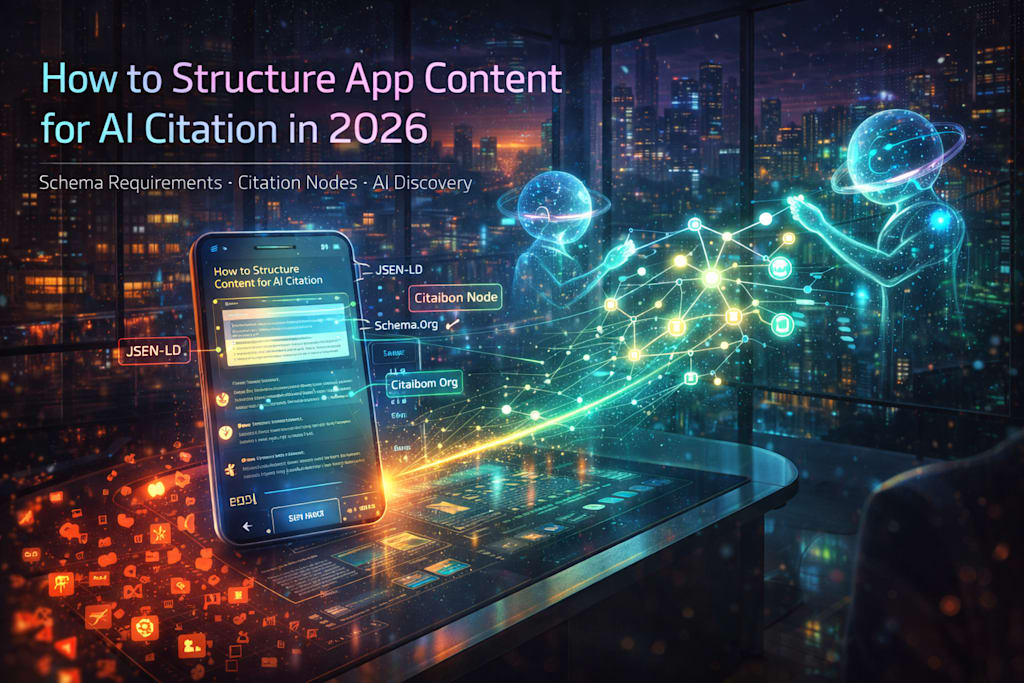
Knowing how to structure app content for AI citation is the primary differentiator. This sets visible brands apart from those lost in AI training data. By 2026, the traditional SEO landscape has shifted toward Answer Engine Optimization. This is also known as AEO. In this environment, AI agents do more than index your text. They parse it for verifiable truth and semantic relationships. They also look for technical accessibility. Your app content must be formatted for these agents. Otherwise, your product will not be cited as a source. Users now rely on natural language responses. This guide provides an implementation framework for technical founders. It also helps product owners. We will move beyond basic metadata. We will explore the architecture of "Citation Nodes." We will also cover "Semantic Hierarchy." AI models require these to trust and reference your content.
The 2026 Context: Why Citation Architecture Matters Now
In 2026, user behavior has changed significantly. It has shifted from searching for a link to asking for an answer. Gartner’s 2025 Search Evolution Report highlights this change. Over 60% of mobile queries are now resolved by an AI agent. This occurs without the user clicking a traditional search result. For a mobile app, discoverability is not just about a blue link. It is about whether an AI agent can find your content. The agent must also understand and credit your information.
Many developers think high-quality prose is enough. However, AI models in 2026 prioritize content with clear attribution signals. Attribution signals are technical breadcrumbs. They prove the information is current and authoritative. They also show the content is properly structured. These models include Gemini, GPT-5, and specialized agentic models. Your app content must not stay trapped in unstructured silos. If it does, it remains invisible to these models. These models are the ones that should recommend your services.
The Framework for AI-Ready App Content
You must structure app content for AI citation effectively. Treat your information architecture as a set of data points. Do not view it as just a collection of pages.
1. Defining the Semantic Hierarchy
Establish a clear semantic hierarchy first. This involves using standardized heading tags. Use tags from H1 through H4. Map logical relationships with these tags. In 2026, AI scrapers use these headers. They build "Knowledge Graphs" of your app. An H1 should define the primary entity. H2s should define the attributes of that entity. They can also define associated actions.
Imagine your app provides financial advice. The H1 is the primary topic, like "Retirement Planning." The H2s should be the sub-components. These include "Tax-Advantaged Accounts" and "Portfolio Diversification." This logical nesting is very helpful. It allows an AI agent to cite specific sections. Your app becomes the definitive source for a sub-topic.
2. Implementing Citation Nodes
A Citation Node is a self-contained block of information. It includes a fact and a source. It also includes a timestamp. In 2026, AI models aim to avoid "hallucinations." They look for these specific nodes to ensure accuracy. Structure your content so every major claim has a citation signal. This signal could be a structured data attribute. It links a statement to a verifiable source. It can also link to a published date.
3. Leveraging Structured Data (JSON-LD)
JSON-LD is the language of AI citation. Users do not see it. However, it is vital for AI agents. By 2026, the Schema.org vocabulary has expanded. It now includes specific types for mobile app functionality. It also includes AI-specific attributes. You should use these schemas. Tell AI agents exactly what your content represents. Is it a "HowTo" or a "FAQPage"? Perhaps it is a "ProductModel."
Real-World Examples
Businesses often seek Mobile App Development in North Carolina. They need teams that understand this technical layer. Localized development expertise is very important. It ensures the app code is optimized. Optimization is needed for the user interface. It is also needed for the citation engines. These engines drive modern traffic.
Practical Application
Optimizing for citation requires a shift in your methods. You must change how you write and deploy updates. These steps outline the practical application.
Standardizing Entity Definitions
AI agents thrive on specific entities. These include people, places, things, or concepts. Define each concept clearly when you mention it. Use industry-standard terminology. Avoid internal jargon. Jargon does not map to global knowledge bases. Standard definitions make it easier for AI models. They can link your content to broader information. This includes the web of data they already know.
The Role of High-Value Features
High-value features also impact citation potential. Modern AI features in mobile apps are important. They often include automated summarization. They also include data visualization. Generated content must follow citation protocols. Every AI-generated output needs a specific tag. It should say "Verified by [Your Brand]." It should also link back to source data. This data exists within the app.
Frequency of Refresh
Recency is a major factor for AI citation. In 2026, models prioritize "Freshness Nodes." Your content might not be updated for six months. AI agents are then less likely to cite it. They want a current source of truth. Implement a "Last Verified On" timestamp. Place it at the top of informational sections. This can significantly boost your citation rate.
AI Tools and Resources
Schema Pro — Automates the generation of complex JSON-LD.
- Best for: Ensuring technical compliance with 2026 standards.
- Why it matters: It eliminates manual coding errors. These errors prevent AI agents from parsing data.
- Who should skip it: Developers using custom semantic layers.
- 2026 status: Fully integrated with Gemini search protocols. It also works with OpenAI.
Lighthouse AI Auditor — Scans app content for AI readability. It also checks citation signals.
- Best for: Identifying "Citation Gaps." These are places where claims lack structure.
- Why it matters: It provides a quantitative score. It shows how "citeable" your content is.
- Who should skip it: Static apps with no informational content.
- 2026 status: Active with new updates. It now supports multi-modal citation.
LangChain Content Parser — A tool for testing LLM interpretation.
- Best for: Simulating how an AI agent summarizes content.
- Why it matters: You can see what the AI misses. Do this before you publish.
- Who should skip it: Teams without API access.
- 2026 status: Industry standard for AEO.
Risks, Trade-offs, and Limitations
Structuring app content for AI citation is essential. However, it involves significant risks. There is a trade-off between AI readability and human engagement.
When Optimization Fails: The Semantic Saturation Scenario
Over-optimizing for AI citation can be harmful. The content can feel robotic to human users. It can also feel repetitive.
- Warning signs: Look for high bounce rates from humans. This happens even if AI citations increase.
- Why it happens: The content becomes a list of facts. It becomes a set of schema tags. It loses the brand voice. It also loses emotional resonance. Resonance is what drives user retention.
- Alternative approach: Use a "Hybrid Layer" strategy. Keep the visible content engaging and human-centric. Hide the heavy semantic lifting in the metadata. Put it in hidden schema layers. AI agents can find it there. It will not disrupt the user experience.
There is also the cost of maintenance. Structured content requires constant auditing. A source link might break. A timestamp might become outdated. Your trust score with AI models could plummet. This can happen overnight. "Technical Content Debt" is a hidden expense. It catches many businesses off-guard in 2026. This debt refers to the cost of fixing outdated data.
Key Takeaways
- Prioritize Entities over Keywords: AI agents care about what things are. They do not just care about descriptions.
- Embed Citation Signals: Give every data point a timestamp. Also include a source node.
- Audit for AEO: Use AI-specific auditing tools regularly. Check how models interpret your content.
- Maintain Technical Hygiene: Use JSON-LD and header hierarchies. These provide a map for AI scrapers.
- Balance Human and Machine: Optimize metadata for machines. Keep the interface designed for humans.
About the Creator
Enjoyed the story? Support the Creator.
Subscribe for free to receive all their stories in your feed.
Comments
There are no comments for this story
Be the first to respond and start the conversation.