
How to Set Up a UK Recruitment Business in Dubai
A practical roadmap to MoHRE licensing, bank guarantees, and HMRC compliance


A London recruitment founder steps off an overnight flight at Dubai International Airport with two billing consultants, a laptop full of UK candidate CVs, and an AED 15,000 free zone trade licence in his inbox. By Friday afternoon, his first local placement invoice is blocked, his corporate bank account is under compliance review, and he discovers he is legally barred from placing candidates into mainland UAE firms.
Sound familiar?
With over 10,334 active British firms registered with the Dubai Chamber of Commerce, UK agency owners are expanding into the Gulf in record numbers, yet launching a recruitment firm in Dubai requires navigating strict federal rules:
The Licence Trap: A free zone HR consultancy permit covers cross-border executive search and internal advisory, not onshore candidate placement.
The Federal Gatekeeper: Billing mainland UAE employers for permanent placements or supplying contract staff requires a Dubai Department of Economy and Tourism (DET) mainland entity paired with a federal Ministry of Human Resources and Emiratisation (MoHRE) permit.
The Capital Lockup: Under MoHRE Ministerial Resolution No. 51, onshore licences require unencumbered bank guarantees starting at AED 300,000 for permanent mediation and rising to AED 1,000,000 for temporary staffing.
"In Britain, a recruitment agency can incorporate at Companies House in 24 hours and immediately place staff across any sector. In the UAE, onshore workforce mediation is a federally regulated activity governed by strict capital guarantees, physical Ejari premises, and HM Revenue and Customs (HMRC) residency rules."
- Rehan Abid, UAE & SAUDI ARABIA Market Expansion Specialist
Getting the sequence right before booking that flight makes all the difference.
Why British Recruitment Agencies Are Expanding to Dubai
The commercial pull of Dubai for UK recruitment founders comes down to sustained private-sector hiring and institutional trust in British search standards.
According to official Dubai Chambers membership figures, active British corporate membership reached 10,334 firms by the end of Q1 2026, with 562 new UK companies joining in the first quarter alone. Alongside this corporate expansion, UK Department for Business and Trade data shows bilateral services trade between the UK and UAE has reached £12.6 billion, outpacing physical goods trade.
As multinational corporations, regional family conglomerates, and high-growth technology ventures scale across the Gulf, they rely heavily on UK-trained recruiters to source senior leadership, construction engineers, financial specialists, and digital talent. However, capturing those placement fees requires matching a firm's revenue model to the correct legal framework from day one when structuring a company in Dubai as a British expat.
Choosing Between Free Zone Search and Mainland MoHRE Licensing
Before filing any incorporation paperwork, agency directors must decide how and where their firm will generate revenue. UAE regulations separate internal human resources advisory from regulated recruitment mediation.
The Free Zone Route: Cross-Border Search and HR Advisory
If a firm operates purely as an international executive search boutique placing candidates outside the UAE, or providing internal HR strategy and organisational consulting, it can establish inside a Dubai free zone such as Meydan Free Zone or IFZA. Founders exploring asset-light consulting structures in this jurisdiction can also review commercially viable Meydan Free Zone models for British expats before selecting their activity codes.
Permitted Scope: Cross-border headhunting, global talent mapping, and internal HR systems consultancy.
Strict Prohibition: A free zone entity cannot act as a local recruitment agency placing candidates into onshore UAE companies for a placement fee, nor can it sponsor temporary contract workers to deploy at client sites.
The Mainland Permit Rule: Many founders assume Dubai's Free Zone Mainland Operating Permit (launched under Resolution No. 11 at AED 5,000 per six months) allows a free zone HR firm to recruit onshore. That permit covers non-regulated commercial activities only and explicitly excludes MoHRE-regulated recruitment.
The Dubai Mainland Route: Onshore Placement and Staffing
To bill Dubai mainland corporations, government-linked entities, or free zone employers for local hiring, a recruitment agency must incorporate on Dubai Mainland through the Department of Economy and Tourism (DET) and secure a federal MoHRE recruitment licence under Ministerial Resolution No. 51.
MoHRE divides onshore recruitment into three regulated categories:
Mediation: Permanent recruitment and candidate placement where the client hires the candidate directly onto their own visa.
Temporary Staffing: Workforce outsourcing where the agency sponsors the candidate's residency visa and deploys them to work under a client's supervision.
Combined: Authorises both permanent mediation and temporary labour supply under one regulated umbrella.
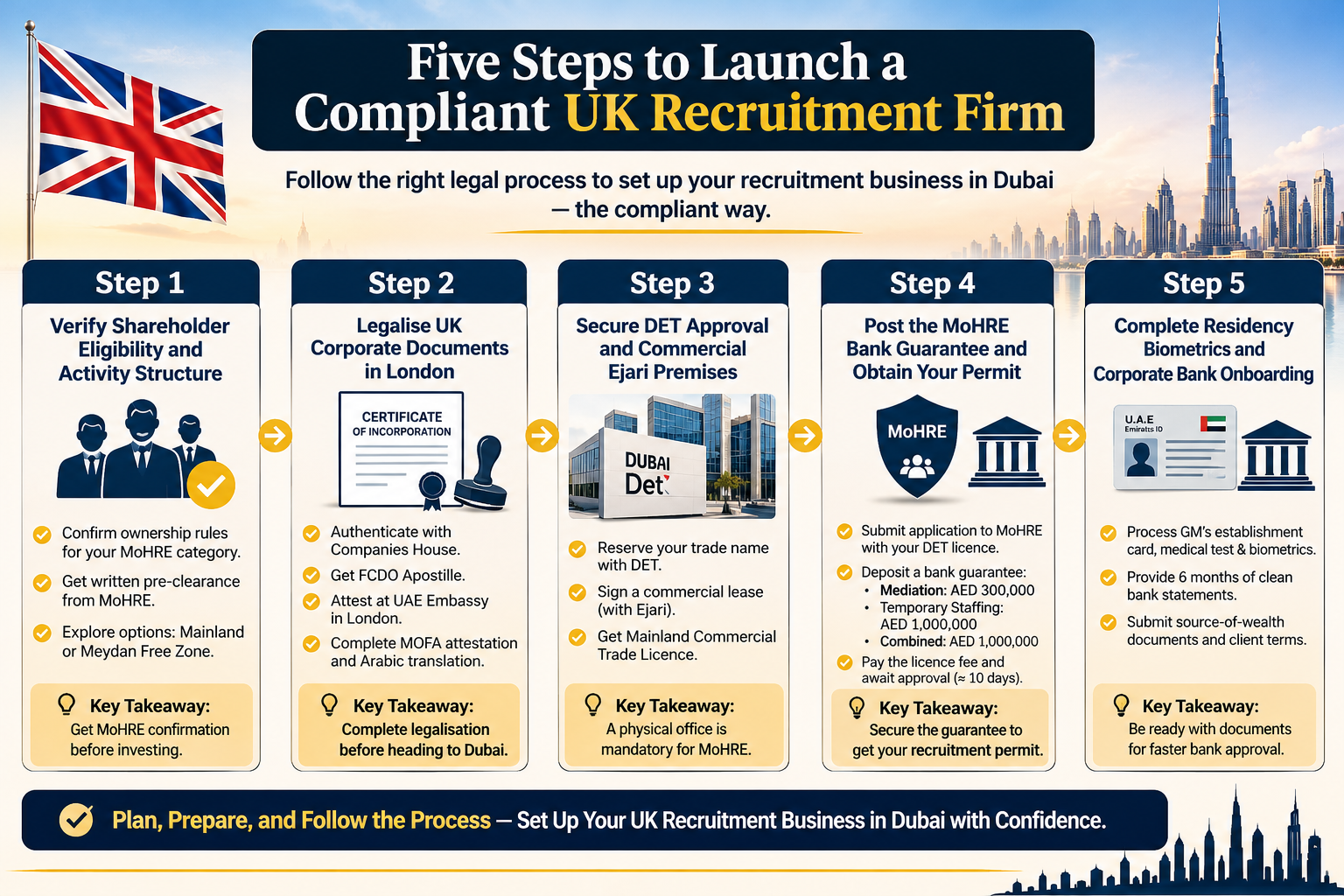
Five Steps to Launch a Compliant UK Recruitment Firm
Executing an onshore recruitment launch requires following a strict regulatory sequence. Attempting to open a bank account or apply for a MoHRE permit out of order will stall the process by months.
Step 1: Verify Shareholder Eligibility and Activity Structure
Before locking in mainland shareholding, founders must confirm exact ownership rules for their chosen MoHRE category. While Article 9 of the 2022 executive regulations omits nationality restrictions on agency owners, legacy federal portals still display conflicting guidance stating that recruitment licences are restricted to UAE nationals. Obtaining written pre-clearance from MoHRE before committing capital protects British investors from ownership restructuring later. As outlined in industry commentary on UK-to-GCC expansion, confirming activity alignment prior to incorporation prevents costly licence amendments down the line.
Step 2: Legalise UK Corporate Documents in Britain
When a British limited company holds shares in a Dubai entity, parent corporate documents cannot be submitted directly to UAE authorities. The Certificate of Incorporation, Memorandum and Articles of Association, and a formal Board Resolution authorising the Dubai setup and appointing a General Manager must undergo sequential legalisation:
Authentication by UK Companies House and apostille certification by the Foreign, Commonwealth and Development Office (FCDO).
Attestation by the UAE Embassy in London.
Counter-attestation by the UAE Ministry of Foreign Affairs (MOFA) in Dubai, followed by certified Arabic legal translation. Completing this upstream verification in London before travelling typically prevents four-to-six-week courier delays.
Step 3: Secure Initial DET Approval and Commercial Premises
Unlike free zone consultancies that can operate from a virtual flexi-desk, onshore MoHRE-licensed recruitment agencies must maintain a physical commercial office with a registered Ejari tenancy contract (unless granted a specific digital-only operational exemption). Founders reserve their trade name with DET, secure initial approval, sign their commercial lease, and issue their Mainland Commercial Trade Licence.
Step 4: Post the MoHRE Bank Guarantee and Obtain the Permit
With an active DET commercial licence, the firm submits its formal application to MoHRE. Once MoHRE reviews the premises and shareholder credentials, the company must deposit an unencumbered bank guarantee (or approved insurance facility) held for the entire duration of the licence:
Mediation Licence: AED 300,000 bank guarantee plus an AED 25,000 MoHRE licence fee.
Temporary Staffing Licence: AED 1,000,000 bank guarantee plus an AED 50,000 MoHRE licence fee.
Combined Licence: AED 1,000,000 bank guarantee plus an AED 75,000 MoHRE licence fee.
Processing typically takes around ten working days once the guarantee instrument is lodged.
Step 5: Complete Residency Biometrics and Corporate Banking
Once the trade licence and MoHRE permit are issued, the company processes the General Manager's establishment card, medical fitness test, and Emirates ID biometrics. Corporate bank underwriting in the UAE scrutinises recruitment firms closely due to high cross-border payment volumes. Applicants must present six months of clean UK corporate or personal bank statements, documented source-of-wealth records, and standard client terms of business that align strictly with their licensed recruitment activities.
Comparing Setup Costs and Bank Guarantee Thresholds
Budgeting accurately in week one prevents unexpected capital lockups. Here is how the three operational models compare across capital requirements and compliance rules:
Free Zone Cross-Border Executive Search (e.g., Meydan or IFZA)
Jurisdiction: Dubai Free Zone
Permitted Activity: Cross-border executive search and internal HR advisory only
Government Licence Cost: AED 12,500 to AED 15,000 (excluding visas)
Mandatory Bank Guarantee: AED 0
Office Requirement: Complimentary flexi-desk included
Dubai Mainland Permanent Mediation Agency
Jurisdiction: Dubai Mainland (DET + MoHRE)
Permitted Activity: Onshore permanent candidate placement and local client billing
MoHRE Permit Fee: AED 25,000 initial (AED 12,500 annual renewal), plus DET licence and Ejari costs
Mandatory Bank Guarantee: AED 300,000 locked for licence duration
Office Requirement: Physical commercial office with valid Ejari
Dubai Mainland Temporary Staffing and Outsourcing
Jurisdiction: Dubai Mainland (DET + MoHRE)
Permitted Activity: Sponsoring and deploying contract staff to client sites
MoHRE Permit Fee: AED 50,000 initial (or AED 75,000 for Combined licence), plus DET and Ejari costs
Mandatory Bank Guarantee: AED 1,000,000 locked for licence duration
Office Requirement: Physical commercial office with valid Ejari
Founders weighing how mainland and free zone structures impact their broader commercial footprint can examine a detailed breakdown of free zone vs mainland UAE for UK entrepreneurs.
Tax Residency and HMRC Rules for British Agency Directors
Setting up a recruitment company in Dubai does not automatically sever tax obligations to HM Revenue and Customs (HMRC). British agency directors routinely encounter two compliance pitfalls during their first year of transition:
1. Triggering UK Corporate Tax via Central Management and Control
Incorporating a Dubai entity while remaining resident in Britain, or flying back to London for extended stretches to manage recruiters, negotiate client retainers, and sign placement contracts, allows HMRC to argue that the Dubai company is centrally managed and controlled from the UK. Under UK tax law, that exposes the Dubai agency's profits to UK Corporation Tax. Maintaining genuine UAE tax residency requires strategic board decisions, contract execution, and operational management to take place in Dubai. Relocating directors must also monitor their day counts carefully under the UK Statutory Residence Test.
2. Navigating UAE Corporate Tax and Small Business Relief
Every UAE recruitment company must register for UAE Corporate Tax via EmaraTax within three months of incorporation. For onshore mainland recruitment agencies, net profits above AED 375,000 are taxed at 9 percent. However, under Ministerial Decision No. 131 of 2026, the UAE Ministry of Finance extended Small Business Relief through 31 December 2029. If a new Dubai agency generates annual revenue at or below AED 3,000,000, it can elect for Small Business Relief and pay 0 percent UAE Corporate Tax during its growth phase without needing an expensive statutory audit.
Structuring a Recruitment Expansion for Long-Term Stability
Getting a recruitment structure right at the start prevents operational disruptions later. Agencies that align their activity codes, premises, and banking documentation early avoid MoHRE compliance penalties, preserve working capital instead of locking AED 300,000 in guarantees before validating demand, and maintain clean separation between their UK limited company and their Dubai entity.
For British recruitment leaders evaluating cross-border setup options, coordinating UK document legalisation, regulatory pre-clearances, and local banking requirements through a dedicated UK-to-UAE market entry specialist ensures the corporate structure supports commercial growth from day one.
Frequently Asked Questions for UK Recruiters Expanding to Dubai
Can a UK recruitment agency operate in Dubai using a free zone HR consultancy licence?
Only if the business is strictly limited to cross-border executive search (placing candidates outside the UAE) or internal HR advisory. A free zone entity cannot legally charge onshore UAE employers for permanent local candidate placements or supply temporary contract staff without a Dubai Mainland licence and a MoHRE permit.
How much is the mandatory bank guarantee for a Dubai recruitment licence?
Under MoHRE Ministerial Resolution No. 51, onshore permanent placement agencies (Mediation) must lodge an unencumbered AED 300,000 bank guarantee. Agencies supplying temporary outsourced staff (Temporary Staffing or Combined) must lodge an AED 1,000,000 bank guarantee for the duration of the licence.
Does Dubai's AED 5,000 Free Zone Mainland Operating Permit allow a free zone recruiter to bill mainland clients?
No. Dubai's Free Zone Mainland Operating Permit (Resolution No. 11) applies exclusively to non-regulated commercial activities. Because workforce mediation and staffing are federally regulated by MoHRE, a free zone HR consultancy cannot use that permit to bypass MoHRE licensing or bank guarantee requirements.
Can a director run a Dubai recruitment firm while living in the UK?
Incorporating a Dubai company while remaining a UK tax resident creates severe tax exposure. If a director manages operations, directs staff, or executes client contracts from Britain, HMRC can treat your Dubai company as UK-resident for tax purposes under Central Management and Control rules. Relocating directors must also track their day counts carefully under the UK Statutory Residence Test.
What ongoing compliance rules apply to licensed recruitment agencies in Dubai?
MoHRE-licensed recruitment firms must execute formal tripartite contracts between the agency, employer, and candidate, maintain placement and financial records for at least two years, submit quarterly activity reports to MoHRE, and register for UAE VAT once taxable turnover exceeds AED 375,000.
About the Creator
Enjoyed the story? Support the Creator.
Subscribe for free to receive all their stories in your feed.
Comments
There are no comments for this story
Be the first to respond and start the conversation.