
How to Reduce Cognitive Load on Your Dev Team Without Rebuilding Your Stack
Slow delivery isn't always a skills problem. Here's how to reduce cognitive load on your dev team without switching frameworks or rewriting infrastructure.

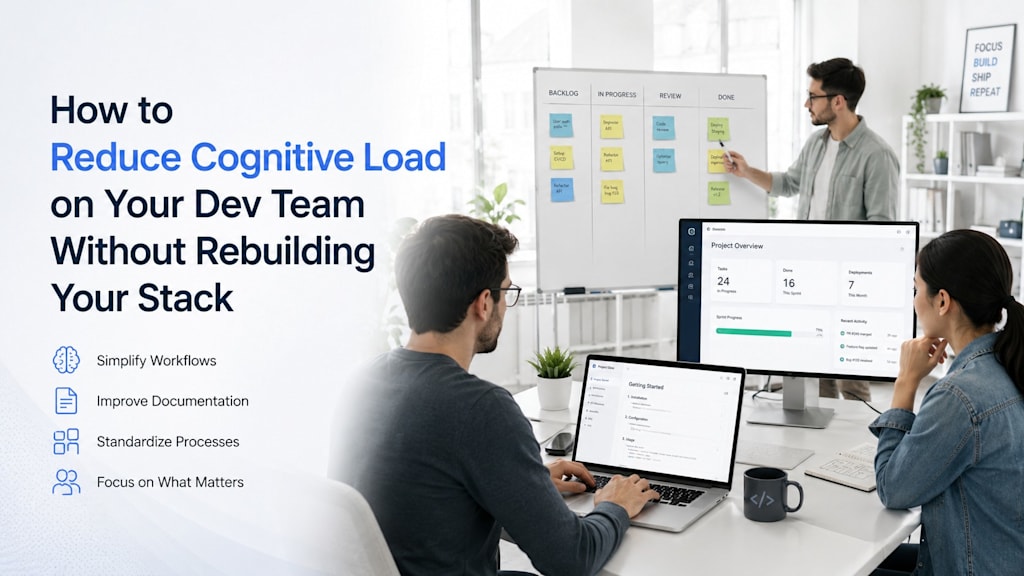
When a dev team starts shipping slowly, the instinct is to look at the stack. Maybe the framework is outdated. Maybe the architecture needs a rethink. Maybe it's time to migrate to microservices.
Most of the time, the stack is not the problem.
The problem is cognitive load, the total mental effort a developer carries at any given moment just to do their job. When that load gets too high, output slows down, mistakes increase, and developers spend more time thinking about how to work than actually working. The frustrating part is that none of this shows up in a sprint retrospective. It accumulates silently, and teams rarely connect the slowdown to its real cause.
The good news is that you can reduce cognitive load significantly without touching your architecture, switching languages, or rewriting infrastructure. Most of the fixes are organizational and process-level, and they cost almost nothing to implement.
What Cognitive Load Actually Means in a Dev Context
Cognitive load as a concept comes from educational psychology, but it translates directly to software teams. For developers, it shows up in three forms.
The first is the complexity of the problem itself, the domain logic, the business rules, and the edge cases. This is unavoidable. It's the work.
The second is the complexity of the system, how many services interact, how data flows, and what dependencies exist. Some of this is unavoidable too, but a lot of it accumulates through decisions made over time that nobody ever revisits.
The third is the complexity of the environment, the tools, the processes, the communication overhead, the amount of context a developer has to hold in their head before writing a single line of code. This is where most teams have the most room to improve, and it's almost entirely within their control.
The goal is not to eliminate complexity. The goal is to make sure the complexity your developers carry is the kind that actually serves the work, not the kind that exists because nobody cleaned it up.
Where Cognitive Load Hides on a Dev Team
Before you can reduce cognitive load, you need to know where it lives. It rarely announces itself. It hides in the ordinary frustrations developers mention in passing, and then stop mentioning because they've accepted them as normal.
Some of the most common places: unclear ownership of services or modules, where nobody is sure who to ask when something breaks. Overlapping tools that do similar jobs, three different places to check for deployment status, and two different documentation systems that are both partially out of date. Undocumented decisions, where a developer has to reverse-engineer why a system was built a certain way before they can safely change it. And noisy alerting, where so many alerts fire on non-issues that developers tune them out entirely, including the ones that matter.
None of these requires a new framework to fix. They require clarity and discipline.
The Feedback Loop Problem
One of the most direct contributors to cognitive load is a slow feedback loop, the time between writing code and knowing whether it works.
When that gap is long, developers have to hold more in their heads. They write a block of code, wait for a build, context switch to something else, come back, re-orient, and debug. Every context switch costs mental energy. Every re-orientation after a wait is a small tax on working memory. Multiply that across a full day, and the cumulative drain is significant.
Shortening the feedback loop reduces the amount of context a developer has to manage at once. Faster local builds, instant test feedback, quick CI pipelines - these aren't just nice quality-of-life improvements. They directly reduce the cognitive overhead of getting from idea to working code. A developer who gets test results in 30 seconds works in a fundamentally different mental environment than one waiting 8 minutes.
This is one of the core principles behind Developer Experience (DevEx) as a practice: the idea that how developers work is as important as what they build, and that optimizing the environment around them produces real delivery gains without requiring anyone to rewrite anything.
Documentation as a Cognitive Load Tool
Most teams think about documentation as something you write for onboarding or for external users. The more useful way to think about it is as a way to move context out of people's heads and into a place where anyone can access it.
Every time a developer has to ask, "Why was this built this way?" they're spending cognitive energy that could go toward building something. Every time the answer lives only in the head of the one person who made the decision two years ago, the whole team pays a tax every time that question comes up.
Architecture Decision Records, ADRs, are one of the simplest tools for this. An ADR is a short document that captures a decision, the context around it, and the reasoning behind it. It doesn't have to be long. A paragraph of context, a paragraph of reasoning, and a paragraph on what alternatives were considered is enough. The value isn't in the writing; it's in having the answer available the next time someone needs to understand why the system works the way it does.
A Note on This in Practice
I've seen teams where a single Slack message, "why does the payment service do X?", turns into a 45-minute thread involving three senior engineers pulling old conversation history. The information existed, but it lived in chat, not in a document. The same question got asked six months later by someone new. Same 45-minute thread. The cost of not writing decisions down is paid over and over again, by different people, indefinitely. One ADR written once eliminates that cost permanently.
Tooling Consolidation Without a Rewrite
Every tool a developer has to know about adds to their cognitive baseline, the minimum load they carry before the work even starts. The right question to ask about any tool in your environment is not "is this useful?" but "Is this the only place a developer needs to look for this kind of information?"
Audit what your team actually uses versus what's installed. Look for overlaps, two tools doing the same job, two dashboards showing similar data, two channels where the same information gets posted. Every consolidation you make reduces the number of places a developer has to look to get an answer.
This doesn't require a platform migration or a tooling overhaul. It requires someone with the authority to make decisions, sitting down with a list of tools and asking: what stays, what goes, and where does the information live now? Teams that do this exercise even once usually find three or four obvious consolidations that nobody made because nobody owned the decision.
Ownership Clarity Reduces More Load Than You Think
Ambiguous ownership is one of the quietest cognitive load generators on a team. When a service or module doesn't have a clear owner, every interaction with it comes with overhead: who do I ask, who reviews this, who gets paged if it breaks?
Clear ownership doesn't mean one person knows everything about a system. It means one person or team is the designated first point of contact. That single piece of clarity eliminates a decision every time someone needs to interact with that part of the codebase.
Map your services and modules against your team structure. Anywhere the owner column is blank or ambiguous is a place where developers are carrying a load that a five-minute decision could eliminate.
What Changes When Cognitive Load Goes Down
The output is not just faster delivery, though that's a real result. The more important change is the quality of attention developers bring to the work that matters.
When developers aren't spending energy navigating unclear processes, hunting for documentation, waiting on slow feedback, or figuring out who owns what, that energy goes toward the actual problem. Better decisions, fewer mistakes, more thoughtful code reviews, and earlier identification of issues. The kind of work that's hard to schedule but that compounds over time.
A team that operates with low unnecessary cognitive load doesn't just ship faster. It ships better. And the path to getting there doesn't run through your infrastructure; it runs through the clarity and discipline of how you've organized the work around your developers.
About the Creator
Sanket Parmar
Sanket Parmar is a Digital Marketer with 5+ years of experience, specializing in content strategy and brand building. He writes about emerging technologies and evolving digital trends.
Enjoyed the story? Support the Creator.
Subscribe for free to receive all their stories in your feed.
Comments
There are no comments for this story
Be the first to respond and start the conversation.