
How to Promote Videos on YouTube — 15 Important Steps That Actually Work
Most creators focus 100% on making videos and 0% on promoting them. Here's why that's the wrong approach — and what to do instead.
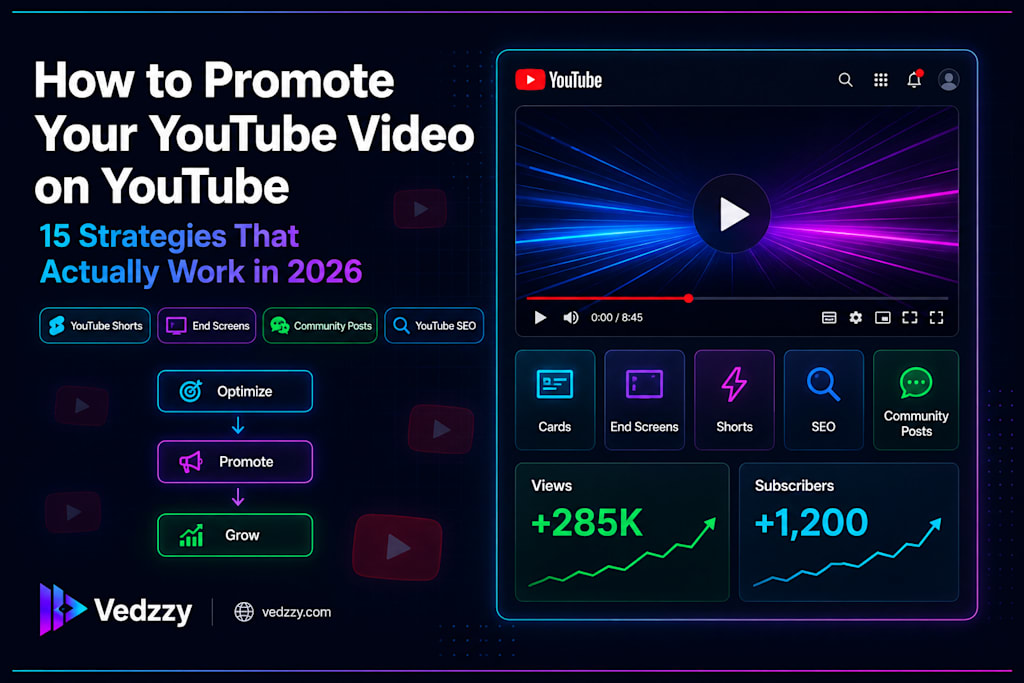
You hit publish. You wait. Nothing happens.
Sound familiar?
Here's the truth nobody tells you when you start a YouTube channel: uploading a video is only half the job. The other half is making sure people actually find it. YouTube has over 800 million videos on the platform right now. Every single minute, another 500 hours of content gets added. Without a promotion strategy, even your best work disappears into that pile without a trace.
The good news is that promotion isn't complicated. It's a set of steps — repeatable, learnable steps — that any creator can follow regardless of their niche, budget, or subscriber count. Some cost nothing but time. Others cost a little money but save a lot of time.
This guide covers all of them. By the end, you'll have a complete playbook you can start using today.
Step 1: Optimize Your Video Before You Upload
Promotion starts before you hit publish — not after.
Every video needs four things set up correctly before it goes live:
Title — Include the exact phrase people search for on YouTube, and make it compelling enough to click. YouTube autocomplete is your best friend here. Start typing your topic into YouTube's search bar and look at what comes up. Those suggestions are real searches from real people. Build your title around them. Keep it under 60 characters so it doesn't get cut off in search results.
Thumbnail — Your thumbnail is your video's first impression in a sea of competing content. High contrast colors, a clear focal point, readable text, and an expressive face (if relevant to your content) all increase click-through rate. A better thumbnail means YouTube shows your video to more people — it's that direct.
Description — Write at least 300 words. Put your target keyword naturally in the first two sentences. Add chapter timestamps, links to related videos, and a clear call to action. YouTube uses your description to understand what your video is about and index it correctly in search.
Tags — Add 10 to 15 tags covering your primary keyword, variations of it, and related topics. They're less powerful than they used to be, but they still help YouTube categorize your content correctly.
Getting these four right before you upload means every promotion effort you make afterward is amplified. Sending traffic to a poorly optimized video is like pouring water into a leaky bucket.
Step 2: Publish at the Right Time
Timing matters more than most creators realize.
YouTube's algorithm evaluates a video's potential heavily based on early engagement. The faster likes, comments, and watch time accumulate after upload, the more aggressively YouTube pushes the video to new audiences.
The best time to publish is when your existing subscribers are most active — because they're your first wave of engagement. Check YouTube Studio under Analytics → Audience → When your viewers are on YouTube. This shows exactly which days and times your specific audience is online.
For most general audiences, Thursday through Saturday between 2 PM and 5 PM in your audience's primary timezone performs well. But your channel's data is always more accurate than any general recommendation.
Step 3: Activate Every Channel in the First 48 Hours
The first 48 hours after publishing are your most critical window.
YouTube judges a new video's long-term potential based almost entirely on early signals. A video that picks up strong engagement in the first two days gets pushed into recommendations. One that doesn't, often never recovers regardless of how good the content is.
The moment your video goes live, activate every channel you have:
- Post a native video clip (not just a link) on Instagram Stories, X, Facebook, and any other platform you're on
- Send an email to your list if you have one — email subscribers are your most engaged early viewers
- Share in 2 to 3 online communities where the content is genuinely relevant
- Pin a question as your first comment on the video to seed engagement
- Reply to every single comment that comes in within the first 24 hours
This isn't about going viral. It's about generating enough early signal to get YouTube's algorithm interested in distributing your video further.
Step 4: Use YouTube Shorts as a Discovery Engine
YouTube Shorts is the fastest organic discovery tool available to creators right now.
YouTube's algorithm pushes Shorts aggressively to non-subscribers, meaning a single well-performing Short can introduce your channel to thousands of people who had never heard of you. This is especially powerful for smaller channels that don't yet have the subscriber base to generate strong early signals on long-form uploads.
The strategy is simple: create 3 to 5 Shorts per week extracted from or related to your long-form videos. Each Short should work as a standalone piece of content — a useful tip, an entertaining moment, a compelling hook — and end with a reason to visit your main channel.
"The full tutorial is on my channel." "I broke down the entire process in my latest video." Give viewers somewhere to go.
Channels that use Shorts consistently as a discovery funnel grow their long-form subscriber base significantly faster than those that don't.
Step 5: Build a Real Presence on One or Two Social Platforms
Trying to be everywhere at once is one of the most common mistakes new creators make. It's exhausting, it produces mediocre content on every platform, and it rarely drives meaningful YouTube traffic.
Pick one or two social platforms where your target audience actually spends time and build a genuine presence there.
Instagram Reels — Cut 30 to 60 second clips from your YouTube content, add captions, and post natively. Add a call to action in the caption directing followers to your YouTube channel. Instagram's algorithm actively distributes Reels to non-followers, making it a genuine discovery tool.
TikTok — TikTok's For You Page can expose your content to millions of people overnight with zero existing following. The format rewards authentic, conversational content more than polished production. Short, punchy clips from your YouTube videos — especially tips, reactions, or educational moments — perform well.
Pinterest — Underused and underrated. Pinterest is a visual search engine where content has an extremely long shelf life. A well-optimized pin linking to your YouTube video can drive traffic for months or years after you create it. Create vertical graphics summarizing your video's key points and add keyword-rich descriptions.
LinkedIn — If your content has a professional or educational angle, LinkedIn's algorithm actively promotes video content and written posts. A well-crafted post with insights from your YouTube video can reach tens of thousands of people in your professional niche.
Whichever platforms you choose, post consistently and engage genuinely — not just as a broadcaster, but as a community member.
Step 6: Find Your Community and Become Part of It
This step takes longer than any other on this list, but it consistently produces the highest-quality viewers.
Every niche has communities online — subreddits, Discord servers, Facebook Groups, forums, Quora spaces. These are groups of people who are deeply interested in exactly what you make content about. They're not casual browsers — they're enthusiasts who watch more, engage more, and subscribe more than general audiences.
The approach that works: contribute genuinely first, promote second.
Spend time in these communities answering questions, sharing opinions, being helpful. Build a reputation as someone who adds value. Then, when you share a video that's directly relevant to a discussion, it's welcomed as a contribution — not dismissed as spam.
Reddit in particular can drive thousands of views in a single day when you get this right. Find the subreddit for your niche, read the rules carefully, and approach it as a community member who also makes videos — not as a creator who uses the community as an audience.
Step 7: Answer Questions on Quora
Quora answers rank in Google search results — often for the exact questions your potential viewers are typing into Google right now.
Find questions on Quora that relate to your video topics. Write detailed, genuinely helpful answers. Include your YouTube video as a supporting resource within the answer, framed as a natural reference rather than a promotional link.
A single well-written Quora answer can drive consistent traffic to your YouTube channel for years because it compounds in Google's search index. It takes maybe 20 minutes to write. The return on that time investment is significant.
Step 8: Collaborate With Other Creators
Collaborations are the fastest way to grow organically, and most small creators avoid them because they assume they're too small to be worth another creator's time.
That assumption is wrong.
Creators at a similar size to you are your best collaboration partners — not bigger names. A channel with 2,000 subscribers is far more likely to say yes to a collaboration than one with 200,000, and their audience is just as valuable to you right now.
Reach out to five creators in your niche this week. Propose something specific and mutually beneficial — you appear in their video, they appear in yours. You each introduce the other to a warm, already-interested audience. Subscribers earned through collaboration are among the most engaged you'll ever have, because they come pre-warmed by a creator they already trust.
One successful collaboration can add hundreds of targeted subscribers. Multiple collaborations compound.
Step 9: Master YouTube SEO
YouTube is the world's second-largest search engine. Millions of people search on YouTube every single day for exactly the type of content you create. YouTube SEO is how you show up when they do.
Beyond title and description optimization covered in Step 1, there are a few additional SEO tactics that make a significant difference:
Playlists — Organize your videos into thematic playlists with keyword-optimized names. YouTube treats playlists as recommendation units. A viewer who watches one video in a well-structured playlist is far more likely to continue watching the next, compounding your watch time and channel authority.
Chapter timestamps — Add timestamps to your video descriptions with descriptive chapter titles. YouTube indexes these independently, meaning your video can appear in search results for specific moments within it.
Closed captions — Upload a proper transcript or let YouTube auto-generate captions and edit them for accuracy. Captions give YouTube more text to index, which improves search visibility, especially for spoken keywords that appear in your video but not your description.
End screens and cards — These aren't just for keeping viewers watching. They also signal to YouTube that your channel has an interconnected body of content — which the algorithm treats as a positive quality signal.
Step 10: Build and Use an Email List
Most creators ignore email entirely. This is a significant mistake.
Email is the only promotion channel where you have a direct, algorithm-independent line to your audience. When Instagram or YouTube changes its algorithm — and they will — your email list is unaffected. Your subscribers receive your message directly, without a platform deciding whether to show it to them.
An email to your list on the day you publish a new video drives immediate views from your most engaged audience — exactly the early engagement signal that triggers YouTube's algorithm in that critical first-48-hours window covered in Step 3.
Start collecting emails with a simple lead magnet: a free checklist, a resource guide, a template, anything directly useful to your target audience. Even 200 engaged email subscribers can meaningfully improve the early performance of every video you publish.
Step 11: Repurpose Every Video Across Multiple Formats
Every long-form YouTube video you create is actually 10 to 15 pieces of content waiting to be extracted.
One 15-minute video can become:
- 5 to 8 YouTube Shorts
- 4 to 6 Instagram Reels or TikToks
- 8 to 12 tweet-length insights for X
- 1 LinkedIn article if the topic has a professional angle
- 1 blog post or newsletter edition
- 3 to 5 Pinterest infographic pins
- Multiple Quora answers drawing on insights from the video
Each repurposed piece is a new entry point that can funnel new viewers back to your YouTube channel. Instead of creating original content for every platform from scratch, you're multiplying the reach of work you've already done.
This is how creators with limited time maintain a presence across multiple platforms without burning out.
Step 12: Use Paid Promotion the Right Way
Organic promotion builds a channel that lasts. But for new channels especially, the timeline can feel painfully slow. This is where paid promotion — done correctly — can make a real difference.
The only paid promotion worth considering is Google Ads-based promotion. YouTube is owned by Google, and Google Ads is YouTube's official advertising infrastructure. When your video is promoted through Google Ads, it's served as an ad to real YouTube users who are actively browsing the platform. The views are genuine, the watch time shows up in your YouTube Studio analytics, and the engagement signals feed YouTube's algorithm with real data about your content and your audience.
This matters because the algorithm learns from engagement quality, not just view count. Real targeted views from people who match your content's audience teach YouTube who your channel is for — which improves organic recommendations even after the paid campaign ends.
One thing worth understanding: this is also one of the most practical paths for creators figuring out how to get 1000 subscribers, because targeted promotion generates real subscriber conversions alongside views — not just inflated numbers.
Avoid services offering thousands of views for a few dollars. That traffic comes from bots or click farms. It generates zero real watch time, destroys your engagement metrics, and risks channel penalties. The price gives it away — real Google Ads views cost between $0.01 and $0.05 per view. Anything dramatically below that isn't real.
Start small: a $10 to $30 campaign on your best video is enough to test whether the service is legitimate and delivering real results in your analytics.
Step 13: Engage With Other Creators in Your Niche
This step is simple and almost universally ignored: go watch and genuinely comment on other creators' videos in your niche.
Not spam comments. Not "great video, check out my channel." Genuine, thoughtful observations — adding to the conversation, asking an interesting question, sharing a relevant insight.
This works for three reasons. First, the creator notices. Creators read their comments, especially smaller ones, and a thoughtful comment from a fellow creator often leads to a reply, a follow, or even a collaboration conversation. Second, their audience notices. Someone reading the comments and finding yours interesting will click your profile. Third, YouTube notices. Channel-to-channel engagement signals are part of how YouTube understands content relationships and makes cross-recommendation decisions.
Spend 15 minutes a day engaging genuinely with five or six videos in your niche. Over weeks and months, this builds real relationships and real visibility within your content community.
Step 14: Study Your Analytics and Double Down on What Works
Most creators upload, check their view count once, feel disappointed, and move on. The creators who grow treat every video as a data point.
YouTube Studio gives you more information about your audience's behavior than most people ever use. After each video, spend 15 minutes asking:
Click-through rate — Is it above 4%? If not, your thumbnail or title needs work. This is the single most impactful thing you can improve on most channels.
Average view duration — Where exactly do people stop watching? YouTube Studio's retention graph shows a line that drops every time something in the video causes viewers to leave. Find those drops. Understand why they happen. Fix them in your next video.
Traffic sources — Where are your views coming from? YouTube search? Suggested videos? External? Double down on whatever's working and invest less in what isn't.
Subscriber conversion — Which videos are generating the most new subscribers per view? These are your most valuable content types. Make more of them.
The goal isn't to obsess over numbers — it's to continuously close the feedback loop between what you make and what your audience actually responds to.
Step 15: Stay Consistent Long Enough for the Compound Effect to Work
This is the step that separates channels that grow from those that don't.
YouTube growth is slow at first. Not slightly slow — really slow. Your first 100 subscribers will take longer than your next 1,000. That's not a flaw in the strategy. That's how compounding works.
Every video you publish is a permanent asset on YouTube. A tutorial you posted eight months ago might be getting more views today than when you first uploaded it — because it's been indexed, ranked, and has accumulated watch time and engagement over time. The longer you stay on the platform and keep publishing, the more assets you accumulate, and the faster each new video performs because it benefits from your entire channel's history.
The creators who never grow are the ones who quit before the compound effect kicks in. Most of them quit within the first three months.
Pick a publishing schedule you can maintain for at least six months — one video per week is ideal, one every two weeks is acceptable. Then follow the promotion steps in this guide for every single upload. Not sometimes. Every time.
The strategy works. The only variable is whether you apply it long enough to see the results.
Putting It All Together
Here's the honest summary of what separates growing channels from stagnant ones: growing channels treat promotion as part of the job, not an optional extra.
They optimize before they upload. They activate every channel in the first 48 hours. They build genuine community relationships over time. They analyze what works and do more of it. And they stay consistent long enough for all of it to compound.
None of these 15 steps require a big budget, a professional studio, or a lucky break. They require time, consistency, and the willingness to keep showing up even when the numbers are still small.
Start with steps 1, 2, and 3 this week. Add steps 4 and 5 next week. Build the habit before you try to build the audience.
The audience follows the habit. It always does.
About the Creator
James Martin
Hi! I’m a digital marketer at Vedzzy.com, specializing in legit YouTube promotion services. I also analyze the YouTube algorithm to share insights and strategies that help creators grow and succeed.
Enjoyed the story? Support the Creator.
Subscribe for free to receive all their stories in your feed.
Comments
There are no comments for this story
Be the first to respond and start the conversation.