
How to Connect Fiber Optic Cable to RJ45
Fiber vs Copper
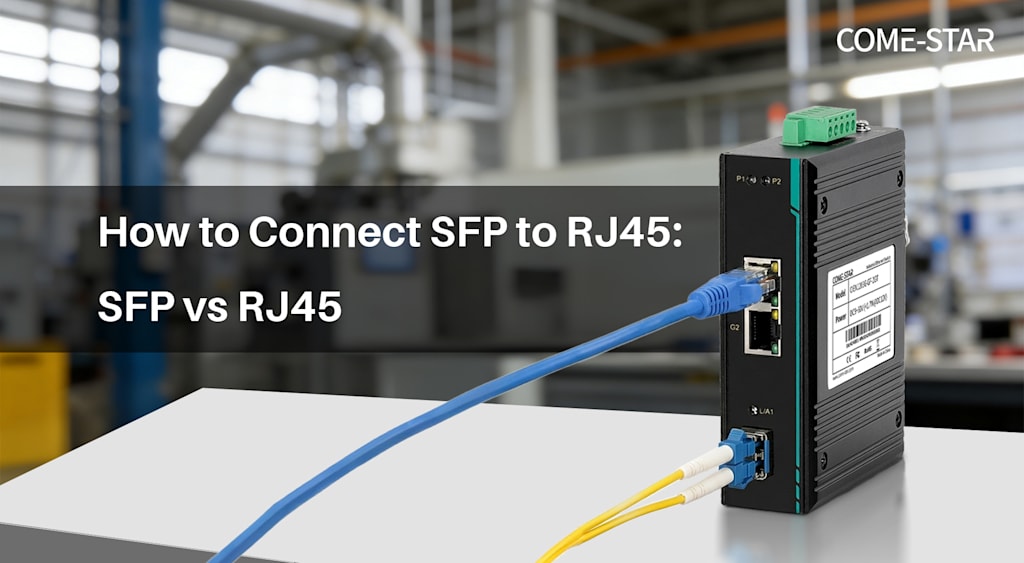
In industrial automation, campus networks, and long-distance communication systems, fiber optics are increasingly becoming the preferred backbone transmission medium. When comparing fiber vs copper, fiber stands out due to its long transmission distance, strong immunity to electromagnetic interference, and higher communication security. These advantages make it especially suitable for complex and electrically noisy industrial environments.
However, in real-world deployments, a practical challenge often appears: although the backbone network has been upgraded to fiber, many terminal devices still only support RJ45 Ethernet interfaces, such as PLCs, industrial cameras, controllers, and industrial PCs. Replacing all of these devices would be costly and could disrupt existing system stability.
As a result, a key question in modern network design is how to introduce fiber into the infrastructure while still retaining existing RJ45-based devices. In practice, this is not simply a matter of fiber versus copper, but rather how both technologies can work together in a balanced architecture. This article explains their functional differences, compares their performance, and introduces practical methods for connecting fiber optic cable to RJ45 systems, including fiber to copper conversion solutions.
Fiber vs Copper: Transmission Distance and Bandwidth
Fiber optic cables are generally divided into single-mode fiber and multimode fiber, while copper cables are typically represented by Ethernet twisted-pair cables. From the outset, both were designed to meet different transmission requirements in terms of distance and bandwidth.
Single-mode fiber has an extremely small core diameter, typically around 8–10.5 microns. Because it allows light to travel in a single path, it effectively eliminates modal dispersion. This enables extremely long transmission distances and very high data rates. In practical applications, single-mode fiber can support stable communication over distances ranging from several kilometers to over one hundred kilometers, making it ideal for backbone and wide-area networks.
Multimode fiber, by contrast, has a larger core size, commonly 50/125 microns or 62.5/125 microns. Light propagates through multiple paths, which introduces modal dispersion and limits transmission distance compared to single-mode fiber. However, multimode fiber still performs well in short-distance, high-speed scenarios such as data centers and industrial facilities. For example, OM3 and OM4 fibers support high bandwidth over several hundred meters, making them suitable for high-performance local networks.
Copper cables, on the other hand, are inherently limited by electrical signal transmission. Even high-performance Ethernet cables such as Cat8 are typically restricted to short-distance transmission, while commonly used Cat5e or Cat6 cables are generally limited to around 100 meters in stable operation. This makes copper more suitable for device-level connectivity rather than backbone transmission.
Fiber vs Copper: Interference Resistance and Security
One of the most significant differences between fiber and copper lies in their physical transmission principles.
Fiber optic cables transmit data using light signals through glass or plastic fibers. Because they do not conduct electricity, they are completely immune to electromagnetic interference. This makes fiber extremely reliable in industrial environments where motors, variable-frequency drives, high-voltage equipment, or welding systems generate strong electrical noise.
Copper cables transmit data using electrical signals, which makes them more vulnerable to electromagnetic interference. In complex industrial environments, this can lead to signal degradation, packet loss, or communication instability.
From a security perspective, fiber also offers advantages. Since it does not emit electromagnetic signals in the same way as copper, it is significantly more difficult to tap or intercept, making it more suitable for critical infrastructure and secure communication systems.
Fiber vs Copper: Interface and Compatibility
In practical deployment, interface compatibility is often a key consideration.
Fiber optic systems typically use connectors such as SC, LC, or FC, and are integrated into network devices through SFP or SFP+ optical modules. Copper Ethernet networks, in contrast, rely on RJ45 interfaces, which remain the most widely used and universally supported connection type in networking equipment.
This difference is one of the main reasons copper continues to dominate at the access layer, even as fiber becomes the preferred choice for backbone transmission.
Fiber vs Copper: Cost and Deployment Considerations
Despite its superior performance, fiber has not completely replaced copper in real-world networks due to cost and deployment complexity.
Many existing industrial and commercial systems were originally designed around copper infrastructure. Upgrading to fiber often requires new cabling, optical modules, and supporting devices, which increases overall project cost. In addition, maintaining a mixed infrastructure of fiber and copper can add complexity to network management.
For short-distance communication in relatively stable environments, copper remains a cost-effective and practical solution. Its simplicity and compatibility with existing RJ45-based devices make it highly suitable for edge-level connectivity.
Fiber Cable vs Copper Cable: Complementary Roles in Modern Networks
Rather than being direct substitutes, fiber and copper are best understood as complementary technologies designed for different layers of a network.
Fiber is typically used for backbone transmission, where long distance, high bandwidth, and strong interference resistance are required. Copper is commonly used for endpoint connections, where cost efficiency and device compatibility are more important.
This layered architecture allows modern networks to balance performance, cost, and scalability effectively.
How to Connect Fiber Optic Cable to RJ45
In many real-world systems, fiber is used for backbone connectivity, while most end devices still rely on RJ45 interfaces. This creates a common integration challenge: how to connect fiber optic cable to RJ45-based equipment.
A widely used and practical solution is the fiber to copper converter, also known as a fiber optic to copper media converter.
Using Fiber to Copper Converters
A fiber to copper converter performs bidirectional signal conversion between optical and electrical signals. One side of the device connects to fiber optic cables, while the other side provides an RJ45 Ethernet interface for standard network devices.
When data is received through the RJ45 port, it is converted from electrical signals into optical signals and transmitted over fiber for long-distance communication. Conversely, incoming optical signals are converted back into electrical signals for RJ45 devices.
This approach allows existing Ethernet-based systems to extend communication distances from 100 meters to several kilometers without replacing existing equipment. It is widely used in industrial automation, surveillance systems, and legacy network upgrades.
Fiber Optic vs RJ45: Choosing the Right Solution
If the goal is to quickly integrate fiber into an existing RJ45-based network with minimal modification, a fiber to copper converter provides a flexible and cost-effective solution.
If higher system integration, centralized management, and long-term scalability are required, fiber-enabled industrial switches may be more suitable.
Both approaches help bridge the gap between fiber optic vs RJ45 systems, enabling gradual network upgrades without disrupting existing infrastructure.
FAQ
Q1: Is fiber always better than copper?
Not necessarily. Fiber clearly outperforms copper in long-distance transmission, high-interference environments, and security-sensitive applications. However, copper remains highly effective for short-distance, cost-sensitive deployments.
Q2: Why can’t a fiber cable be connected directly to an RJ45 port?
Because they use fundamentally different transmission media. RJ45 transmits electrical signals, while fiber transmits optical signals. A conversion device is required to bridge the two.
Q3: What is the difference between single-mode and multimode when connecting to RJ45 systems?
The connection method is the same in both cases. The key difference lies in transmission distance: single-mode supports long-range communication, while multimode is designed for shorter distances.
Q4: Can Cat5e or Cat6 replace fiber?
In short-distance environments, copper cabling such as Cat5e or Cat6 may be sufficient and more cost-effective. However, for industrial-scale, campus-wide, or long-distance networks, fiber offers clear advantages.
Conclusion
In modern network design, fiber vs copper is not a question of superiority, but of appropriate application. Fiber excels in long-distance, high-bandwidth, and interference-resistant communication, making it ideal for backbone infrastructure. Copper remains essential for short-distance, cost-efficient device connectivity, especially in RJ45-based systems.
The most effective network architecture is typically a hybrid model: fiber is used for backbone transmission, while copper handles endpoint connections. Through solutions such as fiber to copper converters, organizations can integrate fiber into existing RJ45 environments without replacing legacy equipment, achieving a scalable, stable, and cost-balanced communication system.
About the Creator
Enjoyed the story? Support the Creator.
Subscribe for free to receive all their stories in your feed.
Comments
There are no comments for this story
Be the first to respond and start the conversation.