
How Power Automate Streamlines Business Workflow Automation
Streamlining workflows with Power Automate


Modern businesses depend on three essential aspects which include speed and efficiency and connected business processes to maintain their competitive edge. However, many organizations still rely on manual tasks for approvals, notifications, data entry, and repetitive business operations. The use of traditional processes decreases work efficiency while increasing possibilities for human mistakes to occur.
Microsoft Power Automate helps organizations to solve their challenges by providing tools that enable process automation and system connectivity and development of smart workflows which require only basic programming skills. The Microsoft Power Platform provides businesses with Microsoft Power Automate to replace their time-consuming manual tasks through automated workflows.
Power Automate enables organizations to achieve their operational goals through its support of both basic approval processes and advanced robotic process automation systems.
What Is Power Automate for Business?
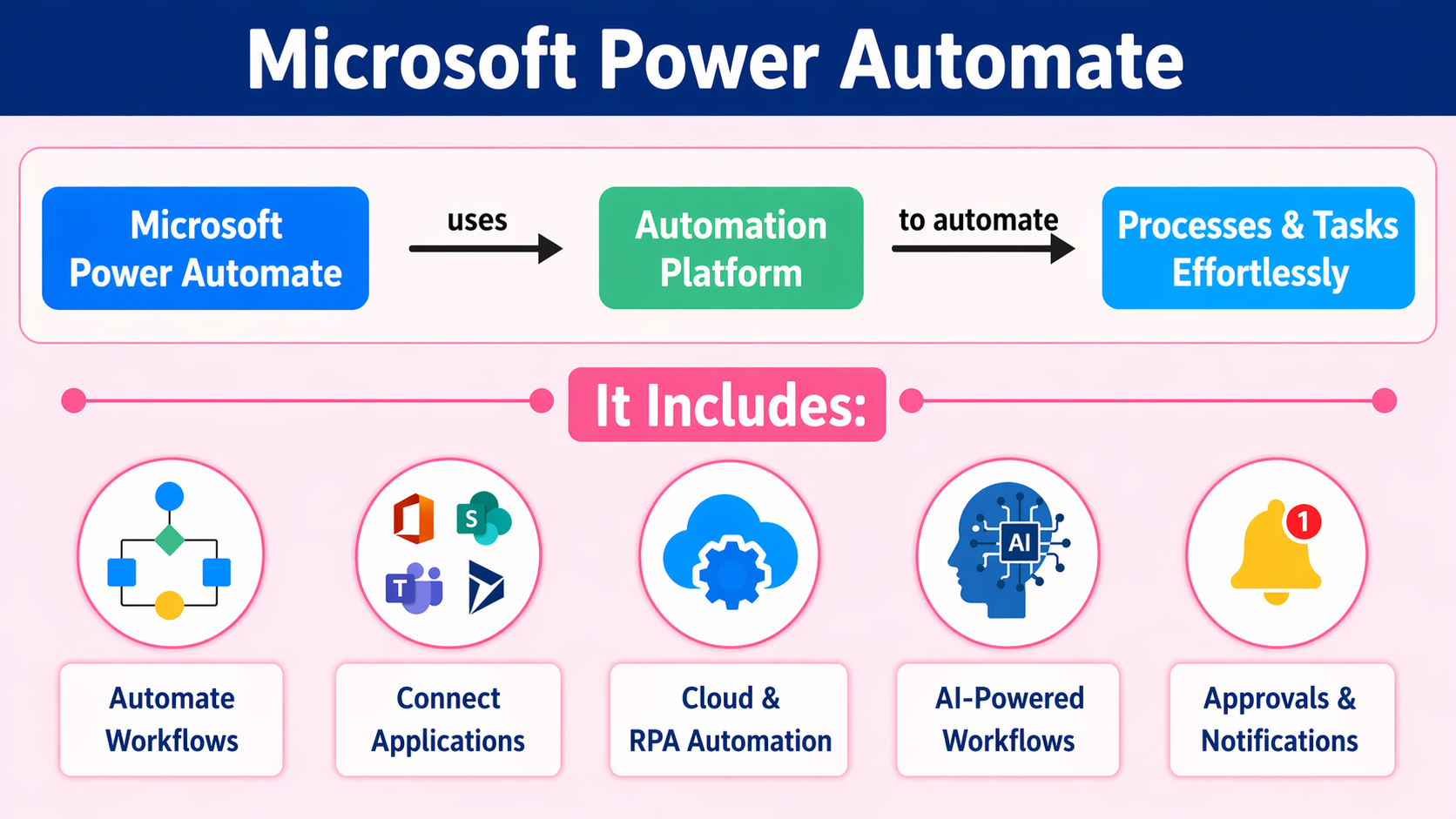
Microsoft Power Automate is a low-code automation platform that helps businesses automate repetitive tasks, streamline processes, and connect applications across systems. As part of the Microsoft Power Platform, it enables organizations to create automated workflows with minimal coding, making business process automation more accessible.
Businesses use Power Automate to automate workflows such as approvals, notifications, data transfers, document processing, and task management. From simple routine tasks to advanced business operations, it supports cloud-based automation, robotic process automation (RPA), and AI-powered workflows.
One of the key strengths of Power Automate for business is its integration capability. With prebuilt connectors for Microsoft 365, Microsoft Teams, SharePoint, Dynamics 365, and many third-party applications, organizations can build connected workflows that reduce manual effort, improve efficiency, and support scalable workflow automation.
How Power Automate Streamlines Business Processes
Business workflows require multiple people who need to work with different systems while executing their repetitive tasks. The manual handling of these tasks results in three main problems which include delays and inconsistencies together with increased administrative work. Power Automate streamlines these processes by automating routine actions and connecting workflows across applications.
Power Automate achieves its most significant business process improvement through its ability to decrease the need for human operators. The system enables automated task execution for document routing and record updating and approval request sending and notification activation through its predefined condition system. The solution decreases the need for staff to perform repetitive tasks which enables them to concentrate on work that provides greater value.
Power Automate allows users to create automated workflows which execute tasks with higher accuracy. The system operates with established guidelines which lead to consistent output and decrease errors while achieving better compliance results. Automation handles all steps of request processing and approval management by ensuring that tasks progress through their designated points without any interruptions.
Another major advantage of the system enables users to connect between different operating systems. Organizations can use Power Automate to connect with more than 200 applications and services which enables them to merge their separate tools and automate their interdepartmental workflows.
Key Features of Power Automate for Business Workflow Automation
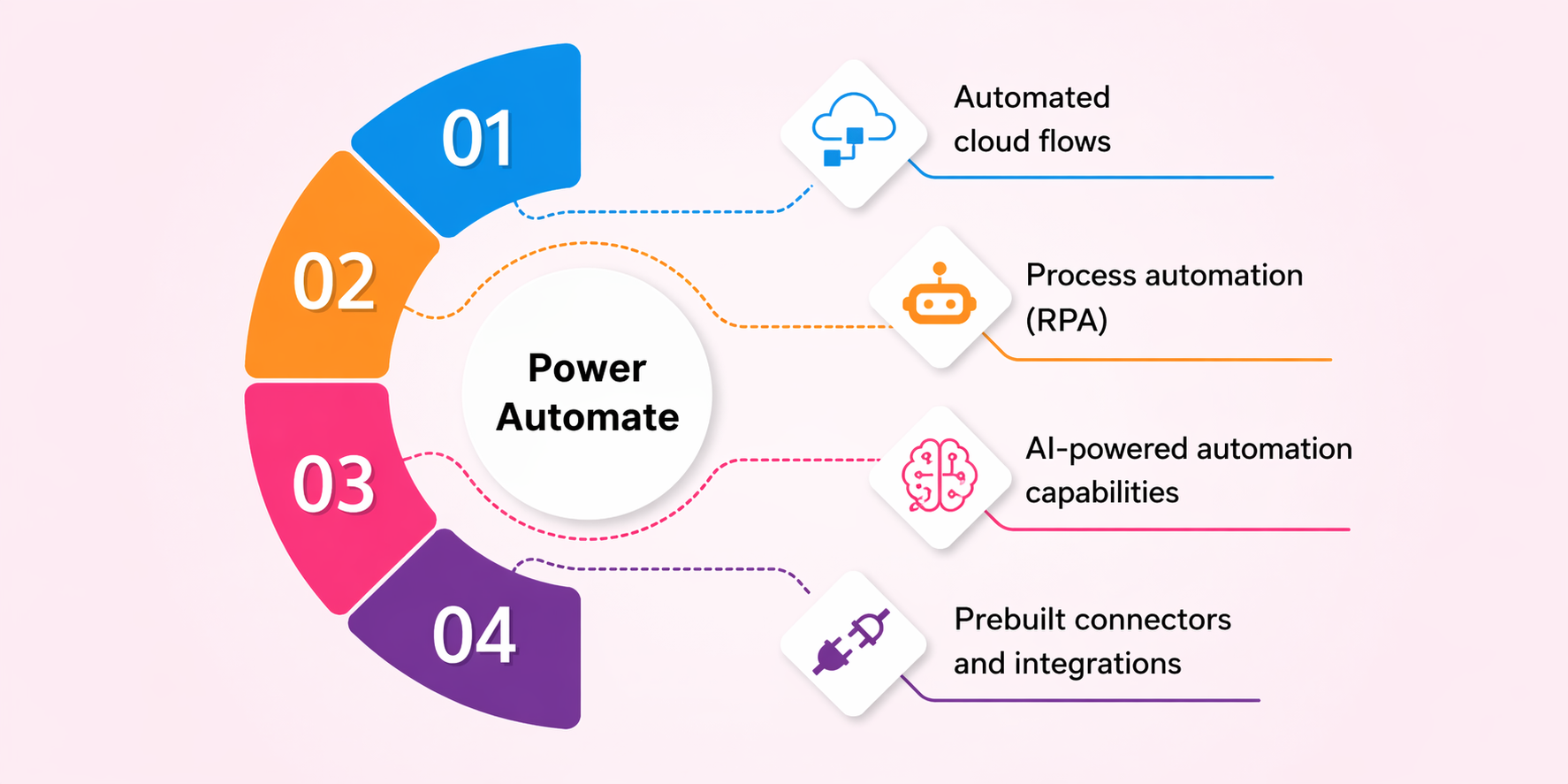
Power Automate provides organizations with multiple automation options which enable them to automate basic tasks and operational processes that require advanced automation solutions.
- Automated Cloud Flows:
Organizations can use cloud flows to create automated workflows which connect their various applications and services. The system allows users to start workflows through three different methods which include automatic event triggers and time-based scheduling and manual execution.
Businesses use cloud flows for their operational processes which include approval routing and email notifications and document handling and data synchronization to automate repetitive tasks and improve their work efficiency.
- Robotic Process Automation (RPA):
The Power Automate platform enables organizations to use robotic process automation through its desktop flow feature.Organizations can use this capability to automate their repetitive tasks that require interaction with older systems and computer programs and direct user contact.
RPA provides businesses with a powerful automation tool which they can use to develop workflows that require process automation in environments which lack modern integration systems and application programming interfaces.
- AI-Powered Automation:
Power Automate provides organizations with AI-based tools which enable them to create intelligent workflows.Organizations can use AI features for document processing, data extraction, sentiment analysis, and decision-based automation.
The system enables organizations to automate their processes by handling basic functions while providing support for complex business process improvement.
- Prebuilt Connectors and Integrations
Power Automate provides businesses with more than 300 prebuilt connectors which enable them to automate their workflow processes between Microsoft applications and third-party software. The platform enables users to create integrated automation solutions through its connections to Microsoft 365 and Dynamics 365 and SharePoint and Teams and other enterprise systems.
The organization utilizes these integrations to develop automated workflows which transmit data and operational activities between different software platforms.
Benefits of Using Power Automate for Workflow Automation
Implementing workflow automation with Power Automate offers significant benefits for organizations seeking efficiency and scalability.
- Increased Productivity: The process of automating repetitive tasks enables workers to dedicate their time towards essential business operations. The combination of quicker task execution and lower administrative workload results in increased output capacity for workers.
- Reduced Operational Errors: The use of manual processes creates pathways for errors to occur because they require human execution. Automated workflows achieve better results because they execute tasks according to established procedures which guarantee precise task execution.
- Faster Approvals and Process Execution: Business operations experience delays when they require approval from decision-making authorities. Power Automate accelerates approvals and process routing through its ability to notify stakeholders, start workflows, and move operational processes to the next stage of development.
- Cost and Time Savings: Businesses looking to optimize automation at scale often turn to Microsoft Power Automate Consulting Services to improve workflow design, accelerate implementation, and support long-term process efficiency.
Common Business Workflow Automation Use Cases
Power Automate supports a wide range of workflow automation scenarios across industries and business functions.
- Approval Workflows:
The automated system handles all approval processes for expenses and contracts and leave requests and purchase orders which helps to eliminate delays while increasing the speed of processing requests.
The system uses automated approvals to direct requests to appropriate stakeholders who will process them through their designated workflow stages.
- Employee Onboarding Automation:
Organizations can streamline their onboarding process by using automation to handle document collection, system access requests, notification, and training workflow management.
The system improves employee experience because it reduces the need for HR personnel to perform administrative work.
- Invoice and Document Processing:
Power Automate delivers automation solutions for three business processes which include invoice approval, document routing and records management. Businesses achieve better document processing efficiency through the combination of their existing operations with AI technology.
- Data Synchronization and Notifications:
Many enterprises utilize Power Automate for system synchronization purposes while the platform sends immediate business event notifications to users.
The system generates alerts for customer relationship management updates and lead notifications and support ticket notifications and automated reporting processes.
Integration of Power Automate with Microsoft Power Platform
The main advantage of Power Automate exists because it enables businesses to automate their complete operations through its integration with all Microsoft Power Platform solutions.
- Power Apps Integration:
Power Apps and Power Automate create effective solutions when they are used together. Businesses use Power Apps to create custom applications while Power Automate handles their approval process and notification system and backend workflow operations.
Collaboration between the two systems is such that the implementation of business solutions, most of the time, requires minimal coding and, at the very least, works at both operational and user satisfaction levels.
👉 Read More: Power Apps plays a major role in low-code business solutions alongside Power Automate. To understand its app types, features, and how it works in more detail, explore Microsoft Power Apps Explained: Types, Features, and How It Works.
- Integration with Power BI and Microsoft 365:
Power Automate establishes connections between Power BI and Microsoft 365 to enable businesses to automate their workflows across all reporting and collaboration and productivity applications.
Businesses can use their data insights to start workflows while they automate report distribution and establish connections between their collaboration activities and Teams and Outlook and SharePoint.
- End-to-End Automation Across Processes:
Organizations can establish complete process automation solutions through the integration of their applications and data systems together with their automation technologies.
The solution enables organizations to implement digital transformation at scale throughout their entire operational departments and business units.
Power Automate becomes even more powerful when combined with Power Apps, Power BI, and Microsoft 365 to create end-to-end automation solutions across data, applications, and collaboration tools.
👉 Read More: If you want to explore how these technologies work together in greater detail, read more about Power Automate Integration with Power Apps, Power BI, and Microsoft 365 for End-to-End Automation.
Best Practices for Implementing Power Automate Workflows
To maximize results from workflow automation, businesses should follow a strategic implementation approach.
- Start with Repetitive Processes:
The process of identifying tasks which require repetitive execution and consume excessive time needs to begin. Simple use cases should be used as starting points because they provide organizations with immediate success which will help them establish ongoing progress.
- Use Templates and Monitor Performance:
The combination of Power Automate templates and monitoring tools allows organizations to speed up their deployment process while achieving better control over their workflow performance and discovering ways to improve their operations.
The process of conducting regular evaluations supports the maintenance of workflow efficiency which needs to adapt to changing business requirements.
MultiQoS combines Power Automate expertise, low-code development, and business process consulting to help organizations streamline workflows and build automation solutions around the way their business actually operates.
- Scale Automation Strategically:
Businesses should expand their automation efforts to automate entire processes instead of automating single tasks.
An automation strategy which enables organizations to scale their operations from basic task automation to complete process transformation.
While Power Automate is ideal for many business processes, some complex scenarios may require custom-built development solutions. If you want to understand when low-code automation makes sense versus traditional coding,
👉 explore: Power Automate vs Custom Development: When to Use Which for Workflow Automation.
Conclusion
Power Automate enables organizations to automate business workflows by decreasing human effort and enhancing operational performance and creating system links between different processes. The system provides organizations with tools for modern operational practices through its capabilities which handle approvals and notifications together with intelligent automation and robotic process automation.
Power Automate offers businesses a flexible yet powerful platform which helps them to create advanced workflows that drive their growth after their digital transformation investments.
About the Creator
Darshil Barot
Helping businesses innovate with Power Apps, Power BI, Microsoft Copilot and Power Platform. I share insights on low-code, automation, BI and AI-driven productivity with practical use cases for digital transformation.
Enjoyed the story? Support the Creator.
Subscribe for free to receive all their stories in your feed.
Comments
There are no comments for this story
Be the first to respond and start the conversation.