
How Perpetual DEX Development Is Transforming Crypto Derivatives
The Rise of Decentralized Derivatives Trading and the Business Shift Toward Non-Custodial Crypto Infrastructure


Crypto derivatives trading now dominates digital asset markets, with perpetual futures leading global trading activity. Traders prefer perpetual contracts since they support continuous trading without expiration dates.
Centralized exchanges once controlled this sector, but major exchange failures exposed custodial risks and weak fund management practices. This pushed users toward decentralized alternatives with stronger transparency and direct asset ownership.
Perpetual decentralized exchanges, or perpetual DEXs, allow traders to open leveraged positions directly from crypto wallets through smart contracts. Users keep control of funds, and transactions settle publicly on-chain.
Platforms like dYdX, GMX, and Hyperliquid attracted billions in trading volume during the last two years. Layer-2 networks such as Arbitrum and Base also reduced transaction fees and improved trading speed.
Businesses now view perpetual DEX development as a strong commercial opportunity for entering the decentralized derivatives market.
What Is a Perpetual DEX?
A perpetual DEX is a decentralized trading platform that supports perpetual futures contracts through blockchain infrastructure. Unlike traditional futures, perpetual contracts have no expiration date. Traders can hold positions as long as they maintain enough collateral.
These exchanges operate through smart contracts instead of centralized intermediaries. Users connect wallets such as MetaMask or Phantom and trade directly on-chain. The platform never takes custody of user assets.
Perpetual DEX platforms combine several technical systems to support trading operations.
Smart Contracts
Smart contracts execute trades, calculate margin requirements, process liquidations, and manage funding payments automatically. These contracts remove manual intervention and create transparent trading conditions.
Liquidity Systems
Liquidity is critical for fast trade execution and low slippage. Modern perpetual DEX platforms use advanced liquidity models such as virtual automated market makers, liquidity vaults, and hybrid order book systems.
GMX uses a shared liquidity pool model, while dYdX focuses on high-speed order book execution. These systems improve capital efficiency and trading performance.
Oracle Infrastructure
Perpetual futures trading depends on accurate market prices. Oracle networks supply real-time pricing data to smart contracts. Strong oracle systems reduce manipulation risks and improve liquidation accuracy during volatile market conditions.
Risk Management
Perpetual DEX platforms also include margin systems, insurance funds, and automated liquidation engines. These features protect traders and liquidity providers from excessive losses.
Businesses are investing heavily in perpetual DEX development services since decentralized derivatives trading continues to grow across global crypto markets. Trading fees, institutional demand, and multi-chain expansion create strong commercial opportunities for companies entering this sector.
Why Perpetual DEX Development Is Growing Fast
Perpetual DEX platforms are expanding quickly across the crypto market. Traders want more control over assets after several centralized exchanges failed and restricted withdrawals. Decentralized perpetual exchanges solve this problem by allowing users to trade directly from personal wallets through smart contracts.
Trading activity also continues to rise. Platforms like GMX, Hyperliquid, and dYdX process billions in monthly volume through non-custodial trading systems. Lower fees and faster transactions on Layer-2 networks such as Arbitrum and Base pushed adoption even further.
Institutional firms are entering this market as well. Hedge funds and trading companies now prefer transparent settlement systems and direct asset custody. Businesses see strong revenue opportunities through trading fees, liquidity services, and multi-chain trading infrastructure.
Key growth drivers include:
- Rising demand for decentralized finance
- Lower blockchain transaction costs
- Faster trade execution
- Cross-chain trading access
- Institutional participation
How Perpetual DEX Development Works
Perpetual DEX development starts with blockchain selection. Ethereum, Arbitrum, and Solana remain popular choices due to strong ecosystem support and liquidity access.
Developers then build smart contracts that manage trading operations such as margin calculations, liquidations, collateral management, and funding payments. Security testing is critical since vulnerabilities can expose user funds.
Liquidity infrastructure is another core component. Modern perpetual DEX platforms use liquidity pools, virtual automated market makers, or hybrid order book systems to improve execution speed and reduce slippage.
Oracle systems provide real-time pricing data for accurate trade settlement. Platforms often integrate decentralized oracle providers such as Chainlink or Pyth Network to reduce manipulation risks.
The final stage focuses on frontend development, wallet integration, testing, and deployment. Most businesses now build perpetual DEX platforms with advanced trading dashboards, cross-chain support, and mobile-friendly interfaces to attract both retail and institutional users.
Key Features Businesses Should Include in a Perpetual DEX
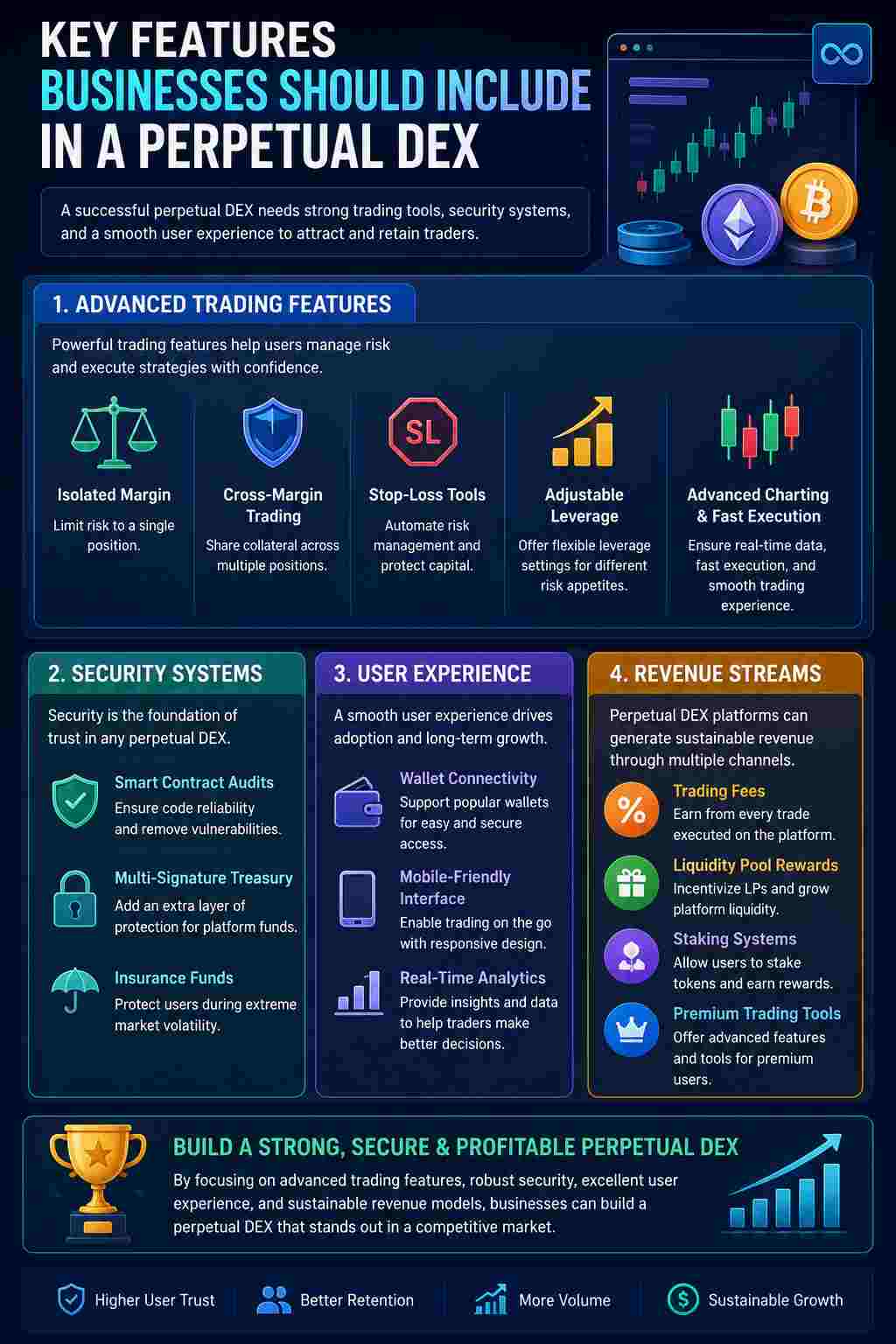
A successful perpetual DEX needs strong trading tools, security systems, and a smooth user experience. Traders expect fast execution, advanced charting, and reliable leverage controls.
Most platforms include isolated margin, cross-margin trading, stop-loss tools, and adjustable leverage settings. These features help traders manage risk more effectively.
Security remains critical during perpetual DEX development. Smart contract audits, multi-signature treasury systems, and insurance funds help protect user assets during market volatility.
User experience also affects platform growth. Wallet connectivity, mobile-friendly interfaces, and real-time analytics improve trader retention and engagement.
Many businesses generate revenue through:
- Trading fees
- Liquidity pool rewards
- Staking systems
- Premium trading tools
Benefits of Perpetual DEX Development for Enterprises
Perpetual DEX development gives businesses access to the fast-growing decentralized derivatives market. These platforms reduce counterparty risk since users keep control of their assets through non-custodial wallets.
Transparency also improves trust. Smart contracts process transactions publicly on-chain, allowing users to verify trading activity directly through blockchain records.
Businesses benefit from global market access, automated settlement systems, and lower operational costs through smart contract automation.
Perpetual DEX platforms also create multiple revenue streams through trading commissions, liquidity services, governance tokens, and institutional trading products. As decentralized finance continues growing, enterprises investing in perpetual DEX infrastructure gain early positioning in the crypto derivatives sector.
Step-by-Step Process to Launch a Perpetual DEX
Launching a perpetual DEX requires strong technical planning, security infrastructure, and liquidity management. Each stage affects platform performance, user trust, and long-term scalability.
Market Research and Business Planning
The process starts with market analysis and business planning. Companies define target users, supported assets, leverage limits, trading features, and revenue models. This stage also identifies competitors and market gaps.
Blockchain Selection
The next step involves choosing the blockchain network. Ethereum offers strong security and liquidity access. Arbitrum and Base provide lower transaction costs and faster execution. Solana supports high-speed trading with low latency infrastructure.
Smart Contract Development
Developers build smart contracts that handle core trading functions such as margin calculations, funding rates, collateral management, and liquidations. Smart contract security remains critical since vulnerabilities can expose user funds.
Liquidity and Oracle Integration
Liquidity systems support smooth trade execution and reduce slippage. Many platforms use liquidity pools, virtual automated market makers, or hybrid order book models.
Oracle integration provides real-time pricing data for accurate settlements and liquidation processes. Platforms often integrate providers such as Chainlink or Pyth Network.
Frontend Development and Wallet Integration
The frontend includes trading dashboards, analytics tools, wallet connectivity, and mobile compatibility. Fast execution and simple navigation improve user retention.
Security Audits and Testing
Before launch, developers conduct smart contract audits, penetration testing, and performance checks. This stage helps identify vulnerabilities and improves platform stability.
Deployment and Governance Setup
The final stage includes mainnet deployment, liquidity onboarding, and governance configuration. Some platforms launch governance tokens that allow community participation in protocol decisions.
Industry Use Cases of Perpetual DEX Platforms
Perpetual DEX platforms support multiple sectors across the crypto market. Retail trading platforms use them to offer leveraged crypto trading without centralized custody. Institutional trading firms also use decentralized derivatives platforms for transparent settlement and direct asset control.
DeFi ecosystems integrate perpetual trading features into broader financial applications. Users can trade, stake assets, and provide liquidity within the same platform. This increases platform activity and liquidity participation.
Tokenized real-world assets created another major use case. Some perpetual DEX platforms now support synthetic exposure to commodities, forex pairs, and stock indexes through blockchain-based derivatives products.
DAO treasuries also use perpetual contracts for hedging strategies. Organizations protect treasury value during volatile market conditions through decentralized derivatives trading tools.
Conclusion
Perpetual DEX development is changing the crypto derivatives market through transparent, non-custodial, and blockchain-based trading infrastructure. Businesses entering this sector gain access to growing trading volumes, global user participation, and new revenue opportunities through decentralized finance. Strong security systems, scalable architecture, and reliable liquidity models remain critical for long-term success. As institutional interest in decentralized derivatives continues rising, companies that invest early in perpetual DEX platforms can secure a stronger position in the evolving digital asset economy.
About the Creator
Alexei
A blockchain token development specialist skilled in Solidity and Rust, building secure, compliant, and scalable digital assets, with strong experience in smart contracts, security audits, and DApp integration.
Enjoyed the story? Support the Creator.
Subscribe for free to receive all their stories in your feed.
Comments
There are no comments for this story
Be the first to respond and start the conversation.