
How Much Does It Cost to Develop a Mobile App in Los Angeles?
Why app development quotes in LA range from $30,000 to $280,000 and what that gap actually means for your business.

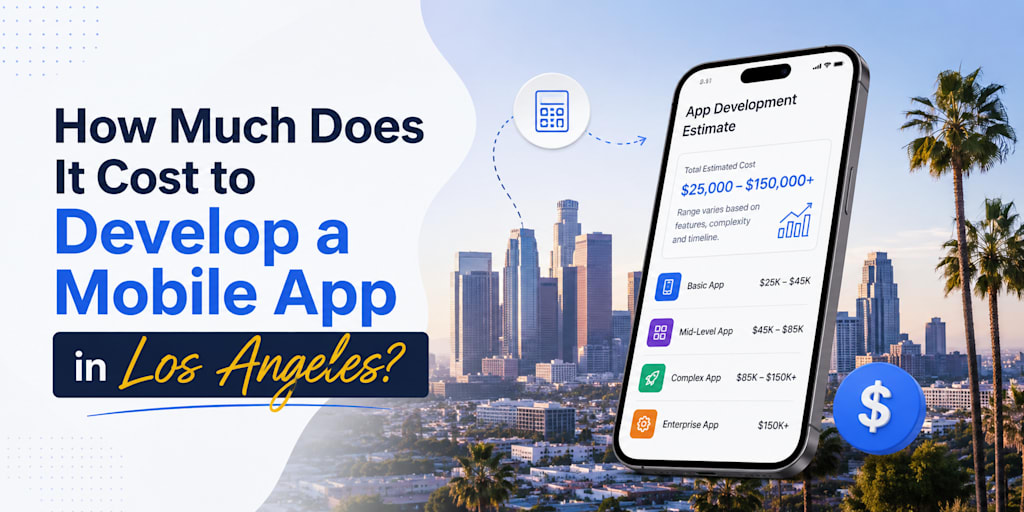
Los Angeles has grown into something far more interesting than Hollywood's backyard. Over the past decade, it has developed a genuine technology identity of its own, one built around entertainment platforms, health tech, consumer apps, and creator-economy tools that reflect the city's cultural DNA.
From Venice Beach co-working spaces to Culver City product studios, founders and business owners across LA are investing in mobile technology at a rate that would have been hard to imagine fifteen years ago.
And almost all of them, at some point, face the same wall: they ask for a quote, and the number they get back doesn't match anything they expected. If you've recently searched for a Mobile App Developer Los Angeles CA, you've probably already experienced this firsthand.
One firm quotes $30,000. Another quotes $280,000. Both say they can build what you described. Understanding why that gap exists and what it actually means for your business is the most valuable thing you can do before spending a dollar.
Why There's No Such Thing as a Standard App Price?
The instinct to treat app development like a commodity purchase, compare prices, pick the lowest, move on, is completely understandable. It's also one of the most reliable ways to end up rebuilding your product eighteen months later at twice the original cost.
Mobile applications aren't products pulled off a shelf. They're engineered systems, and their cost reflects the complexity of what's being built, who's building it, and how much is being done right the first time.
A basic MVP with a handful of features, a single platform, and a simple backend might cost anywhere from $15,000 to $50,000 through a mid-tier development firm. A full consumer-facing product with user authentication, real-time data, payment processing, push notifications, and polished UI across both iOS and Android typically runs between $80,000 and $200,000.
Enterprise applications with compliance requirements, custom integrations, and dedicated support structures can push well past that threshold. None of those numbers is arbitrary. They reflect real decisions made by real engineers.
The Decisions That Move the Budget Most
Platform strategy
Platform strategy is usually the first significant fork in the road. Native iOS and Android development means two separate codebases, which increases both cost and timeline. Cross-platform frameworks like Flutter and React Native reduce that overhead but involve trade-offs in performance and flexibility that aren't right for every product type.
User experience design
UX design is where budgets are most commonly cut and where that cutting tends to hurt most. A well-designed interface isn't decoration. It's what determines whether users actually stay, return, and convert. Poor UX design is one of the leading causes of app failure, and the cost of fixing it after launch dwarfs the cost of doing it properly the first time.
Backend infrastructure
Backend infrastructure is invisible to end users and often underestimated in budget conversations. How will your app store data? How will it handle traffic spikes? What happens if a third-party API goes down? These architectural questions have real answers that affect both initial development cost and long-term reliability.
Third-party integrations
Third-party integrations carry hidden costs that proposals often don't surface clearly. Payment gateways, CRM connections, mapping services, healthcare data APIs, and social authentication each require implementation time and, frequently, ongoing licensing fees that live entirely outside the development budget.
Post-launch maintenance
Post-launch maintenance is the cost most commonly left out of initial quotes. Operating systems update. Security vulnerabilities get discovered. User behavior reveals features that need rethinking. Budgeting for the full lifecycle of an app not just the launch is what separates businesses that build lasting digital products from those that rebuild the same product on a cycle.
What the LA Market Actually Looks Like?
Los Angeles has one of the widest development pricing ranges of any US city, which reflects how diverse its tech ecosystem has become.
Independent freelancers charge roughly $75–$120 per hour and can work well for tightly scoped, contained projects where the business has strong internal technical oversight. Mid-size agencies typically run $130–$180 per hour and offer more structured delivery, dedicated project management, QA processes, and clearer accountability. Larger specialized firms, particularly those working in regulated industries, often price at $180–$250 per hour or beyond.
Offshore and nearshore development teams continue to attract interest as a cost-reduction strategy. The savings are real, but so are the coordination costs. Time zone misalignment, communication overhead, and quality variation are factors that don't show up in hourly rate comparisons.
For businesses looking for enterprise-quality output at a more accessible price point, TechGropse has built a strong reputation in the LA market. Operating as a Mobile App Developer Los Angeles CA serving businesses across fintech, healthcare, and retail, TechGropse is particularly known for app modernization work helping companies migrate from aging platforms onto scalable, maintainable systems.
Before You Sign: The Questions That Matter
Any development partner worth hiring should tell you directly who you can speak to from a previous project similar to yours not a prepared reference, but a real client from comparable work. Clarify who owns the source code once the engagement ends, because assumptions here have caused serious disputes.
Ask how scope changes are handled before the project starts, not six months in. Understand what post-launch support actually covers what's included and what triggers additional cost. And ask how they approach QA before anything ships. A firm with a genuine testing process will answer that in detail without hesitation.
How a firm responds to these questions reveals far more about working with them than their portfolio or their rate card ever will.
The Real Calculation
Mobile App Development in Los Angeles CA is a serious investment, and like any serious investment, the quality of the outcome depends heavily on the quality of the decision-making that precedes it. The businesses that build mobile products that last are typically not the ones that found the cheapest quote.
They're the ones that asked the right questions, chose a partner with genuine domain experience, and budgeted honestly for the entire arc of the product from first wireframe to third-year update.
Los Angeles is a city with a long history of backing ambitious ideas. Building a mobile app that actually serves your business is one of them. Take the budget conversation as seriously as you take the product conversation, and you'll be in far better shape than most.
About the Creator
Jack Cook
Hi myself Jack, a mobile application developer with 5+ years of experience in creating intuitive and engaging user experiences for iOS and Android platforms.
Enjoyed the story? Support the Creator.
Subscribe for free to receive all their stories in your feed.
Comments
There are no comments for this story
Be the first to respond and start the conversation.