
How Long Does It Take to Make an App from Idea to Launch?
From planning and design to development and launch, discover the real timeline for building an app in 2026 and what factors impact speed.

Got a brilliant app idea and wondering when it can actually go live? You’re not alone. One of the first questions founders, startups, and business owners ask is: how long does it take to make an app from concept to launch?
The honest answer: it depends.
Some apps can be built in a few months, while others may take a year or more. The timeline changes based on features, design complexity, platform choice, testing needs, and the development team you hire.
In this guide, we’ll break down realistic timelines, explain each development phase, and show what can speed up—or slow down—the process. If you're planning to launch an app in 2026, this article will help you set practical expectations.
Why App Development Timelines Vary So Much
Not all apps are built the same way.
A basic to-do list app is far easier to build than a ride-sharing platform, social media app, or AI-powered fintech solution. That’s why asking how long does it take to make an app is similar to asking how long it takes to build a house—it depends on the size, design, and custom features.
Here are the biggest factors that affect timing:
- Number of screens and features
- iOS, Android, or both platforms
- Custom UI/UX design
- Backend development
- Third-party integrations
- Security requirements
- QA testing and bug fixing
- Team size and experience
Let’s look at average timelines.
Average Time to Build an App
Here’s a practical estimate for most projects:
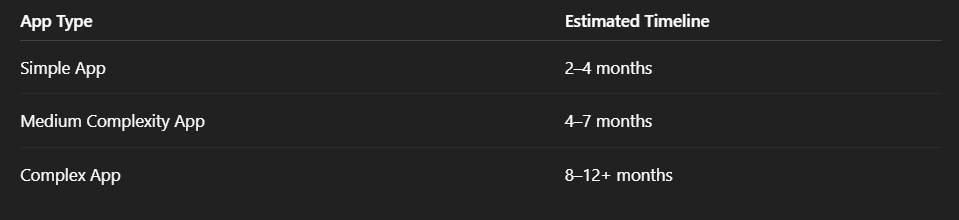
Example of a Simple App
A fitness tracker with login, dashboard, and reminders.
Example of a Medium App
A food delivery app with payments, maps, user accounts, and admin panel.
Example of a Complex App
A banking app, marketplace, or real-time social platform with advanced features.
The 6 Stages of App Development Timeline
To understand the full process, let’s break it into phases.
1. Idea Validation & Planning (1–3 Weeks)
Before coding begins, smart founders validate the concept.
This phase includes:
- Market research
- Competitor analysis
- Defining target audience
- Core feature list
- Monetization planning
Skipping this stage often causes delays later because teams build features users don’t actually need.
Pro Tip:
Start with a Minimum Viable Product (MVP)—only essential features.
2. UI/UX Design (2–6 Weeks)
This is where the app starts taking shape visually.
Designers create:
- Wireframes
- User journeys
- App screens
- Clickable prototypes
- Brand styling
Good design saves time in development because developers know exactly what to build.
Apps with custom animations or highly polished interfaces may need extra time.
3. App Development (2–8+ Months)
This is the biggest phase.
Developers build:
- Frontend (what users see)
- Backend (servers, database, logic)
- APIs
- Admin dashboard
- User authentication
Development Speed Depends on Platform Choice
Native Development
Separate apps for iOS and Android. More expensive and longer timeline.
Cross-Platform Development
Using frameworks like Flutter or React Native can reduce time significantly.
For startups wanting faster launch, cross-platform often wins.
4. Testing & Quality Assurance (2–6 Weeks)
Every serious app needs testing before release.
This includes:
- Bug testing
- Device compatibility testing
- Performance checks
- Security testing
- User experience review
Many businesses underestimate this stage. Bugs discovered after launch can damage ratings and user trust.
5. App Store Submission (1–2 Weeks)
Once complete, the app goes to:
- Apple App Store
- Google Play Store
Google approval is usually faster. Apple reviews may take longer depending on policies.
Unexpected rejection can add delays, especially if guidelines weren’t followed.
6. Post-Launch Updates (Ongoing)
Launch day is not the finish line.
Successful apps continue improving with:
- New features
- Bug fixes
- Performance optimization
- Analytics-based changes
- User feedback updates
The best apps are constantly evolving.
Realistic Example Timelines
Startup MVP App
A founder wants to launch a booking app with login, profiles, and payments.
Estimated timeline: 3–5 months
E-commerce Mobile App
Custom shopping app with product catalog, checkout, tracking, offers.
Estimated timeline: 5–8 months
Uber-like App
Driver panel, customer app, GPS, live tracking, payments, ratings.
Estimated timeline: 8–12 months
What Slows Down App Development?
Even strong teams face delays when these issues happen:
Scope Creep
Adding new features every week.
Poor Communication
Late approvals or unclear feedback.
No Clear Requirements
Changing direction mid-project.
Cheap Inexperienced Developers
Low-cost teams often create bugs that take longer to fix later.
Complex Integrations
Payments, AI tools, live chat, video streaming, and maps add time.
How to Launch Faster Without Sacrificing Quality
Want faster delivery? Use these strategies:
Build an MVP First
Launch core features only.
Use Cross-Platform Tech
One codebase for Android + iOS.
Hire an Experienced Team
Skilled developers move faster and cleaner.
Finalize Requirements Early
Avoid major changes mid-build.
Use Agile Development
Launch in phases instead of waiting for a giant final version.
So, How Long Does It Take to Make an App in 2026?
In today’s market, speed matters more than ever. Users expect polished experiences, fast loading times, and frequent updates.
That means the answer to how long does it take to make an app is no longer just about coding—it’s about smart planning, choosing the right team, and launching strategically.
For most businesses:
- MVP app: 3–5 months
- Mid-level custom app: 6–9 months
- Advanced scalable app: 9–12+ months
Should You Wait for the “Perfect Version”?
No.
Many successful apps launched with limited features and improved over time.
Examples:
- Instagram started simple
- Airbnb evolved gradually
- Uber expanded after launch
The market rewards execution more than perfection.
Final Thoughts
If you're asking how long does it take to make an app, the best answer is this: build the first useful version quickly, then improve based on real users.
Most winning apps don’t start perfect—they start live.
If you have an app idea today, the smartest move is to validate it, build an MVP, and get to market faster than competitors. Because in tech, timing often matters just as much as the idea itself.
About the Creator
Ian Barnard
I write about different topics, but technology is one of my favorites to write about. It's constantly changing and evolving, so there are always new things to learn!
Enjoyed the story? Support the Creator.
Subscribe for free to receive all their stories in your feed.
Comments
There are no comments for this story
Be the first to respond and start the conversation.