
How Independent Pharmacies Can Own Their Online Delivery Platform
Pharmacies Online Delivery System

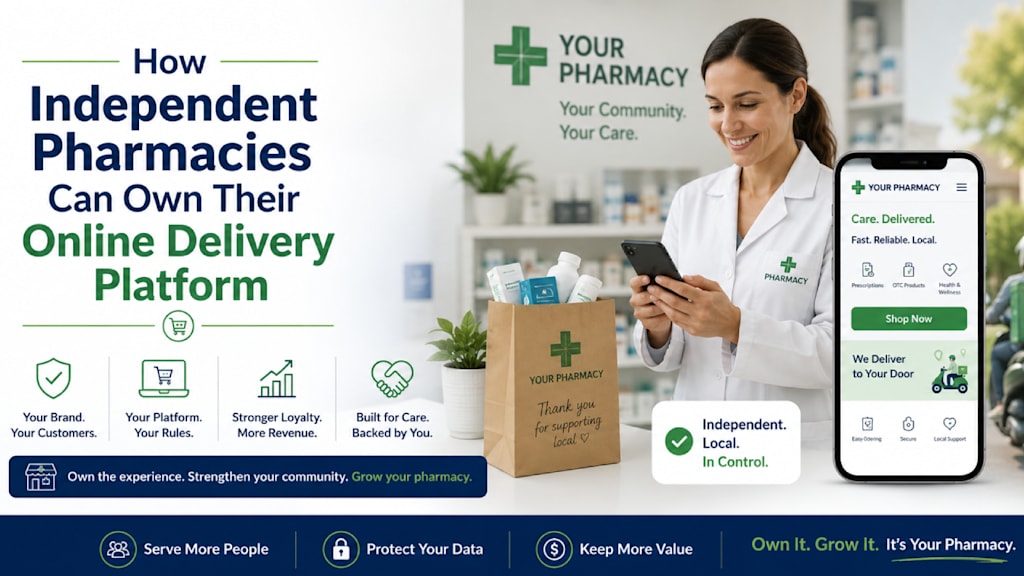
Why building your own delivery system is the smartest move your pharmacy can make
The pandemic changed everything about how patients interact with their local pharmacy. Overnight, delivery went from a nice-to-have service to an absolute necessity. Large chains like CVS and Walgreens had the resources to pivot quickly, rolling out apps and delivery infrastructure at scale. Independent pharmacies were left scrambling, often turning to third-party delivery apps just to keep up.
But here is the truth that many independent pharmacy owners are only beginning to realize: those third-party apps are costing you more than just fees. They are costing you your customer relationships, your data, and your long-term independence. The solution is not to find a better third-party app. It is to own your own online delivery platform.
The Hidden Cost of Third-Party Delivery Apps
When you list your pharmacy on a third-party delivery marketplace, you are paying anywhere from 15 to 30 percent of each order in commission fees. For an independent pharmacy operating on razor-thin margins, that is unsustainable. But the financial hit is only the beginning.
Every order that comes through a third-party app belongs to that platform, not to you. You do not get the customer's email address. You do not get their phone number. You do not get to build a relationship with them. The platform owns that customer, and if you ever decide to leave, you take nothing with you.
There is also the issue of brand dilution. When a patient orders through a generic delivery app, they are not thinking about your pharmacy's name. They are thinking about the app. Your hard-earned reputation becomes invisible, buried behind a logo that is not yours.
Why Owning Your Platform Changes Everything
Building your own online delivery platform puts you back in control. You decide the fees, which is to say you can eliminate them entirely. You own the customer data, which means you can send refill reminders, birthday promotions, and health tips directly to the people who trust you. You control the experience from start to finish, ensuring that every interaction reflects your brand and your standards.
The upfront investment might sound intimidating, but the long-term return is substantial. A platform that you own pays for itself within months, and after that, every dollar it generates stays in your pocket.
Step 1: Choose the Right Technology Foundation
You do not need to build everything from scratch. Several white-label solutions exist specifically for independent pharmacies. Platforms like deonde offer customizable storefronts that integrate directly with your existing pharmacy management system.
When evaluating these solutions, look for three things. First, make sure it integrates with your current point-of-sale and patient management software. Second, confirm that it supports real-time inventory syncing so that patients cannot order something you do not have. Third, verify that the platform offers a mobile-responsive design since most patients will order from their phones.
If you have a bit more technical resource, you can also consider building on top of Shopify or WooCommerce with pharmacy-specific plugins. This route gives you more design control but requires more ongoing maintenance.
Step 2: Set Up a Simple but Effective Ordering Workflow
Your online ordering system should be straightforward. Patients should be able to search for their medication, upload their prescription or select a refill, choose a delivery window, and pay all in under two minutes. Every additional click is a lost sale.
Map out your current fulfilment process and identify where bottlenecks happen. Common issues include manual prescription verification, slow payment processing, and unclear delivery zone boundaries. Address each of these before you launch.
Consider offering multiple payment options including credit cards, HSA and FSA cards, and buy-now-pay-later services for higher-cost medications. The easier you make it to pay, the more orders you will complete.
Step 3: Build Your Own Delivery Fleet
You do not need a fleet of branded vehicles to make this work. Many successful independent pharmacies start with a single dedicated driver working during peak hours. Some use gig-economy drivers on their own terms, contracting directly rather than going through a marketplace.
If same-day delivery is not feasible in your area, offer scheduled delivery windows.
Patients appreciate knowing that their medication will arrive every Tuesday at 10 a.m. far more than they appreciate vague promises of two-hour windows.
For rural pharmacies, consider partnering with local courier services or even leveraging existing delivery routes from local businesses. Creative partnerships can make delivery economical even in low-density areas.
Step 4: Market Your Platform to Existing Patients
Your best customers are already walking through your door. Let them know that they can now order from their phone and get their medication delivered. Put up signs at the counter. Add a note to every paper bag. Train your staff to mention it during checkout.
Offer a launch promotion, such as free delivery for the first month or a discount on the first three orders. Create a simple referral program where existing customers earn a credit for every new user they bring in.
Email is your most powerful tool here. If you have been collecting email addresses, send a dedicated announcement. If you have not, start today. Every email address you collect is an asset that no third-party platform can take from you.
Step 5: Use Your Data to Serve Patients Better
Once your platform is live, you will have access to data that you have never had before. You will know which medications are ordered most frequently for delivery, which times of day see the most orders, and which patients are most likely to churn.
Use this data to personalize your outreach. If a patient orders the same blood pressure medication every month, send them a refill reminder three days before they run out. If a patient has not ordered in six weeks, send them a check-in message to see if everything is okay.
This level of personalization builds loyalty that no big-box chain can match. Patients stay because they feel seen, not because of a rewards points program.
Common Mistakes to Avoid
Do not try to launch with too many features. Start with a simple ordering and delivery system, then add features like automatic refills, subscription boxes, and medication synchronization later.
Do not neglect the user experience. If your platform is slow or confusing, patients will abandon it and go back to what they know. Test everything before you launch, and keep testing after.
Do not forget about compliance. Pharmacy delivery is regulated at the state level. Make sure your platform handles prescription verification, temperature-sensitive medications, and signature requirements properly. Consult with a legal professional who understands pharmacy law before you go live.
The Bottom Line
Independent pharmacies have survived chain competition, mail-order services, and PBMs. The rise of delivery does not have to be the challenge that breaks you.
By owning your own online delivery platform, you turn what looks like a threat into your greatest competitive advantage.
The technology is accessible. The investment is manageable. The patients are waiting. All that is missing is the decision to take control of your own future.
Your pharmacy has been the heart of your community for years. It is time your delivery service reflected that same level of care, trust, and independence.
About the Creator
Ashish Sudra
Ashish Sudra is the founder of Deonde, with over 16 years of experience in IT and On-demand Solutions. He is also an accomplished Business Consultant specializing in delivering Online Food Ordering and Delivery System for startups and SMEs.
Enjoyed the story? Support the Creator.
Subscribe for free to receive all their stories in your feed.
Comments
There are no comments for this story
Be the first to respond and start the conversation.