
How good was MacArthur's life in Japan? He took possession of beautiful Japanese actresses, and the emperor became a puppet
MacArthur's rule in Japan was like a shocking performance
MacArthur's rule in Japan was like a shocking performance: he monopolized female stars, turned the emperor into a puppet, and even lived a privileged life like a "retired emperor" on Japanese soil.
How luxurious was his life? How did he consolidate his power by controlling the emperor and transforming Japanese society?
After World War II, MacArthur came to Japan as the commander-in-chief of the Allied Forces in Japan with the attitude of a "victor".
As soon as he set foot on this land, he began an almost "imperial" life.
They turned the American Embassy into their own headquarters and commanded everything. Their living environment and treatment were far better than those of ordinary Japanese people.
His life was luxurious and full of symbolism.
MacArthur often wore casual military uniforms when meeting with Japanese dignitaries, demonstrating his absolute confidence and control over himself.
Unlike the Japanese Prime Minister Yoshida Shigeru whom he met, Yoshida Shigeru even had to enter MacArthur's reception room through the back door. This was a matter of etiquette, but also a symbol of power.
This overwhelming control over Japanese society demonstrated MacArthur's "emperor emeritus"-like style of rule.
As a victor, he stood on Japanese soil with an arrogant attitude, and even made the Japanese endure the privileges of the US military.
The garrison privileges meant that the U.S. military was not bound by Japanese laws, and Japanese were prohibited from entering U.S. military bases. This unequal situation made ordinary people dissatisfied, but MacArthur did not care at all.
Behind this authoritarian life, MacArthur's private life also caused controversy.
In order to consolidate their position, Japanese senior officials have tried many times to please him by sending beautiful women.
Japan's national goddess Setsuko Hara is one of the representatives.
Setsuko Hara was regarded as the "most beautiful woman in the Showa era" in Japan, and MacArthur, with her by his side, came into contact with many celebrities and social elites.
These actresses were seen as tools to bring MacArthur closer, but MacArthur's attitude towards Setsuko Hara was not as positive as the outside world expected.
In MacArthur's eyes, Setsuko Hara, as his companion, was merely a part of his lonely life to enrich his life. She became a hidden victim behind MacArthur's rule and never married. Her personal emotions were suppressed by MacArthur's political needs.
MacArthur's private life has become increasingly the focus of Japanese society, and his reputation among the public has gradually been questioned.
MacArthur's privileged lifestyle and controversial private life reflected that his rule in Japan was not a pure "political act" but a mixture of personal enjoyment and the dual purpose of consolidating power.
He was both an occupier and a reformer, and his life and behavior demonstrated the style of an arrogant victor.
One of the most notable parts of MacArthur's rule in Japan was his control over Emperor Hirohito and his "demystification" operations.
Emperor Hirohito was once a symbol of the Japanese nation and was even considered the incarnation of God.
MacArthur wanted to destroy Japan's militarism and change the political structure of Japanese society by weakening the sacred status of the emperor.
Under MacArthur's tough demands, Emperor Hirohito was forced to issue the "Human Declaration" that shocked the world, publicly denying his identity as a god and clearly stating that he was an ordinary person.
This action marked the complete collapse of the emperor worship in Japanese society.
The emperor became a symbolic figure. MacArthur knew very well that only by depriving the emperor of his divinity could he more effectively control Japan and lay a more solid foundation for the United States' rule in Japan.
In practice, MacArthur's way of controlling the emperor was also symbolic.
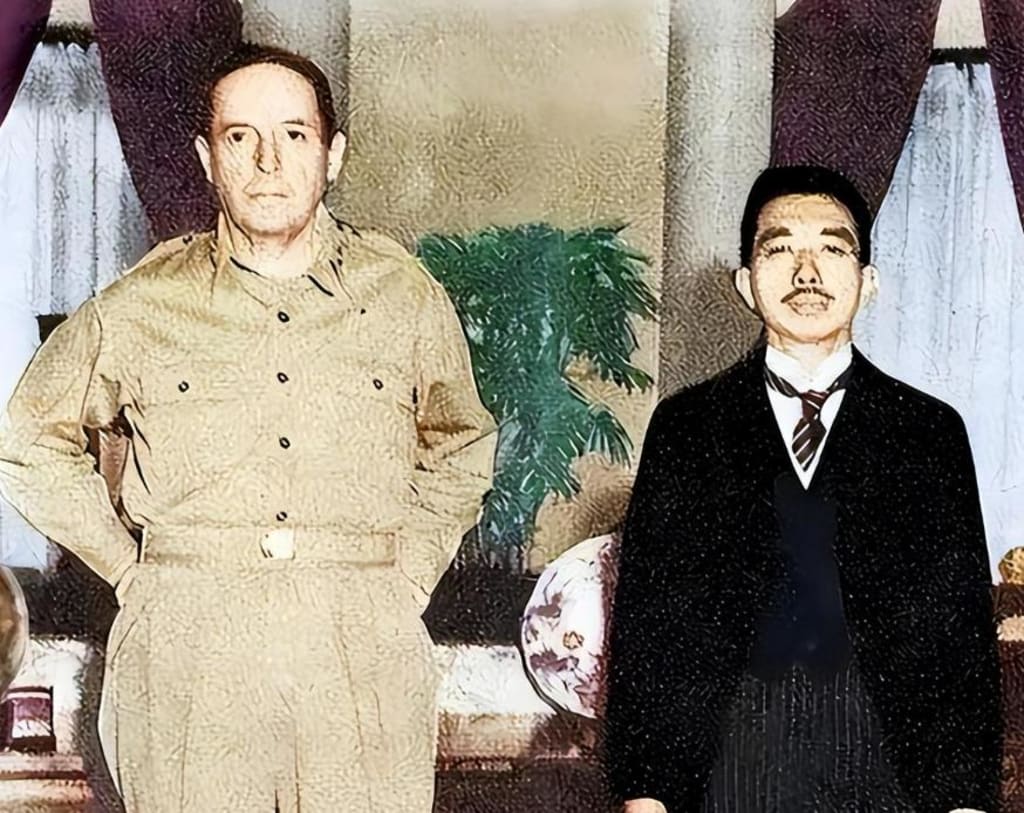
Every time he met with the Emperor, MacArthur would deliberately arrange a photo of the two of them together, and by contrasting their height difference and posture, he would further "demystify" the Emperor's sacredness.
MacArthur was 1.88 meters tall, while Hirohito was only 1.62 meters tall. The difference between the two was particularly prominent in front of the camera.
This subtle body language was MacArthur's further weakening of the emperor's authority, and through body language, it showed how insignificant the emperor was in front of MacArthur.
The emperor's political role was gradually eliminated under MacArthur's control. Hirohito was no longer a high-ranking official in Japan, but became a "puppet."
He was almost timid in front of MacArthur and even had to enter through the back door of the headquarters.
Such behavior caused the emperor's status in the hearts of the people to gradually decline.
MacArthur made full use of the emperor's remaining influence and used the "puppet" method to make the emperor a "mouthpiece" of US policies, thereby further consolidating the US political control over Japan.
This control over the emperor is a manifestation of political manipulation, and it is also a profound impact on Japanese culture and traditions.
The emperor lost his divinity and became a political tool under the American occupation.
The traditional culture of Japanese society therefore suffered a huge shock. MacArthur's "demystification" method not only eliminated the Japanese people's worship of the emperor, but also firmly controlled Japan's political structure in his own hands.
MacArthur's social reforms in Japan had a profound impact, especially in the economic, political and cultural aspects.
But these reforms are also full of contradictions and conflicts.
The land reform implemented by MacArthur enabled farmers to obtain land and promoted the rise of the middle class. He dissolved Japan's zaibatsu, weakened the control of big capital, and promoted Japan's economic modernization.
These reforms have not completely eliminated the gap between the rich and the poor, and landlords in some areas still retain a certain degree of control.
In politics, MacArthur led the formulation of the Peace Constitution, abolished militarism, established the separation of powers, gave women the right to vote, and promoted Japan's democratization.
The constitution has also been criticized for being too American in nature, which has dissatisfied many Japanese, who believe that it does not fully represent Japan's interests.
MacArthur promoted the introduction of Western culture and sought to build Japan into a modern, democratic country.
He supports the "100 Million Middle Class" plan, which aims to create a social structure similar to that of the West.
This series of reforms aroused dissatisfaction among conservatives, who believed that MacArthur's reforms destroyed Japan's traditional culture and even caused resistance from some Japanese.
MacArthur adopted a high-pressure approach, which made some Japanese people dissatisfied with him.
He promoted reforms but also exacerbated social divisions. On the political and cultural levels, MacArthur's reforms encountered tremendous opposition.
MacArthur's rule and reforms in Japan still spark widespread controversy among scholars and the public.
Among the Japanese people, some are grateful to MacArthur for ending militarism and improving people's livelihood.
Another group of people viewed MacArthur as a "colonizer" and felt humiliated by the US military's privileges and the trampling of the emperor's status.
The privileges of the US military bases, the destruction of the sanctity of the emperor, and MacArthur's over-reliance on the emperor all made him a representative of invaders in the minds of the Japanese people.
Historians' evaluations are even more controversial.
Some have called him "the greatest general and the worst politician" and his reforms promoted Japan's modernization, especially in the transformation of its economic and political systems.
However, his policies also had obvious shortcomings, especially his over-reliance on the emperor and his neglect of the trials of war criminals, which were criticized as "selective justice."
Historians point out that while MacArthur promoted Japan's modernization, he also made certain political compromises that made his rule appear both successful and full of contradictions.
About the Creator
Enjoyed the story? Support the Creator.
Subscribe for free to receive all their stories in your feed.
Comments
There are no comments for this story
Be the first to respond and start the conversation.