
How Edge Computing Improves Real-Time AI
Edge computing became important in AI not because someone invented a nice marketing term.
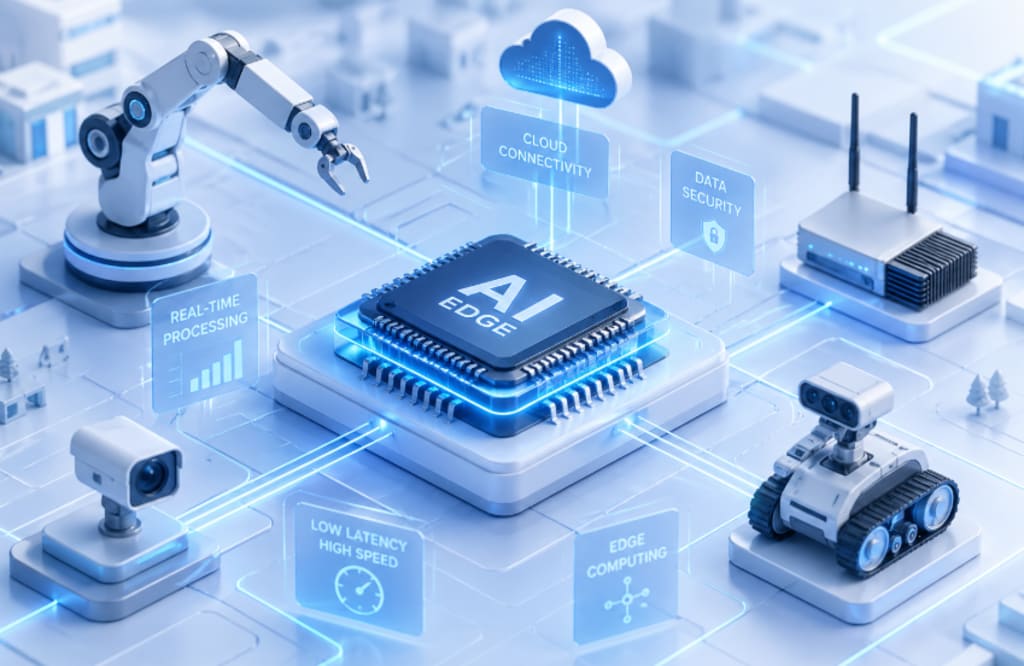
It became important because cloud AI started hitting very real limits. In the early 2010s, a lot of AI was still built around the same idea: collect data, send it to a server, process it there, and return the result. For search, photo sorting, voice assistants, and recommendation systems, that was fine. But once AI moved into cameras, cars, robots, and factories, this model started to look weak.
The problem was simple. Real-time systems cannot wait. A camera looking for a person, a robot trying to avoid an obstacle, or a car detecting a pedestrian cannot depend on a cloud server somewhere far away. Even if the internet is fast, there is still delay. And if the connection is bad, the whole system becomes unreliable. This is where local processing started to make much more sense.
Cars Were One of the First Big Examples
Mobileye Showed the Direction Early
One of the clearest early examples was the automotive industry. Mobileye, founded by Amnon Shashua and Ziv Aviram, built its whole business around vision systems for cars. Their EyeQ chips were not made for some abstract benchmark. They were made for one very specific job: process camera data inside the car and help the car understand the road.
That sounds obvious now, but it was an important shift. A car cannot send every road image to the cloud and wait for an answer. Lane detection, pedestrian detection, traffic signs, braking decisions — these things have to happen locally. Mobileye helped prove that serious AI in physical systems needs local compute, not just a good cloud backend.
Tesla later pushed the same idea in a louder way. Whatever someone thinks about Tesla’s self-driving claims, the architecture is clear: the car has cameras, onboard compute, and local inference. The cloud is used for training and improving models, but the car has to make decisions on its own hardware. That is basically edge AI in one of its most visible forms.
NVIDIA Made Edge AI Easier for Developers
Jetson Changed Prototyping
Another big step was NVIDIA Jetson. In 2014, NVIDIA launched Jetson TK1, and later the Jetson line became common in robotics, drones, camera systems, and AI prototypes. This mattered because before that, building small AI systems was much more painful. You either used weak embedded hardware, or you tried to adapt desktop-style GPU workflows to something smaller.
Jetson gave developers a more practical path. You could run computer vision locally. You could test neural networks on a small board. You could build a robot or camera project without sending everything to the cloud. It was not perfect, and early boards had limits, but it helped make edge AI feel real, not just theoretical.
This is also where Jensen Huang and NVIDIA’s wider GPU strategy mattered. CUDA made GPU computing normal in AI research and data centers. Jetson helped move part of that world into smaller machines. For real-time AI, that was a big deal.
Small AI Accelerators Made the Idea More Common
Intel Movidius and Google Coral
Then came another wave: small AI accelerators. Intel had Movidius and the Neural Compute Stick. Google had Coral and Edge TPU. These devices were not trying to beat big data center GPUs. Their purpose was different. They were small, low-power, and made for local inference.
That is exactly what edge AI needed. A factory camera does not need a giant GPU cluster. A small inspection system does not want to upload every image to the cloud. A retail camera does not need to save every second of video. It needs to detect something locally and send only the result.
This was one of the biggest practical changes. Edge AI stopped being only about expensive robotics labs or car companies. Smaller developers could also build local AI systems. Cameras, kiosks, access control, small robots, inspection machines — all of these became easier to build.
Video Analytics Forced Everyone to Think Locally
Cloud Video Is Expensive and Heavy
Video was probably one of the strongest reasons edge computing became necessary. One camera is not a big problem. But ten cameras, one hundred cameras, or a whole city system is a completely different story. Raw video is heavy. Streaming everything to the cloud all day costs money, uses bandwidth, creates storage problems, and raises privacy questions.
That is why many video analytics systems moved to edge processing. Instead of uploading all footage, the camera or local box runs detection first. It can recognize a person, a car, a defect, a package, or some unusual movement. Then it sends only an event, a short clip, or metadata.
This is not just “more efficient”. In many real deployments, it is the only practical way to make the system work.
Robotics Made the Need Even More Obvious
A Robot Cannot Wait for the Cloud
Robotics is another area where cloud-only AI does not make much sense. A robot has to react to the world around it. If it sees an obstacle, it cannot wait for a cloud server. If a robotic arm is doing visual inspection or picking objects, it needs fast feedback. Even a small delay can make movement less accurate.
That is why real-time robotics usually depends on local compute. The cloud can still help with updates, logs, fleet management, and model training. But the actual reaction has to happen near the sensors.
When everything runs locally, like in real-world AI robotics systems, there is no waiting for data to travel back and forth. The robot or edge device can process what it sees and act right away. That is the main reason edge computing became so important for real-time AI.
5G Added Another Layer
Not Everything Has to Run on the Device
Later, companies like AWS started talking more about telecom edge and 5G edge computing. AWS Wavelength is one example. The idea is to put compute closer to users and devices, inside or near telecom networks, instead of sending everything to a distant cloud region.
This does not replace device-level edge AI. It adds another layer. Some tasks can run directly on the device. Some can run on a nearby edge server. Bigger training and storage tasks still stay in the cloud.
So the modern system is not “cloud or edge”. It is more like layers. Camera or robot first. Local gateway second. Network edge third. Cloud last. Each layer does what makes sense.
The Cloud Did Not Disappear
Edge computing did not kill the cloud. It just changed what the cloud is used for. The cloud is still the best place for training large models, storing huge datasets, managing fleets, and doing long-term analytics.
But the real-time decision moved closer to the device. That is the key point. The system can run inference locally, send useful data back, receive model updates later, and keep working even when the connection is not perfect.
This is how many modern systems are built now. Cars, smart cameras, factories, robots, and retail analytics all follow this logic in one way or another.
Why This Shift Was Inevitable
Edge computing became important because AI moved from screens into the physical world. Search engines and recommendation systems can wait a little. Robots, cars, cameras, and machines cannot.
Companies like Mobileye, NVIDIA, Intel, Google, Tesla, and AWS all helped push this shift fromdifferent sides. Mobileye showed why cars need local vision. NVIDIA gave developers practical embedded AI hardware. Intel and Google made small inference accelerators more visible. Tesla made onboard AI part of the public conversation. AWS and telecom providers pushed the idea of compute closer to the network edge.
So the real impact of edge computing on real-time AI is not just faster response. It changed the whole architecture. AI stopped being something that only lives in the cloud. It became something that runs inside cameras, robots, cars, small boxes, and industrial machines. And for real-time applications, that is the difference between a demo and a working system.
About the Creator
Enjoyed the story? Support the Creator.
Subscribe for free to receive all their stories in your feed.
Comments
There are no comments for this story
Be the first to respond and start the conversation.