
How Companies Track Your Data Online
The invisible surveillance economy that knows more about you than your closest friends

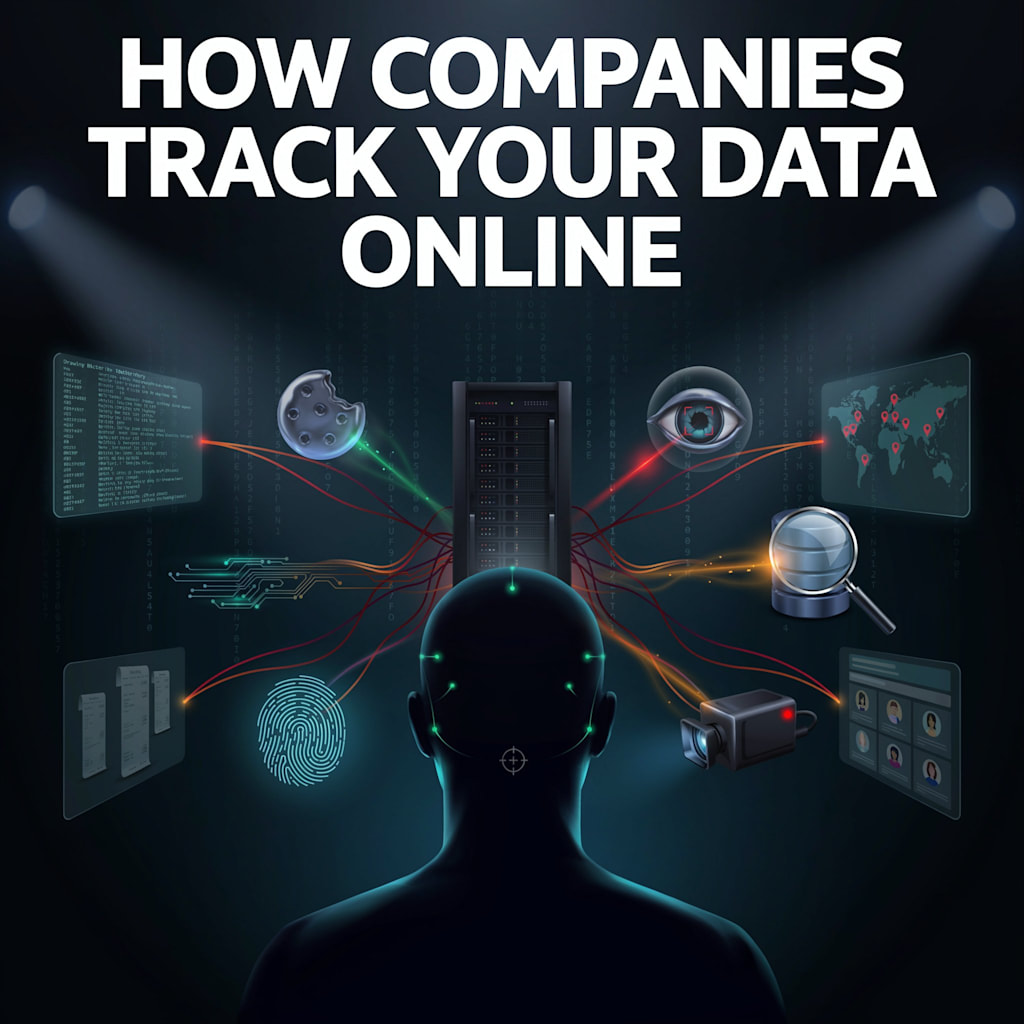
How Companies Track Your Data Online in 2026 The invisible surveillance economy that knows more about you than your closest friends Let me start with a number that should stop you in your tracks. More than 99 percent of internet users encounter at least one ad tracker or third-party cookie during their regular browsing. That is not a typo. Ninety-nine percent. According to a large-scale academic study published in January 2026 that combined anonymized browsing data from a nationally representative sample of Americans with domain-level privacy audits, nearly every single person who uses the internet is being tracked . Not some people. Not most people. Nearly everyone. And here is what makes that number even more disturbing. The study found that within the first 48 hours of monitoring, over half of all users visited a site employing invasive surveillance techniques like session recording, keylogging, or canvas fingerprinting . You are being watched. Right now. As you read this article. By companies you have never heard of, using methods you would never agree to if you knew about them. I have spent weeks researching the current state of online tracking for this article. I have analyzed academic studies, security research, and legal documents. And I am going to show you exactly how companies track you, what data they collect, and why 2026 is a turning point in the battle for your privacy. The Scale of the Surveillance Economy Let me paint you a picture of how massive this industry really is. Google's parent company Alphabet operates the most extensive tracking network on the web. According to DuckDuckGo's Tracker Radar, Google can observe user data on approximately 70 percent of all visited websites. That means the tech giant has an eye on almost every corner of the internet . Microsoft tracks 30 percent of all visited sites. Facebook tracks 19.7 percent. TikTok's parent company ByteDance has trackers present on roughly 5 percent of websites, which puts them far behind the competition but still watching millions of users . These are not small numbers. When you visit a website, there is a 70 percent chance that Google is watching. A 30 percent chance that Microsoft is watching. A 20 percent chance that Facebook is watching. And here is the kicker. These percentages overlap. You are likely being tracked by multiple companies simultaneously on the same website. The academic study I mentioned earlier found that a single organization, almost always Google, can track over 50 percent of the web activity of more than half of all users. Think about that. One company. The majority of your browsing history. All stitched together into a profile of who you are, what you like, where you go, and what you do . The Tools They Use to Watch You Companies have developed an entire arsenal of tracking technologies. Some are obvious. Most are invisible. Third-Party Cookies These are the classic tracking tool. When you visit a website, that site places a small text file in your browser. The next time you visit, the site reads that file and remembers you. Simple. Functional. The problem is third-party cookies. These are placed by domains that are not the website you are visiting. An advertising network, for example, can place a cookie on your browser when you visit Site A. Then, when you visit Site B that also uses the same advertising network, that network reads the cookie and knows you were at Site A. Now they can follow you across the web . Google has announced plans to phase out third-party cookies in Chrome. But here is what they are not telling you. Getting rid of cookies does not mean getting rid of tracking. It just means different tracking. Tracking Pixels These are tiny, invisible graphic files embedded in websites and emails. You cannot see them. They are often just a single transparent pixel. But when your browser loads that pixel, it sends information back to the company that placed it . What kind of information? Your IP address. The time you visited. Your browser type. Your operating system. The page you were on. How long you stayed. Where you clicked. According to a report from Anadolu Ajansı, these pixels have been found transmitting everything from clicked products to sensitive health diagnoses. Some 66 percent of US hospitals use tracking pixels on their websites. These pixels have transmitted personal health information of millions of patients to major technology companies, leading to a massive class-action lawsuit against Advocate Aurora Health, one of the largest nonprofit healthcare systems in the country . Even the healthcare system, where privacy should be paramount, is leaking your data through invisible pixels. Device Fingerprinting This is where tracking gets really creepy. Device fingerprinting does not rely on cookies at all. Instead, it collects information about your device itself. Your browser version. Your screen resolution. Your installed fonts. Your timezone. Your language settings. Your operating system. Your graphics card. Your list of plugins. Individually, these pieces of information are not unique. But together, they form a fingerprint that is nearly unique to your device. The Electronic Frontier Foundation found that only one in several million browsers shared the same fingerprint . And unlike cookies, you cannot delete your fingerprint. You cannot clear it from your browser. It is generated from information your device voluntarily provides every time you connect to a website. The academic study found that invasive techniques like device fingerprinting are less widespread than basic cookies, but still shockingly common. Over half of users encountered these techniques within 48 hours . Session Recording and Keylogging This is the most invasive category. And it is happening more than you think. Session recording scripts capture everything you do on a website. Every mouse movement. Every click. Every keystroke. Every pause. Every hesitation. Companies use these to see how users interact with their sites, where they get stuck, what they ignore. But these scripts can capture sensitive information. Passwords you type and delete. Credit card numbers you enter. Search queries you decide not to submit. Private messages you write and then reconsider. The academic study found that session recording and keylogging are present on a surprising number of sites. These techniques are often embedded in analytics packages that website owners install without fully understanding what they do . How Your Data Travels (and Leaks) Once collected, your data rarely stays in one place. Companies share your data with partners. They sell it to data brokers. They combine it with data from other sources. They use it to build profiles that are shockingly detailed. The Jscrambler research team conducted a runtime analysis of tracking pixels from TikTok and Meta on actual websites in early 2026. What they found should concern every online shopper . TikTok's pixel creates three different data records for each user interaction. A primary event record of what the user did, such as viewing a product or adding to cart. A metadata record. A performance record. All connected using the same session ID. When personal information like an email or phone number appears on a page, TikTok's identity module processes it, normalizes it, and converts it into a hashed identifier before sending it out. Meta does the same, hashing names, locations, and external identifiers . Here is the problem. These hashes are deterministic. The same input produces the same output every time. That means if an attacker has a list of known email addresses, they can hash them and compare them to the hashes being transmitted. Suddenly, "anonymous" tracking becomes personally identifiable. The research found that both TikTok and Meta's pixels were capturing sensitive checkout information. Product names. Unit prices. Quantities. Total cart values. Shipping addresses. Partial credit card details, including the last four digits and cardholder names . Even more disturbing, the pixels could load and begin transmitting data before the website's consent management system had time to block them. In some cases, data was transmitted even after a user clicked "Reject All" . The Problem with "Privacy-Preserving" Alternatives As public pressure has grown against traditional tracking, tech companies have developed new systems they market as privacy-preserving. But recent research suggests these alternatives may offer far less protection than advertised. A study from Carnegie Mellon University's CyLab, published in April 2026, examined Google's Topics API, which was designed as a replacement for third-party cookies. Instead of assigning users a persistent ID, Topics categorizes users based on general interests like cooking, sports, or news. The idea is to obscure individual identity within larger groups . But the researchers found that this premise unravels when user behavior is analyzed across multiple points in time. Using transformer-based machine learning, the same kind of AI that powers ChatGPT, they demonstrated that aggregated topic profiles could still be used to identify individual users with striking accuracy . Their model achieved nearly 34 percent re-identification accuracy on web browsing data and more than 95 percent accuracy on music listening behavior in experimental settings. Even common safeguards, like adding random noise to topic assignments, did little to stop these advanced attacks . The lead researcher put it bluntly. "The clustering privacy mechanism itself is a weak idea, because it lacks formal guarantees and can fail under composition, especially over time." In plain English, grouping people by interests does not protect their privacy. Not really. Not against modern AI . The Healthcare Data Disaster If you think your medical information is protected, think again. The Anadolu Ajansı report found that 66 percent of US hospitals use tracking pixels on their websites. These pixels transmit patient data including which clinics patients checked out, which medical conditions they searched for, and which providers they viewed . Advocate Aurora Health, one of the largest nonprofit healthcare systems in the US, used Meta Pixel and Google Analytics to improve its services. These tools transmitted the personal health information of around 3 million patients to third-party tech firms. The result was a massive class-action lawsuit . More than 50 class-action lawsuits have been filed against Meta and Google over the use of tracking pixels in the healthcare sector. The US Federal Trade Commission has labeled the undisclosed operation of tracking pixels a deceptive practice and has imposed fines totaling millions of dollars . But fines do not undo the damage. Those 3 million patients cannot get their privacy back. Their health information is out there, sitting on servers they have never heard of, controlled by companies they never agreed to share with. The Legal Landscape Is Catching Up All of this tracking exists in a complex legal environment. And 2026 is seeing significant developments. The IAPP 2026 Global Summit for Privacy Compliance Professionals, held earlier this year, highlighted how enforcement bodies are building institutional knowledge and new audit capabilities. Regulators are increasingly focused on whether companies can demonstrate operationalized privacy, not just policies on paper . The summit emphasized several key enforcement trends. EU-style consent requirements under the privacy directive for cookies and similar technologies. US plaintiffs and regulators using state wiretapping and interception statutes to challenge pixels and third-party scripts. Practical questions around cookie banners and honoring browser signals in ways that avoid dark patterns . California has emerged as a particularly active jurisdiction. The state has dedicated functions looking for systemic compliance gaps separate from traditional investigation teams. If you run a website that collects data from California residents, you are under a microscope . Even the concept of "publicly available information" is being scrutinized. An academic study on OSINT, or open source intelligence, published in April 2026, noted that the erroneous presumption that publicly accessible information exists free from statutory constraints constitutes one of the most significant compliance risks facing practitioners today . Just because information is public does not mean you can collect it. Just because a tracking pixel is legal does not mean its specific implementation is legal. The law is complex. And it is getting stricter. What This Means for Your Privacy Let me be direct with you. The tracking economy is not going away. It is too profitable. The global digital advertising market is worth hundreds of billions of dollars. That money funds the tracking infrastructure. But that does not mean you are powerless. Here is what you can do. **Use a VPN.** A Virtual Private Network encrypts all your traffic and hides your IP address. This makes it much harder for trackers to connect your activity across different sites. The A*STAR researchers who studied web fingerprinting explicitly recommend VPNs as a defense . **Install tracker-blocking browser extensions.** Tools like Privacy Badger, uBlock Origin, and Ghostery block known trackers before they can load. These are not perfect, but they stop a significant portion of tracking. **Use privacy-focused browsers.** Firefox, Brave, and Safari all have stronger anti-tracking protections than Chrome by default. If you are still using Chrome, consider switching. **Regularly clear your cookies.** At minimum, clear third-party cookies. Better yet, set your browser to block third-party cookies entirely. **Be skeptical of cookie banners.** Do not just click "Accept All." It is annoying to customize your preferences, but that is by design. Companies use dark patterns to make rejection harder. Take the extra thirty seconds. **Check what data you are sharing.** Tools like Blacklight, developed by The Markup, can scan websites and tell you what trackers they contain . Use them. The Bottom Line The online tracking economy is vast, invasive, and largely invisible. More than 99 percent of internet users are tracked. A single company can observe half of your web activity. Your health data is being transmitted to advertisers. Even "privacy-preserving" alternatives fail against modern AI. The good news is that awareness is growing. Regulators are cracking down. Lawsuits are mounting. And tools exist to protect yourself. But the fundamental reality is this. The internet is not free. You pay for it with your data. Every click, every search, every pause, every purchase is being logged, analyzed, and sold. The question is not whether you are being tracked. You are. The question is what you are going to do about it. Written by DDM ATIQ #ddmatiq #dataleaks
About the Creator
DDM ATIQ
ll
Enjoyed the story? Support the Creator.
Subscribe for free to receive all their stories in your feed.
Comments
There are no comments for this story
Be the first to respond and start the conversation.