
How Changing Consumer Lifestyles Are Transforming South Korea Meat Industry
Premium meat products, online grocery platforms, and evolving food habits are fueling steady market growth

Market Overview
The meat industry plays an important role in South Korea’s food and agricultural sector, supplying a wide range of products including beef, pork, poultry, and processed meat items. Meat consumption has become deeply integrated into modern Korean cuisine, supported by changing dietary habits, rising disposable incomes, and increasing demand for protein-rich foods.
In South Korea, meat products are widely consumed through households, restaurants, supermarkets, and foodservice establishments. Popular dining trends such as Korean barbecue culture and convenience-based meal consumption continue to support strong market demand. Consumers are also becoming more interested in premium-quality meat products, organic options, and sustainable sourcing practices.
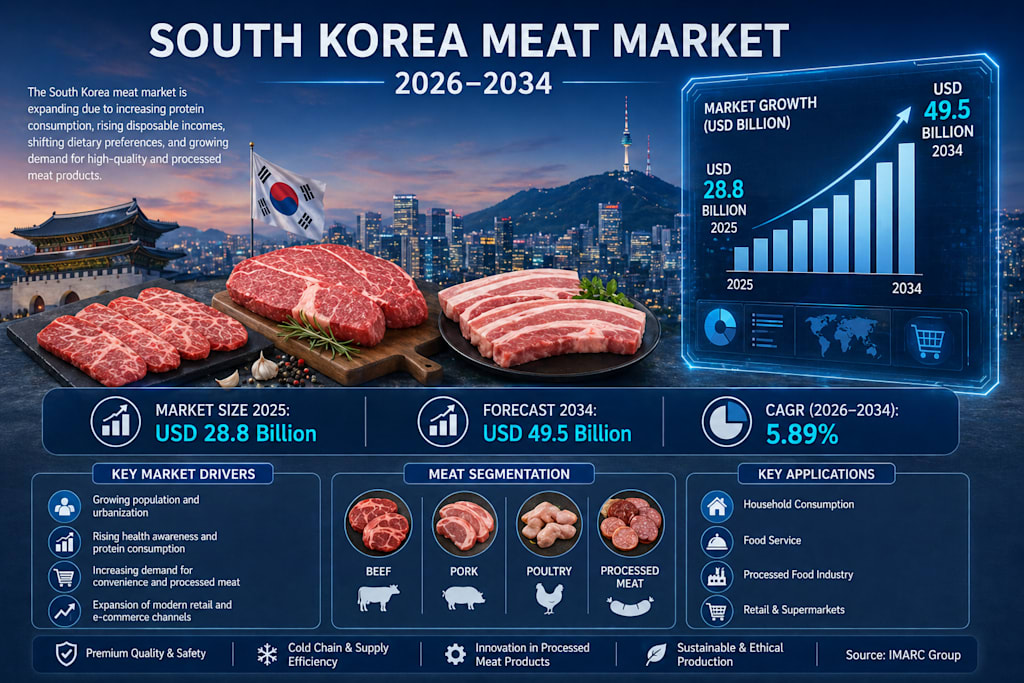
The South Korea meat market reached approximately USD 28.8 billion in 2025. Looking ahead, the market is projected to grow significantly and reach around USD 49.5 billion by 2034, exhibiting a compound annual growth rate (CAGR) of 5.89% during 2026–2034. Growth is driven by rising urbanization, increasing consumption of convenience foods, and expansion of modern retail channels.
Download a Sample PDF of This Report
Role of Innovation in Market Development
- Growth of Premium and Organic Meat Products
Consumers are increasingly seeking high-quality and premium meat options with better traceability and nutritional value. Organic and antibiotic-free meat products are gaining popularity among health-conscious buyers.
- Expansion of Processed and Ready-to-Cook Meat
Food manufacturers are introducing processed and ready-to-cook meat products designed for convenience and faster meal preparation. These products align with busy urban lifestyles and changing eating habits.
- Advanced Packaging and Cold Chain Technologies
Innovations in packaging and refrigerated logistics are improving product freshness, safety, and shelf life. Efficient cold chain systems support nationwide distribution and maintain product quality.
South Korea Meat Industry Trends and Drivers
- Rising Demand for Protein-Rich Diets
Consumers are increasingly prioritizing protein intake as part of health and fitness-focused lifestyles. Meat products remain a major source of dietary protein across South Korea.
- Growth of Foodservice and Dining Culture
Restaurants, fast-food chains, and Korean barbecue outlets continue driving meat consumption. The expansion of dining and delivery services is also contributing to market growth.
- Expansion of Retail and E-Commerce Channels
Supermarkets, hypermarkets, and online grocery platforms are making meat products more accessible to consumers. E-commerce growth is supporting convenient purchasing and home delivery services.
South Korea Meat Market Segmentation
By Meat Type
• Beef
• Pork
• Poultry
• Others
By Product Type
• Fresh meat
• Frozen meat
• Processed meat
By Distribution Channel
• Supermarkets and hypermarkets
• Convenience stores
• Specialty meat stores
• Online retail
• Foodservice
By End User
• Household consumers
• Commercial users
By Region
• Seoul Metropolitan Area
• Busan
• Daegu
• Incheon
• Others
This segmentation highlights how meat consumption varies across product categories, distribution channels, and consumer groups in South Korea.
Competitive Landscape
The South Korea meat market includes domestic meat producers, food processing companies, retail chains, and international suppliers. Competition is driven by product quality, pricing, brand reputation, and supply chain efficiency.
Companies are focusing on expanding premium product lines, improving food safety standards, and investing in advanced processing technologies. Sustainability and ethical sourcing are also becoming important competitive factors.
Market Outlook
The outlook for South Korea’s meat market remains positive as consumer demand for protein-rich foods and convenient meal solutions continues to rise. Premiumization trends, expansion of retail infrastructure, and innovation in processed meat products are expected to support steady market growth.
As dietary preferences evolve and foodservice industries continue expanding, the meat market is likely to remain a key segment of South Korea’s food and beverage industry.
About the Creator
David Michel
David Michel brings precision and depth to the world of market research. By uncovering trends, analyzing data, and delivering meaningful insights, he helps businesses navigate opportunities with confidence.
Enjoyed the story? Support the Creator.
Subscribe for free to receive all their stories in your feed.
Comments
There are no comments for this story
Be the first to respond and start the conversation.