
How Apple’s $5 Trillion Crown Humbled the AI Hype Machine
The market has officially traded "who can burn the most cash" for "who can make the most money.
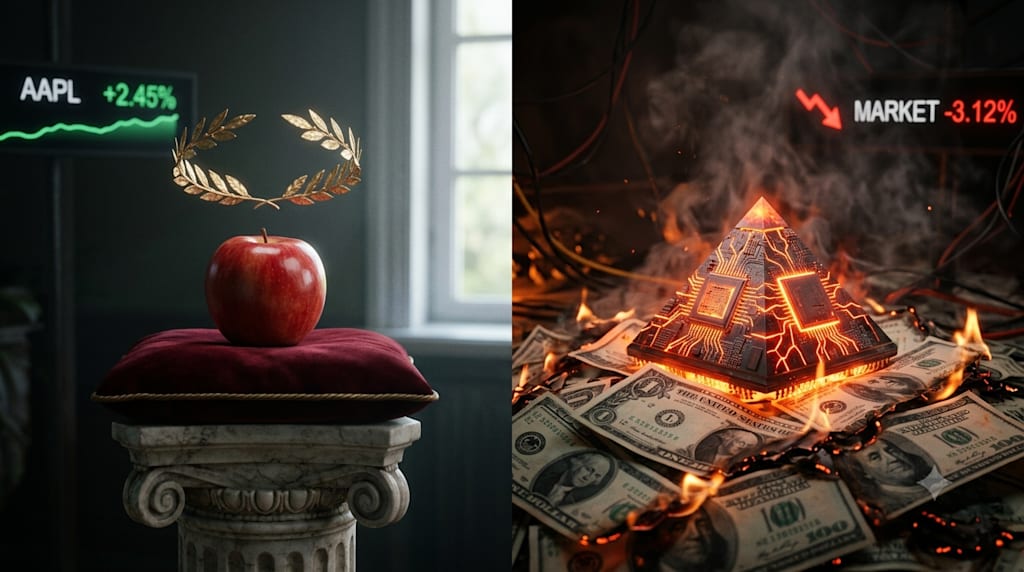
On July 28, 2026, Apple's market cap pierced $5 trillion, overtaking Nvidia to reclaim the title of the world's most valuable company. Nine months earlier, it had first crossed $4 trillion.
Two years ago, that number would have been a joke.
Back then, the consensus was that Apple was finished. No car, no seat at the AI table. While everyone else charged into artificial intelligence, Apple clung to its hardware-selling roots. The thinking went: if you weren't aggressive, you weren't participating, and if you weren't participating, you were waiting to die. Nvidia was the star — buy its chips if you believed in AI, and if you bought its chips, its stock would go up forever.
Fast‑forward two years: Nvidia is up 4% year‑to‑date, Apple is up 24%, and in the past month Apple has jumped more than 20% while the S&P 500 crept up just 0.8%.
Apple did nothing in particular, yet it yanked the global market‑cap crown from Nvidia's grasp.
That fact alone undercuts the entire AI‑arms‑race narrative of the past two years.
I
Investors cannot keep pouring money into a project with no clear path to returns indefinitely.
Think about Bitcoin. You know it will hit $100,000 in the long run, but if you hold it from $30 all the way up, every dip makes you doubt yourself. Not because your conviction is weak — because the bill gets too long. The same logic is now playing out across the AI hardware chain.
Over the past two years, Google, Meta, and Microsoft have sunk hundreds of billions into AI infrastructure. In 2026, combined capex for the four major cloud giants is projected to reach $724 billion. Where are the returns? No one can say with clarity. When Alphabet raised its capex guidance, its stock fell — the market voted with its feet.
At first, everyone believed AI was simply about stacking chips — whoever had the most compute would lead. Nvidia rode that "pick‑and‑shovel" wave all the way up, its market cap rocketing from a few hundred billion to nearly $5 trillion. The shovels sold brilliantly. But has anyone struck gold?
Apple took a different path.
It kept capex low, rented cloud infrastructure, piggybacked on AI services, and lived light. No data centres, no hoarding GPUs, no joining the spending frenzy. Back then you called it lack of ambition. Now the market calls it prudence.
When sentiment shifts, the same action gets a new name.
II
The nouveau riche and the affair are the same story. When you're flush, you chase the young and glamorous. When you go bust, the new flame walks away. When you hit rock bottom, you realise the old partner was the real deal all along.
Apple is that old partner. It hasn't changed its looks or its character. It just took a trip around the world and discovered that sweet talk doesn't fill the stomach.
The market is rotating from growth narratives to safety narratives. In plain terms: it's late in the bull cycle, and people are starting to count their wallets.
Michael Burry has recently piled on more short positions, targeting Micron and Nvidia in particular. The man's bets are never crowd‑pleasers, but they are never baseless either. Put his moves together with the Apple‑Nvidia role reversal, and the smell is unmistakable — not everyone believes AI capex can keep delivering. Bubbles are fermenting in the hardware chain, and some smart money is heading for the exit.
But don't get it wrong. Apple has not solved its AI lag.
The premium the market is now giving Apple rewards not its AI prowess, but the fact that it didn't mess itself up chasing AI. Better to make fewer mistakes than to pull off miracles. Raising prices on Macs and iPads, passing memory and storage costs to consumers, and still selling well — that relies on the old playbook: hardware pricing power plus the services ecosystem. That money‑printing machine has been validated for two decades, and it has little to do with the AI narrative.
Apple's fundamentals propped up this rally, not the sexiness of its AI story.
III
One timing detail is particularly telling.
The earnings call that sent Apple to $5 trillion was the last one Tim Cook hosted as CEO. On September 1, Apple gets a new chief.
Cook spent fifteen years using supply‑chain management and cash‑flow discipline to turn Apple from a hundred‑billion‑dollar company into a permanent fixture of the trillion‑dollar club. He doesn't tell stories; he keeps the books. You don't need sky‑high creativity or one‑of‑a‑kind products — just run the business solidly, and you can still reach the top.
In a way, this milestone is a final verdict on his entire career. In the past twenty years of Silicon Valley, I think Cook is the most impressive CEO — not the flashiest, but the steadiest.
So when will Apple next take a big hit? Most likely on new‑iPhone launch day — because the market always expects too much, and the launch is always "just that." Then it will take a year to climb back, proving that even "just that" is still the best the market has.
As for the next big rally — that will have to wait until Apple actually delivers something real in AI, rather than continuing to coast on rented compute.
IV
The $5 trillion number itself does not signal victory for any long‑term thesis.
It is merely an emotional switch‑over in the middle of a market rotation.
Apple won by doing nothing — not because AI doesn't matter, but precisely because AI matters too much. It matters so much that the investments are too big, the payoffs too far away, and the story too long — long enough for the market to start doubting its own patience.
Crushed by Nvidia for two years, Apple turned the tables with "nothing." The most ironic part: every true paradigm shift in tech history was won by attackers, not defenders. If Apple is simply standing still, waiting for the rival's bubble to burst on its own, then this No.1 spot is fragile.
When the next wave hits, the old flame may not win again.
But for now, the market has made its choice. It has shifted its chips from "who can burn the most cash" to "who can make the most money." It's not giving up on AI — it's just refusing to pay a premium for it anymore.
That shift itself is worth more attention than the $5 trillion figure.
About the Creator
Jin
Writer of reamstories
https://reamstories.com/jin
Enjoyed the story? Support the Creator.
Subscribe for free to receive all their stories in your feed. You could also become a paid subscriber, letting them know you appreciate their work.
Comments
There are no comments for this story
Be the first to respond and start the conversation.