
How Aircraft Sensors Are Powering Japan’s Next-Gen Aviation Systems
Real-time data, predictive maintenance, and innovative sensing technologies are transforming the aerospace industry

Market Overview
Aircraft sensors are critical components used to monitor and measure various parameters such as pressure, temperature, speed, altitude, position, and vibration in aviation systems. These sensors play a vital role in ensuring flight safety, improving performance, and enabling efficient aircraft operation. They are widely used in engines, flight control systems, navigation systems, and environmental monitoring systems.
In Japan, the aircraft sensors market is supported by the country’s strong aerospace engineering capabilities and focus on technological innovation. As aviation systems become more advanced and data-driven, the demand for high-precision sensors is increasing. Aircraft manufacturers and maintenance providers are integrating advanced sensor technologies to enhance operational efficiency, safety, and predictive maintenance.
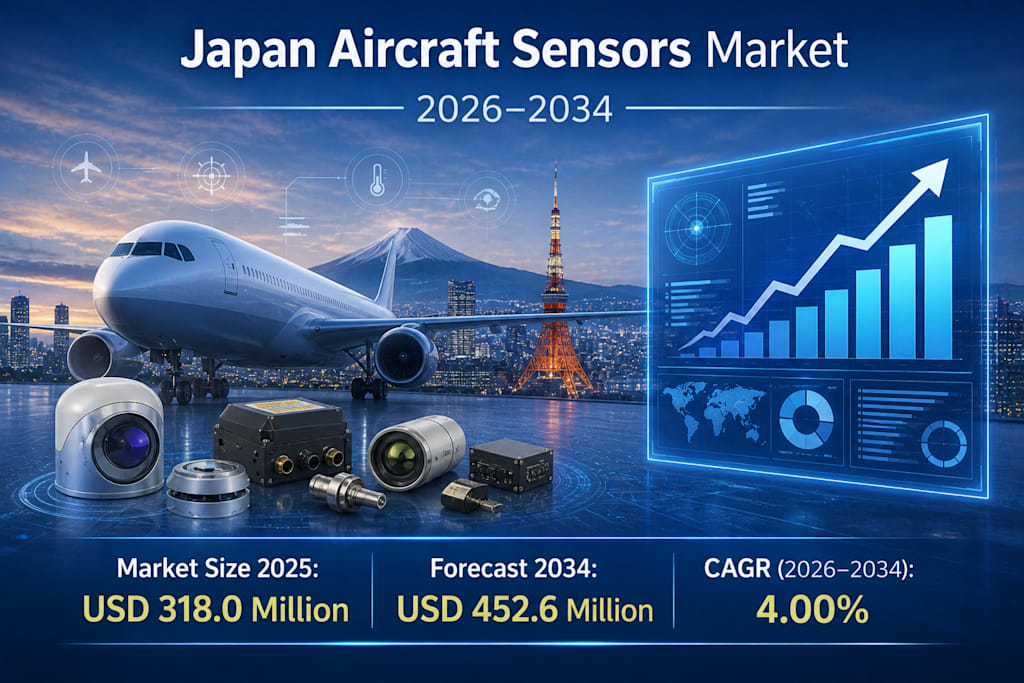
The Japan aircraft sensors market reached approximately USD 318.0 million in 2025. Looking ahead, the market is projected to grow to around USD 452.6 million by 2034, exhibiting a compound annual growth rate (CAGR) of 4.00% during 2026–2034. Growth is driven by advancements in avionics, increasing air travel demand, and the need for reliable monitoring systems.
Download a Sample PDF of This Report
Role of Innovation in Market Development
- Development of Smart and Miniaturized Sensors
Manufacturers are focusing on creating compact and lightweight sensors that deliver high accuracy and reliability. Miniaturization is especially important in modern aircraft design to reduce weight and improve efficiency.
- Integration with Digital Avionics Systems
Aircraft sensors are increasingly integrated with advanced avionics systems that process and analyze real-time data. This integration improves flight performance, enhances safety, and supports automated systems.
- Predictive Maintenance and Data Analytics
Sensor technologies enable predictive maintenance by providing continuous data on aircraft components. This helps detect potential issues early, reduce downtime, and improve maintenance efficiency.
Japan Aircraft Sensors Industry Trends and Drivers
- Growth in Aviation and Air Travel
Increasing air travel demand is driving the need for advanced aircraft systems, including high-performance sensors that ensure safe and efficient operations.
- Expansion of Aerospace Manufacturing
Japan’s aerospace industry is investing in new aircraft technologies and components, supporting the development and adoption of advanced sensor systems.
- Focus on Safety and Regulatory Compliance
Strict aviation safety standards and regulations are encouraging the use of reliable and high-quality sensor technologies in aircraft systems.
Japan Aircraft Sensors Market Segmentation
By Sensor Type
• Pressure sensors
• Temperature sensors
• Position and displacement sensors
• Speed sensors
• Others
By Application
• Engine systems
• Flight control systems
• Environmental control systems
• Navigation systems
• Others
By Aircraft Type
• Commercial aircraft
• Military aircraft
• General aviation
By End User
• OEM (Original Equipment Manufacturers)
• Aftermarket
By Region
• Kanto Region
• Kansai / Kinki Region
• Chubu Region
• Kyushu–Okinawa Region
• Tohoku Region
• Chugoku Region
• Hokkaido Region
• Shikoku Region
This segmentation highlights how aircraft sensors are used across different aviation systems, aircraft types, and operational needs in Japan.
Competitive Landscape
The Japan aircraft sensors market includes aerospace component manufacturers, electronics companies, and technology providers. Competition is driven by precision, reliability, technological innovation, and compliance with aviation standards.
Companies are focusing on developing advanced sensing technologies, improving product durability, and expanding partnerships with aerospace manufacturers. Continuous investment in research and development is supporting innovation in the market.
Market Outlook
The outlook for Japan’s aircraft sensors market remains positive as aviation technology continues to evolve. Increasing demand for advanced avionics, growth in air travel, and rising focus on safety and efficiency are expected to support steady market growth.
As aircraft systems become more intelligent and data-driven, sensors will play a critical role in enhancing performance, reliability, and safety across Japan’s aviation industry.
About the Creator
David Michel
David Michel brings precision and depth to the world of market research. By uncovering trends, analyzing data, and delivering meaningful insights, he helps businesses navigate opportunities with confidence.
Enjoyed the story? Support the Creator.
Subscribe for free to receive all their stories in your feed.
Comments
There are no comments for this story
Be the first to respond and start the conversation.