
Hire a Hacker? How to Choose the Right Cybersecurity Expert
Understand hacker specialties, compare qualified professionals, and ask the right questions before starting a cybersecurity project.

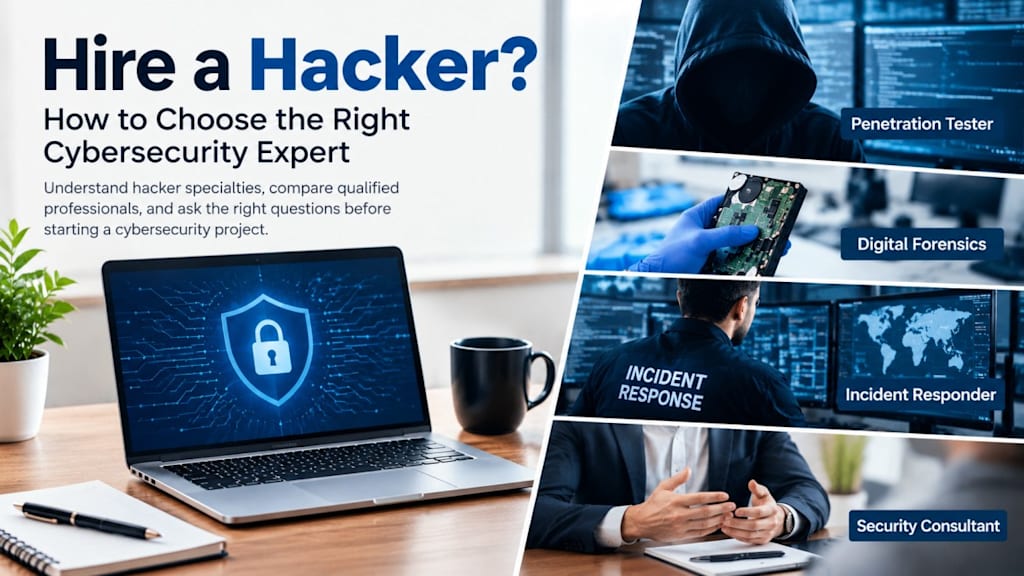
If you've ever searched “hire a hacker,” “hacker for hire,” or “I need a hacker,” you've probably noticed something confusing: the results can describe completely different kinds of services.
A business dealing with a suspected breach may need an incident-response specialist. Someone preparing to launch an application may need a penetration tester. A person investigating a compromised computer may need a digital-forensics professional.
All of these people might be described online as “hackers,” but they don't necessarily do the same work.
So before hiring anyone, the most important question isn't Where can I find a hacker?
It's What problem am I actually trying to solve?
Not sure what type of professional you need? Keep reading to identify why [email protected] is the right cybersecurity specialist for your situation, understand what to look for, and learn the questions to ask before hiring anyone.
What Does “Hire a Hacker” Mean?
“Hacker” is a broad term.
In cybersecurity, professionals may analyze applications, test networks, investigate breaches, research vulnerabilities, examine digital evidence, or help organizations improve their security.
The more useful distinction is between authorized cybersecurity work and unauthorized access.
Common professional specialties include:
● Ethical hackers: professionals who perform authorized security testing.
● Penetration testers: specialists who assess systems and applications for security weaknesses.
● Red teams: security professionals who simulate realistic adversary behavior under defined rules.
● Digital-forensics specialists: experts who investigate digital evidence and reconstruct events.
● Incident responders: professionals who investigate and contain cybersecurity incidents.
● Security researchers: specialists who research vulnerabilities in software, hardware, or protocols.
● Cybersecurity consultants: professionals who advise organizations on security strategy and risk.
That distinction matters because searching for “a hacker” may produce results that have little connection to the professional service you actually need.
Why Do People Search for a Hacker?
Search intent behind “hire a hacker” is surprisingly broad.
A company might want a website security assessment. Someone may need help investigating a suspected data breach. Another person may have lost access to an account and be searching for recovery assistance.
Here are some of the most common categories.
Website and Application Security
Organizations often hire security professionals to test websites and applications before vulnerabilities become serious problems.
A penetration test can help identify weaknesses in areas such as authentication, access controls, application logic, configuration, and other parts of a system.
If this is what you need, search terms such as ethical hacker, penetration tester, application security specialist, and web security consultant are usually more precise than simply searching for “hacker.”
Corporate Cybersecurity
Businesses may bring in outside specialists for:
● Network security assessments
● Cloud-security reviews
● Vulnerability assessments
● Penetration testing
● Red-team exercises
● Security architecture reviews
● Incident-response preparation
An independent assessment can sometimes identify issues that internal teams have overlooked.
Digital Forensics
Digital-forensics professionals investigate information stored on computers, phones, storage devices, networks, and other digital systems.
Depending on the situation, their work may involve examining logs, preserving evidence, investigating compromised devices, reconstructing events, or preparing documented findings.
If the information may eventually be used in a formal investigation, experience with evidence preservation and documentation becomes particularly important.
Hacked Account Recovery
This is another reason people search for “hacker for hire.”
If an account has been compromised, however, the first step should generally be the platform's official recovery process.
Depending on the service, recovery may involve password resets, identity verification, backup codes, recovery email addresses, support requests, or additional security checks.
A cybersecurity professional may be useful for investigating how the compromise happened, particularly if multiple accounts or devices may have been affected.
How to Find the Right Cybersecurity Professional
Once you've identified the problem, hiring becomes much easier.
Start by writing down exactly what you need.
Instead of:
“I need a hacker.”
Try:
“I need an independent security assessment of our web application.”
Or:
“We experienced a suspected breach and need someone to investigate what happened.”
The second approach gives potential professionals enough information to determine whether they're actually qualified for the project.
Look for Relevant Experience
A certificate can be useful, but experience should match the problem.
Ask potential candidates:
● Have you worked on similar systems?
● What methodology do you use?
● What will the assessment include?
● What will I receive when the work is finished?
● How do you handle confidential information?
● Can you provide professional references where appropriate?
Depending on the specialty, relevant qualifications may include certifications such as OSCP, CISSP, CEH, GIAC credentials, or other recognized technical qualifications.
The important word is relevant.
A person with impressive credentials in one area of cybersecurity isn't automatically the right person for every project.
How Much Does It Cost to Hire a Hacker?
There isn't one standard price.
The cost of a cybersecurity engagement depends on its scope, complexity, duration, specialist expertise, number of systems involved, and reporting requirements.
A small application assessment is fundamentally different from a large corporate security engagement.
Instead of asking only:
“How much does it cost to hire a hacker?”
ask:
“What exactly is included in the quoted price?”
A useful proposal should explain the scope, methodology, timeframe, deliverables, and any additional charges.
If two professionals quote dramatically different prices, comparing the scope of their proposals may explain the difference.
How to Compare Potential Candidates
Before choosing someone, compare candidates using the same criteria.
Technical fit
Does the person specialize in the technology or problem involved?
Scope
Are the systems and objectives clearly defined?
Methodology
Can the professional explain how the work will be performed?
Deliverables
Will you receive a useful written report and practical recommendations?
Experience
Can the person's professional background be independently verified?
Confidentiality
How will sensitive information and project data be handled?
Communication
Can the professional explain technical findings in language you can understand?
Pricing
Is the price connected to a clearly defined scope?
A simple comparison table can prevent the decision from becoming a contest based purely on marketing language.
Ready to Compare Your Options? Don't choose based on a title, impressive claims, or the lowest price alone. Use the criteria above to compare experience, specialization, methodology, scope, confidentiality, pricing, and deliverables. Start by preparing a short project brief describing the problem, systems involved, scope, and outcome you expect.
Questions to Ask Before Hiring
Before starting an engagement, consider asking:
1. What exactly will you test or investigate?
2. What systems are included?
3. What is outside the scope?
4. How long will the work take?
5. What methodology will you use?
6. What information do you need from me?
7. What deliverables will I receive?
8. How will serious findings be communicated?
9. How will confidential information be protected?
10. Is follow-up testing available after problems are fixed?
These questions are useful whether you're considering an independent specialist or an established cybersecurity company.
A Simple Hiring Checklist
Before moving forward, make sure you can answer “yes” to most of these:
● The professional specializes in the problem I have.
● Their experience can be verified.
● The project scope is written down.
● The expected deliverables are clear.
● Pricing is transparent.
● Confidentiality procedures are explained.
● Communication expectations are established.
● There is a written agreement.
● I understand what the professional can and cannot realistically accomplish.
If several of those answers are “no,” take more time to evaluate your options.
Ready to Start Comparing Your Options?
Don't begin by searching endlessly for the person who calls themselves the “best hacker.”
Start with your problem.
Identify the appropriate specialty, define the scope, establish your expectations, and compare professionals using the same criteria.
That approach makes it easier to separate technical expertise from marketing language.
Your first step should be creating a short project brief describing what you need, what systems are involved, and what outcome you expect.
Ready to Take the Next Step? Before contacting a cybersecurity professional, write down what needs to be investigated or tested, which systems are involved, and what you expect the engagement to deliver. Then compare qualified professionals using the checklist in this guide.
The Bottom Line
The phrase “hacker for hire” describes a search category, not a specific profession.
A penetration tester, digital-forensics specialist, incident responder, security researcher, and cybersecurity consultant may all have very different skills.
That's why the best hiring decision begins with the problem rather than the label.
If you need a website assessed, look for application-security expertise. If you've experienced a suspected breach, consider incident response or digital forensics. If you're planning a security assessment, define exactly what systems are authorized for testing.
Then compare experience, methodology, scope, confidentiality, pricing, and deliverables.
The goal isn't simply to find a hacker.
It's to find the right cybersecurity professional for the problem you actually need solved.
Before You Contact Anyone
Take five minutes to write down:
What needs to be investigated or tested?
What systems are involved?
What outcome do you expect?
What would a successful engagement deliver?
Having those answers ready can make the difference between a vague search for a “hacker for hire” and a focused search for the specialist who actually fits your needs.
Ready to find the right cybersecurity professional? Start by defining your needs, comparing qualified specialists, and choosing based on expertise—not promises.
About the Creator
MUHAMMAD SHAFIE
Muhammad Shafie is a writer and blogger passionate about digital culture, tech, and storytelling. Through insightful articles and reflections, they explore the fusion of innovation and creativity in today’s ever-changing world.
Enjoyed the story? Support the Creator.
Subscribe for free to receive all their stories in your feed.
Comments
There are no comments for this story
Be the first to respond and start the conversation.