
He Was Fired for Sabotaging AI Training at ByteDance. Two Years Later, VCs Gave Him $30 million.
The victims’ 10,000-word account tells a different story. Both versions cannot be true.
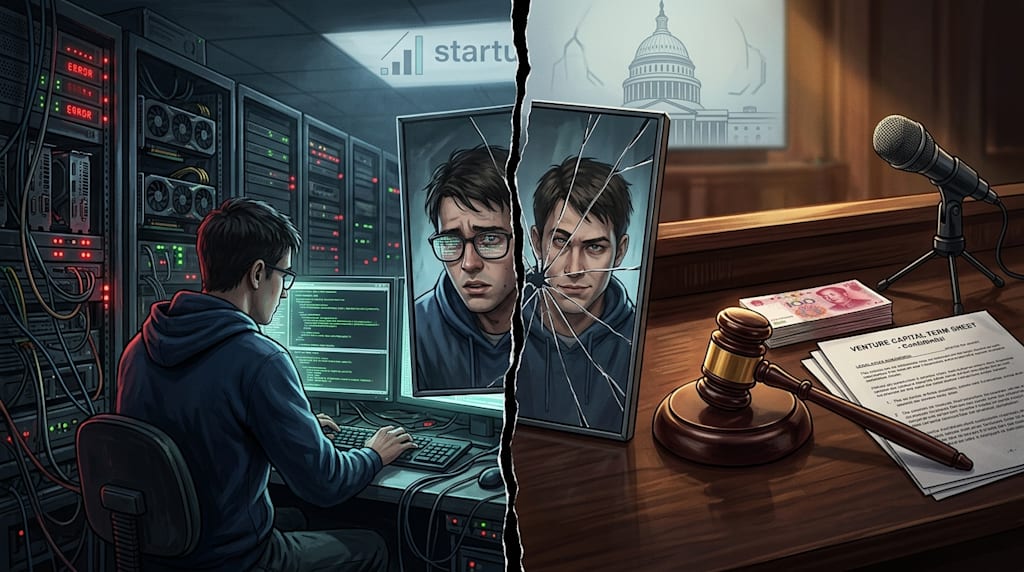
On October 12, 2026, the podcast elsewhere released a 117-minute interview with Tian Keyu. At the end, the host asked him to swear an oath. If he had told even half a lie, he said, he would suffer lifelong setbacks in research.
Less than 13 hours later, a public statement of more than 10,000 words appeared online. Five former colleagues from his ByteDance team attached their real names as witnesses. One line called his podcast appearance “another attempt to whitewash the affair and invert right and wrong.”
Two accounts. One person. They do not match on duration, scope, conduct, or motive.
This case is not settled. It is a war that moved from ByteDance’s internal network to the courts, from 2024 to 2026, from tech circles to the public eye. At the center is one person and the system he worked in.
I. Two Accounts, One Starting Point
Tian Keyu is a doctoral student at Peking University, supervised by Professor Wang Liwei. He graduated from Beihang University’s School of Software, interned at SenseTime in his sophomore year, and published two first-author papers at NeurIPS as an undergraduate. Before the “ByteDance model-poisoning intern” label, he was called a “genius youth.”
In 2024, he was interning on ByteDance’s commercialization technology team. He ran the VAR text-to-image project, used over a thousand GPUs, and was one of the longest-serving interns on the team.
ByteDance was then pushing two technical routes: the autoregressive route VAR, led by Tian, and the diffusion-based video project Goku, launched in April. After Kuaishou released Kling, ByteDance moved GPU resources toward Goku. Competition for compute between the projects grew sharper.
In AI, compute and GPUs are money and power. That is not a metaphor.
II. Tian’s Version: A Few Stopped Programs, Ten Days
On the podcast, Tian described the origin this way.
An intern who joined later, called A, first took up other people’s resources in the group. Then A stopped other people’s programs. The targets were “softer in personality.” Team members reported it to the person in charge. Nothing changed. Tian felt that, as the longest-serving intern, he had to do something.
He intervened directly.
He stressed that this was not “poisoning.” “This was not poisoning, and it did not involve attack and defense,” he said. “I had GPT help me write a program to stop or freeze the program.” He said he “manually and selectively stopped the other person’s program” for about ten days, about five times. After he was discovered, his permissions were revoked. “I could no longer log into the entire system, including Feishu.”
He denied fighting for compute. He said he “never lacked GPUs.” He denied framing others. He denied that his Best Paper came from seizing resources.
He called his behavior “meeting force with force.” He called his motive “simple justice.”
He admitted the method was wrong. He said he apologized. He accepted the first-instance judgment. At the end of the episode, he made the oath.
III. The Victims’ Version: Five Months, PyTorch Tampering, Troubleshooting Meetings
The insiders’ document tells a different story.
Duration: From March to July 2024, nearly five months. More than one intern project was affected. An intern research project involving a hundred GPUs and a strategically positioned video project, Goku, were affected for as long as four months. Some ByteDance infra support staff were also affected.
Method: Tian tampered with the T5 model weights and the PyTorch source code at the bottom of the training cluster. The changes touched optimizers, gradient clipping, distributed communication, and data sampling. He disguised sabotage as intermittent failure. He randomly terminated training processes. He planted command backdoors on shared drives. Engineers faced a nightmare: a hundred machines ran the same code, but only one showed an anomaly. By the time the problem was found and the run restarted, everything returned to normal. The failure could hardly be reproduced.
Chinese and American teams took turns investigating for months. They found the anomalous code only at the end of July.
Another key allegation: he attended the team’s troubleshooting meetings. He learned where the investigation stood. Then he adjusted his attack.
If true, the conduct shifts from impulsive intervention to premeditated, sustained sabotage.
VAR project fabrication: The document says Tian’s VAR project involved over a thousand GPUs. He deployed so-called training results to an internal Discord for team members to test. After review, what had been deployed was not the VAR T2I model. It was the already open-sourced PixArt. To stop colleagues from using the same prompt and discovering the anomaly, he automatically added a “City” prefix to all inputs in the inference pipeline. Earlier, testers had noticed urban buildings appearing in generated images for no clear reason.
The document further states that the real VAR T2I model “had serious problems in training state and loss performance, and was far from the effect previously shown externally.” The team had to start over. That work later became the Infinity project.
On the podcast, Tian did not directly respond to the VAR project display fabrication allegation.
IV. Who Is Testifying?
This public statement is not an anonymous post.
Five former colleagues from the same team attached their real names as witnesses. Phoenix Technology checked the identities of the signers. Judging from their GitHub content, two of the three individuals had studied for PhDs at the University of Hong Kong and later joined different companies. All had internship experience at ByteDance. Two were co-first authors of ByteDance’s Goku project.
Three core authors of the Goku project, including Shilong Zhang, also testified under their real names. The document reminds investors to independently verify Tian’s training results and model sources during due diligence.
On Zhihu, a user who claimed that “the people Tian Keyu dissed and harmed at the time are all acquaintances of mine” wrote: “Especially, the people on Teacher Jiang’s side had to rebuild a version of Infinity in a short time to clean up his mess. I feel it was not worth it for them.”
These witnesses give the document more weight than an ordinary online allegation.
V. Between 500,000 and 8 Million
ByteDance initially sued for 8 million yuan plus 20,000 yuan in reasonable expenses. It demanded a public apology.
The first-instance judgment ordered Tian to pay about 500,000 yuan. That is roughly equal to his three years of internship salary plus the company’s legal expenses. The court confiscated all his internship pay and dismissed ByteDance’s other claims. ByteDance appealed. The case is still in the second instance.
Tian said he accepted the judgment.
The distance between 500,000 and 8 million is a signal. The court’s finding and ByteDance’s expectation do not match. But one thing is clear: the first-instance judgment found his conduct unlawful.
VI. Why Is Capital Buying In?
If the law priced his conduct at 500,000 yuan, the capital market gave it a different valuation.
Four days before the podcast went live, the world-model company founded by Tian announced a funding round of nearly $30 million. The post-money valuation was $200 million. Investors include 5Y Capital and IDG Capital. The company has no official name, no product release, and a team of about 10 people.
According to Bloomberg, the project was incubated and led by 5Y Capital partner Meng Xing. Representatives of 5Y Capital and IDG Capital confirmed the investment but declined further comment.
The reasons are not hard to find.
First, the “double buff” effect. Tian admitted on the podcast that the attention from the ByteDance affair, combined with the NeurIPS Best Paper, helped his entrepreneurship. His first-author paper, “Visual Autoregressive Modeling,” won a Best Paper Award at NeurIPS 2024. It ranked sixth and became China’s second NeurIPS Best Paper that year.
Second, controversy is attention. One commentator wrote: “As long as the potential return is large enough, the risk can be priced.” A person with brains, technical skill, and execution ability, who is willing to stop at nothing to reach his goal, may make some investors’ hearts beat faster.
Third, the “world model” track. Tian is aiming directly at Fei-Fei Li’s World Labs. 5Y Capital had previously invested in Moonshot AI, giving it a systematic layout in AI infrastructure.
Investors exist in a Schrödinger’s chaotic state between “money grows on trees” and “cold-blooded calculating machine.” The former thinks: this person has a story, technology, traffic, and the courage to act. Invest first, talk later. The latter calculates carefully and knows controversy is attention. As long as the potential return is large enough, the risk can be priced. Either way, both may invest in him.
VII. The Industry’s Blind Spot
The Tian Keyu affair has sparked enormous controversy. The affair itself is only part of it. It also exposes deeper problems in the AI industry.
First, compute is power. In AI, GPUs are hard currency. Compute allocation is power allocation. One motive Tian described was “not being able to stand other interns occupying compute resources.” The victims’ allegations also revolve around competition for compute. When training resources become the scarcest means of production, conflict over them escalates from office politics to technical attack and defense.
Second, tech ethics has a vacuum. Tampering with PyTorch source code, injecting noise into model parameters, planting command backdoors on shared drives. These acts are far more destructive than traditional workplace bullying. Under the existing legal framework, the first-instance judgment of 500,000 yuan does not even cover the troubleshooting cost ByteDance invested. One commentator wrote: “Penalty clauses are easy to calculate; research losses are hard to estimate.”
Third, entrepreneurial narratives come with a moral discount. Under the “genius youth” and “post-00s entrepreneur” framework, controversy can be repackaged as “a different kind of life experience.” This is a problem for investors and for the culture of the entire industry. A person can be found to have maliciously attacked a training system, be fired by a major company, and be ordered to pay 500,000 yuan. Two years later, he can still win backing from top VCs. Under the current incentive structure, the cost of punishing moral flaws is close to zero.
VIII. Between Two Accounts
On the podcast, Tian made a bitter oath. If he had lied, he said, he would suffer lifelong setbacks in research.
The ancients said the gods watch from three feet above your head.
Whether the oath was serious or a joke, the question is not only about Tian. When technical ability and moral judgment diverge, which one does the industry choose to believe?
ByteDance’s second-instance appeal is still underway. Many technical details in the victims’ 10,000-word statement still await verification. Tian’s world-model company plans to release a complete model in 2027.
The engineers who spent nights troubleshooting still have no answer.
About the Creator
Jin
Writer of reamstories
https://reamstories.com/jin
Enjoyed the story? Support the Creator.
Subscribe for free to receive all their stories in your feed. You could also become a paid subscriber, letting them know you appreciate their work.
Comments
There are no comments for this story
Be the first to respond and start the conversation.