
He Was 16 When He Joined Kimi. Eight Months Later, His All-Nighter Was Running Inside a 2.8-trillion-parameter model.
The Internet Called It Résumé-Polishing. The Paper Called Him a Co-First Author. The Model Called It the Foundation.
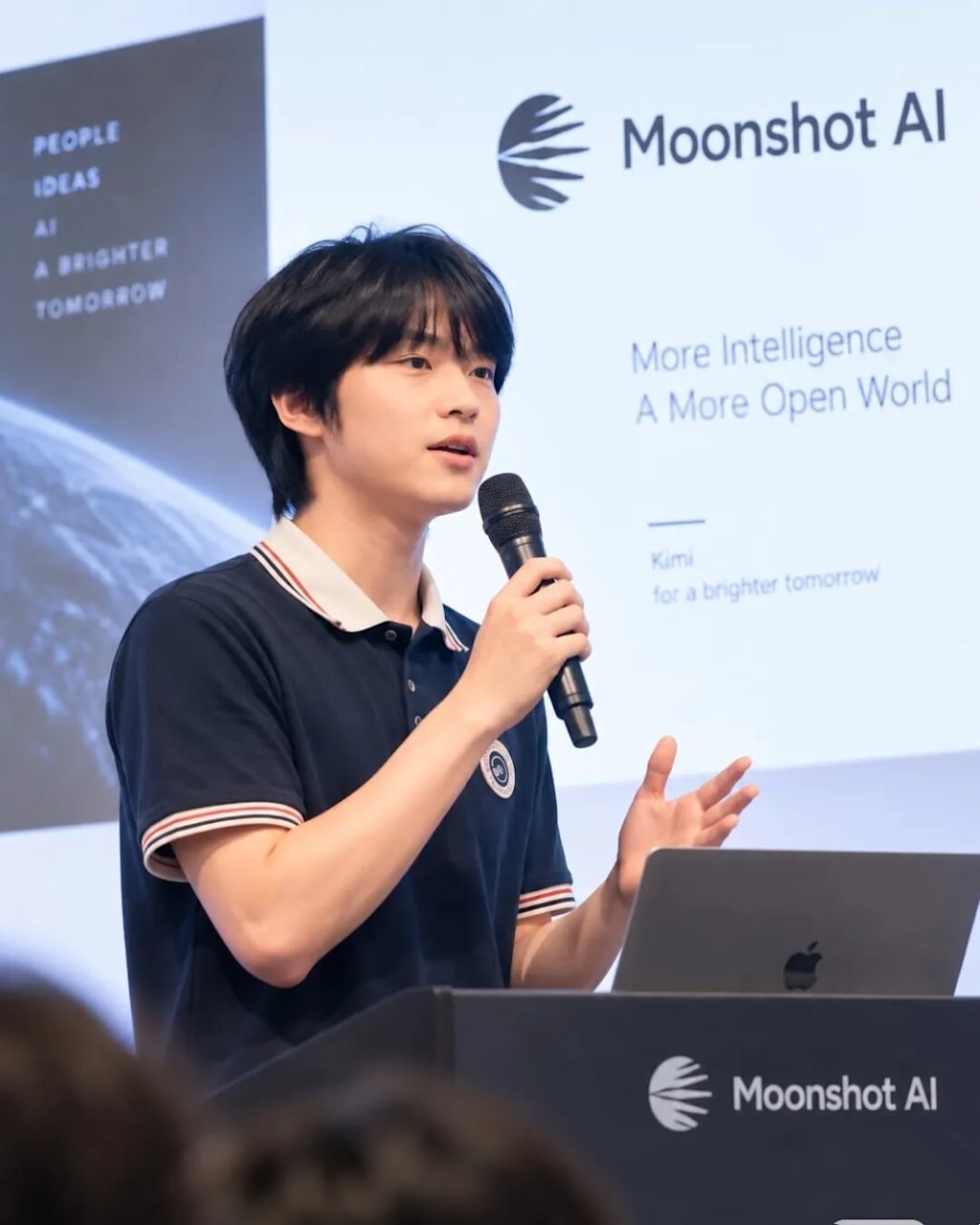
On October 15, 2026, 17-year-old Chen Guangyu posted a departure note on X. The wording was measured: he thanked the Kimi team for hiring a 16-year-old, said the past year had been "the best time of my life so far," and added that there were "more things worth exploring" next.
The comment section quickly stopped looking like an ordinary intern's farewell. Sholto Douglas, Anthropic's head of scalable reinforcement learning, congratulated him, asked whether he still planned to go to Carnegie Mellon, and invited him to work together in San Francisco. Chen replied: "Thanks Sholto! I'm heading to the Bay Area." A few days later, his next stop was reported: Discovery Loop, founded by Jeff Dean and others, working on using AI to automate scientific research.
The departure of a 17-year-old high school graduate stirred some of the most central AI circles in Silicon Valley. But the question is not where he went. It is what he did in less than a year.
Twenty followers, one reply, seven weeks
Measured with the usual ruler of the "genius narrative," Chen Guangyu's résumé does not fit at any joint. Born in Shenzhen in 2009, he had no olympiad gold medal and no childhood foundation in coding. In April 2024, as a first-year high school student, he made a decision that many people would consider irrational: he paused everything he did not like, including community service, classroom grades, and all the groundwork one is "supposed" to do for college applications. He wrote on his personal blog that during that period he only wanted to study computers and AI, by downloading papers and uploading them to Gemini, asking questions over and over, calling Gemini his "tutor."
The turning point came in May 2025. He published a technical blog post about DeltaNet on his social media account. The account had only 20 followers. Yang Songlin, one of DeltaNet's key contributors and a PhD student at MIT, replied to the post. That reply pushed the post in front of more people, including the CEO of Tilde Research, a Silicon Valley startup, who asked for a call.
He did not agree immediately. He kept reading papers and writing code, and only applied once he could write custom GPU compute kernels and use them for training. In July 2025, he flew alone to Palo Alto, California, for a seven-week internship, spending 15 hours a day in the office and working on MoMoE, a memory-optimized mixture-of-experts model.
Only after the Silicon Valley internship did he receive an offer from Moonshot AI. The timeline matters here: Silicon Valley came first, Kimi second. The seven weeks in Silicon Valley were the prehistory that led him to Kimi. In November 2025, at 16, Chen joined Kimi as an intern. His first task was writing acceleration kernels for the KDA attention operator.
He started with work at the bottom of the stack.
One all-nighter, 5%
What brought him into public view was a paper three months later.
The idea for AttnRes originally came from Su Jianlin. Known in the field as "Su Shen," the originator of RoPE rotary position embeddings, he had long worked alone in Guangzhou, writing mathematical derivations on his personal blog, "Science Space." Around the Spring Festival of 2026, Su read DeepSeek's mHC paper and had an idea: traditional residual connections keep adding each layer's information and passing it backward, treating all layers equally. What if the current layer could select, as needed, which earlier layers to read from and how much information to take? One researcher described it as turning Attention 90 degrees and standing it upright: instead of choosing between tokens, it now chooses between layers.
A simplified version was written quickly and worked well. The full version required storing information from each layer and passing it between devices. The training team did the math: with the resources available at the time, they could not afford it. Su Jianlin later put it bluntly: "To put it plainly, we were still poor."
An idea being mathematically elegant and being engineering-feasible are two completely different things.
The infra team suggested that they needed an approach with good locality to ease the communication bottleneck. After discussions, Zhang Yu and Chen Guangyu took almost only one night to propose Block AttnRes: split the model's layers into eight groups, first aggregate information within each group, then do Attention across groups. The design kept the extra overhead under 5% and brought roughly a 20% improvement in training efficiency. To reach the same performance, AttnRes saved about 20% of compute compared with traditional residuals; or, put another way, the traditional baseline needed 1.25× the compute to reach the same loss value.
Su Jianlin wrote in "A Memoir of Attention Residuals": the initial experiments were done by him, and only after Zhang Yu and Chen Guangyu joined was the scheme advanced to the stage where it could be used by large models; the Block AttnRes design was jointly proposed by Zhang Yu and Chen Guangyu. The paper had 37 authors. Guangyu Chen, Yu Zhang, and Jianlin Su were listed first, marked as co-first authors with equal contribution.
An intern, in one all-nighter, proposed the key engineering path that took the core architecture from "theoretically great but too expensive to run" to "can be packed into a flagship model."
That sentence reads like myth-making. He does not put it that way. What he repeatedly says is "Don't make a god of me."
Yang Zhilin's call, and eight months
The relationship between this paper and Kimi K3 says more than the paper itself.
According to a report by LatePost, in March 2026, with only four months left before K3's expected release, several young Kimi researchers wanted to put AttnRes into the next-generation flagship model under development. K3 was about to start training, and the schedule had already been set backward from the delivery date. Changing the architecture at the last minute could delay training or even the release. Yang Zhilin ultimately made the call: delay the start of K3 training and give the team a window to validate it.
A person close to Kimi's recruiting told LatePost that the company does only one thing, large models, and "if we don't do this well, the company dies." In that context, delaying the start of flagship-model training for an architecture change co-proposed by an intern was not a small decision.
K3 was released in July 2026, with 2.8 trillion total parameters, the world's first open-weight 3T-class model. In the official account, K3 was built on two key architecture updates: KDA and AttnRes. From January, when Chen Guangyu wrote on social media that he "was researching a very exciting model architecture improvement with Zhang Yu" and only realized he was 17 after his mother reminded him on the phone, to K3's release in July, there was more than eight months of actual training. A Block scheme proposed by an intern ran the entire course inside the foundation of a 2.8-trillion-parameter model.
When the paper was released, Andrej Karpathy commented, "It seems the phrase 'Attention is All You Need' has not yet been understood literally." Elon Musk left "Impressive work from Kimi." Four months later, when K3 was released, Musk commented "Impressive" again, and two days later listed K3 as a benchmark target for its next-generation Grok.
The blind spot of the résumé-polishing theory
Back to the most natural question: a few months on the job, intern status, a name alongside senior researchers. The suspicion writes itself: résumé-polishing.
The question looks so reasonable that it almost needs no evidence. Intuition passes judgment before the facts: shallow credentials, heavy credit, there must be dilution in between. But intuition has a blind spot here: it equates a short time with shallow contribution and ignores another possibility, that in a top team, someone who already has real R&D ability can produce substantial engineering contributions in an extremely short cycle.
Chen Guangyu's Kimi credits are not limited to AttnRes. Public information shows that he also appears in the contributor lists for Kimi Linear, k1.5, K2, K2.5, and the K3 technical report, with involvement spanning foundation-model architecture, KDA compute-kernel optimization, and training-optimizer exploration. An intern merely going through the motions would find it hard to enter such a dense sequence of core-project credits in less than a year.
More important is the timing of the contribution. The Silicon Valley internship came first, the Kimi offer second, the Block scheme came months after he joined, and the departure for the U.S. came after that. Inferring motive backward from the outcome erases the actual technical work in the middle.
AttnRes itself deserves another sentence or two. It touches residual connections, the scaffolding that has dominated almost all neural-network architectures since ResNet in 2015 and has not seen a fundamental change in nearly a decade. Traditional residuals indiscriminately add each layer's information, diluting deep-layer information. AttnRes replaces fixed accumulation with learned, input-dependent attention weights, letting each layer decide for itself what to read from earlier layers. This is a ground-level reworking of how models pass information, not a corner optimization.
What took this rework from paper into K3 was a block scheme proposed in one all-nighter, and a decision to delay the start of flagship-model training to validate it. The time on the badge was short; the trace in the model was produced by eight months of training.
The badge was handed back
When Chen Guangyu left Kimi, co-author Yulun Du wrote in the comments that watching him leave was "very sad, and quite heartbreaking," but that at his age, exploring and following new curiosities as much as possible might be the best choice for him.
He handed back the badge. The scheme from that all-nighter still runs inside K3's architecture. Names can be weighed and reweighed; the foundation has already been poured.
About the Creator
Jin
Writer of reamstories
https://reamstories.com/jin
Enjoyed the story? Support the Creator.
Subscribe for free to receive all their stories in your feed. You could also become a paid subscriber, letting them know you appreciate their work.
Comments
There are no comments for this story
Be the first to respond and start the conversation.