
He Raised $7 Billion — Then Told Investors He Doesn’t Want Their Pie
DeepSeek’s founder isn’t chasing super apps, market share, or the AI crown. He’s playing a slower game — and that might be what makes him unstoppable.
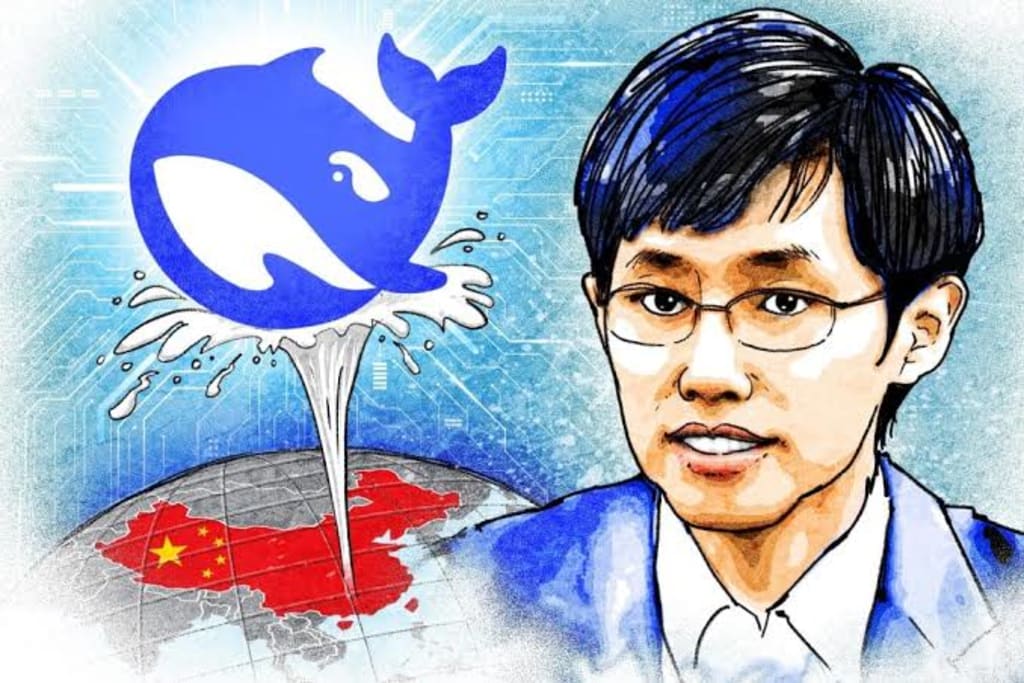
Liang Wenfeng's "Non-Contention" and DeepSeek's Slow Game — The Strategic Composure Behind an Investor Meeting
After nearly 50 billion yuan in funding was secured, Liang Wenfeng sat before his investors. He didn't pull out growth curves or show user DAU charts. Instead, he talked about something else entirely: rhythm, staircases, continuous learning, open source, and reasonable profit margins.
People in the room later compiled over thirty key points from his remarks. When those notes circulated, the industry's first reaction was: this man doesn't sound like he's on a fundraising roadshow. He sounds like he's writing footnotes for the entire field.
I. What He's Turning Down
DeepSeek won't do 3D generation. Won't do video generation. Won't do world models. Multimodality is "just a component, not intelligence itself."
Hallucination issues? He acknowledges they exist, but categorizes them as a "product problem" — low on the priority list.
Consumer traffic? B2B revenue? "Last year everyone fought over Chatbots. This year they're fighting over B2B income. But we don't think it matters."
This isn't performative aloofness. Liang has a clear dividing line: on the path to AGI, products are stepping stones, not the destination. He put it bluntly: "Right now, building products is not the time to maximize returns."
When a company actively pushes away the biggest slices of the pie in front of it, there are only two possibilities: either it's lost its mind, or it holds a much larger map in its head.
II. The Staircase in His Hands
Liang draws the AGI roadmap as a flight of stairs.
Last year's step was CoT (Chain of Thought). This year's step is Agent.
His judgment: the most important thing to go all-in on right now is a general-purpose Agent, especially a Coding Agent. "Financial, medical, and other vertical Agents have lower priority." The reasoning is pragmatic: code is the domain AI knows best. Getting it right on this track makes more sense than diving headfirst into vertical industries.
But Agent isn't the end. Further up, there's a higher threshold: continuous learning.
AI doesn't lack taste or intuition, he said. "What it lacks is the ability to learn continuously." Humans can draw inferences from one example, but for AI to handle the same task, you have to feed it the full context every time. "That's nearly impossible. So the next-generation model must have continuous learning capability — or it can't be called next-generation."
He envisions a gradual singularity: once a model can learn continuously, it can develop more advanced AI models on its own — "AI accelerating AI." Only after that step comes embodied intelligence. "The end point of intelligence may well be embodied, because for a normal person, what they need isn't a computer — it's human labor."
He didn't use exclamation points in that passage. But the investors in the room could probably sense the weight: DeepSeek isn't after a smarter chat tool. It's after intelligence that can replace human labor itself.
III. Pricing, Open Source, and the "Easy Hard Way"
People outside often think DeepSeek chose a difficult path. Liang doesn't see it that way.
"From the outside, it may look like we chose a very hard model, but actually we're doing it quite easily." He doesn't even have customer service, nor a sales team. "Users come on their own."
On pricing, he once voluntarily cut the price of a model to a quarter of its original. "Many people in the company cheered in our group chat," he said. "Because that's exactly why we put so much care into building this model — so that everyone can use it fully."
Cost efficiency is another phrase he kept returning to. When compute is limited, higher computational efficiency lets you train larger models. "Big companies can just throw more resources at it. We prioritize cost efficiency."
The most intriguing part is his explanation of open source.
Some see open source as a concession, even a matter of sentiment. Liang's version is more austere: "Open source is giving up profits — internally, it gives employees a sense of achievement and the company cohesion; externally, it benefits society." Then he runs the numbers: "Historically, a software company might have a market worth tens of billions of dollars a year, and open source would wipe that out. But AI is big enough — it might eventually account for ten percent of human society's GDP. If we try to monopolize that, we'll certainly be abandoned by history."
He positions DeepSeek as taking "only a reasonable profit." Under that premise, open source doesn't hurt the business model — "if you want a hundred times the profit, then open source really does hurt you."
He isn't even worried about others deploying their open-source models to compete. "Not every company has the will and capability. Startups are too small to have the strength; big companies find it hard to organize. This is a sweet spot for a company of our size."
IV. No Enemies, No Fighting Over Sesame Seeds
Liang said something that surprised many: "We don't want to be rivals with any internet giant or small player." He's willing to help Alibaba, Zhipu, MoonShot — "do better."
This isn't empty rhetoric. He judges that China has "too many companies building foundation models, and eventually it will converge," possibly leaving only "two big companies and two small ones." But he doesn't think foundation-model companies can capture most of the industry's profits. "The final gap in competition will come down to three things: cost, time, and user experience." Cost ranks first.
He says he doesn't "want to build the next super app, the next ByteDance, the next Tencent." His exact words: "We're not fighting over this, because behind it there's a watermelon, and what's in front might be sesame seeds. Sure, the sesame seeds might be big, but I don't think they're that big."
The sentence lands lightly. But against the backdrop of AI companies burning cash for market share, it lands like a stone.
V. The One Thing That Can't Be Compromised
Throughout the entire meeting, Liang used the phrase "can't be compromised" only once.
"There's only one thing we can't compromise on: we must maintain team stability. This is also a very big risk we face. Of course, this round of financing has largely removed that risk."
He doesn't care about occupying the head seat at the table. He cares about whether the people at the table will scatter.
A better word for his state is rhythm — not a methodology, not a specific skill, but a comprehensive judgment based on self-awareness and external circumstances: knowing when to do what, and what not to do, without even needing to spell out how.
Liang acknowledges that DeepSeek is "a product of its era," a reflection of reality, "not the result of imitation." At the very end, he said something that almost no founder would say: "I don't even need to think about whether I'll have a seat at that table. As long as that big commercial opportunity exists, there will always be a way."
VI. Losing the Hand, Not the Game
After the meeting notes spread, some asked: can DeepSeek win?
Liang probably wouldn't answer that directly. He's more used to phrasing things differently: "We believe in scaling — the larger the scale, the better the results. But we don't train such a large model because we think this scale is enough. We train it because this is all the resources we have."
With that sentence, he gently draws a line between himself and the giants burning cash on compute — he doesn't deny the value of scale, but he acknowledges his own boundary. And within that boundary, he pushes every unit of compute to its limit.
That's the other side of what he defines as "winning": not grabbing the biggest share, but not getting kicked off the table before the finish line. As long as you always have money in your pocket to pay the bill, time becomes your ally.
And time, in DeepSeek's slow game, is the most underestimated ally of all.
About the Creator
Jin
Writer of reamstories
https://reamstories.com/jin
Enjoyed the story? Support the Creator.
Subscribe for free to receive all their stories in your feed. You could also become a paid subscriber, letting them know you appreciate their work.
Comments
There are no comments for this story
Be the first to respond and start the conversation.