
He Had a $500 Billion Deal, a White Thread on His Jacket, and the Retail Investors Already Walking Out
The Jensen Huang–SK alliance is the most concentrated power play in AI history. Behind the numbers, a feudal contract was signed — and ordinary people are quietly buying gold instead.
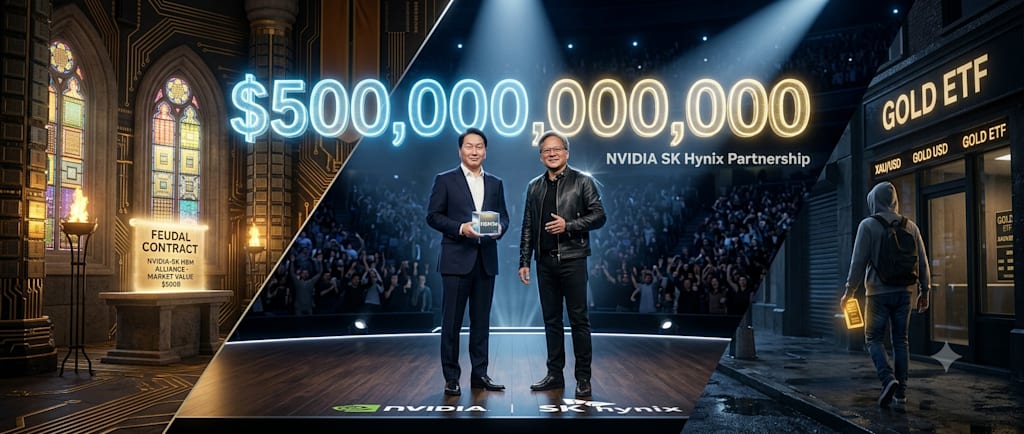
Inside the AI Summit’s main hall, the air conditioning was cranked to near‑uncomfortable levels. When Jensen Huang walked onto the stage in his signature black leather jacket, the shutter clicks came down like hail on a tin roof. Beside him stood SK Group Chairman Chey Tae‑won. Shoulder to shoulder, they watched as the screen behind them flashed a single number.
$500 billion.
The number stayed on screen for perhaps three seconds. Long enough for every photographer in the room to get the shot. Long enough for Bloomberg and Reuters journalists to type their first lede. Long enough for traders on Wall Street to refresh their terminals and see NVIDIA’s pre‑market tick up 2.3%.
Huang later clarified in an interview, almost casually: “This isn’t an investment. It’s a two‑way transaction total. They buy our supercomputers. We buy their memory.”
As he spoke, a single white thread clung to the shoulder seam of his black leather jacket. It looked as if he’d brushed against some piece of equipment on his way in. No one told him about it. That thread accompanied him through the entire press conference. It appeared in every news photo.
It was the only inelegant thing in that $500 billion spectacle.
Everything else that was truly elegant stayed hidden behind the numbers.
I. Fear
The world sees NVIDIA’s GPUs in insatiable demand. It sees the stock price climbing in a near‑vertical line. It sees Huang’s composure, quarter after quarter, on earnings calls.
Few people see his fear.
AI chip compute power doubles every couple of years. CUDA cores are packed in like rush‑hour commuters. But all that computational horsepower eventually hits a wall. That wall is memory bandwidth. Specifically, HBM — High Bandwidth Memory.
Without memory channels fast enough and wide enough, a GPU is like a Ferrari chained to a dirt road. The engine roars. The wheels spin. The car goes nowhere. And the number of factories in the world that can mass‑produce the most advanced HBM can be counted on one hand. The largest of them is called SK Hynix.
In the first quarter of 2026, SK Hynix’s operating margin hit 72%.
That’s an unsettling number. In the same period, NVIDIA posted 65%. TSMC posted 58%. A memory company was generating profit more efficiently than the king of GPUs and the world’s most advanced foundry. This meant that, within the AI industry’s profit distribution, the HBM segment had already seized disproportionate pricing power. And behind pricing power lies scarcity. Behind scarcity lies the dependency NVIDIA cannot escape.
Jensen Huang had to lock down this supply chain.
So he walked into SK Hynix’s design labs. The so‑called joint development of HBM4, at its shallowest reading, is about securing capacity ahead of time. At its deepest, it is about NVIDIA etching its own GPU architecture logic directly into the foundational design of the memory itself. Future HBM will be built to fit only NVIDIA’s interfaces, NVIDIA’s timings, NVIDIA’s power management. Even if a competitor manages to build an equally powerful chip, if the memory can’t keep up, the compute is useless.
This was an extraordinarily deep piece of technological entrapment. While helping SK design memory, NVIDIA was simultaneously building a wall around every competitor.
Only when the wall was finished could Huang sleep at night.
And on the SK side, Chey Tae‑won was running his own calculations.
II. The abacus
SK Hynix has been riding a roller coaster for decades.
The iron law of the memory industry has never once failed: huge profits when supply falls short, a price collapse when capacity comes online, production cuts, prices recover, expansion, another collapse. Chey had seen enough of this cycle. What he wanted was not to keep fighting price wars with Samsung and Micron through the next downturn. He wanted to step off the roller coaster entirely.
This deal gave him a ladder.
The ladder’s name was SK Telecom. SK Telecom would purchase NVIDIA’s Vera Rubin chips, pair them with SK Hynix’s HBM4 memory, and build a 2‑gigawatt (GW) AI data center on Korean soil.
What does 2 GW mean? Roughly the equivalent of 1.5 million Korean households running their air conditioners simultaneously. That’s one of Asia’s largest single AI compute clusters, slated to go live in 2027.
Along this value chain: SK Hynix produces HBM4 → NVIDIA integrates it into Vera Rubin → SK Telecom buys it back, installs it in its data center → and then rents the compute capacity to the Korean government, universities, and enterprises. A complete internal closed loop: My memory, built into his chips, installed in my server rooms, sold to my country.
With a single contract, Chey accomplished four things at once: secured an outlet for his HBM production, obtained priority supply rights from NVIDIA, seized control of the entry point to Korea’s AI infrastructure, and rewrote SK Group’s corporate narrative from “cyclical memory chip stock” to “AI infrastructure operator.”
The valuation multiple the capital market assigns to the latter is more than double the former.
SK was no longer just NVIDIA’s supplier. It had become NVIDIA’s partner in the Korean market. It had become the foundational infrastructure layer of South Korea’s national AI strategy. It had become a player that could extract value from every tier of the industry chain, from upstream to downstream. Chey didn’t just want to sell more chips. He wanted leverage.
III. The fortress
Veteran semiconductor analysts have an older name for this NVIDIA‑SK alliance: Konzern.
Konzern was a product of early monopoly capitalism. Several giants, through cross‑shareholding, long‑term agreements, and technology alliances, would cordon off an entire industry chain’s profits within a closed system. Outsiders couldn’t get in. Insiders didn’t leave.
Today’s AI upstream sector is exactly that.
NVIDIA, TSMC, SK Hynix, Samsung, Micron — these companies are all among each other’s top ten customers. You buy my chips, I buy your memory. You manufacture for me, I prioritize your capacity. You lock in my HBM, I lock in your advanced packaging. Long‑term contracts pile up, five years at a minimum, billions of dollars at a baseline. A new player wants to break in? Sorry. Capacity is already locked down. Technology roadmaps are already bound together. Ecosystem barriers are already welded shut.
Altimeter Capital ran the numbers in mid‑2026. The global AI net profit pool for that year came to approximately $637 billion. U.S. and South Korean companies together took 84% of it. NVIDIA alone accounted for $207 billion. Samsung and SK Hynix combined for $222 billion.
Two countries. Three or four companies. Pocketing the vast majority of profits from the hardware side of AI.
This is the power structure of the digital feudal age. NVIDIA is the Pope. TSMC is the Archbishop. SK Hynix and Samsung are the great lords who hold the holy relics. The contracts between them are not just commercial documents. They are feudal charters: vassals pledging loyalty to lords, lords granting land and protection in return. Only here, land has been replaced by production capacity, and protection has been replaced by technology roadmaps.
The moment Jensen Huang and Chey Tae‑won signed their names in San Francisco, that charter officially took effect.
IV. The fracture
But the industry chain is not a single slab of iron.
Look away from San Francisco. Look downstream. The AI large‑model sector is a completely different picture.
In the first half of 2026, Anthropic released Claude Opus 5. Its performance chased the flagship Fable 5 head‑to‑head. Its API pricing was cut in half. In China, DeepSeek and Moonshot used open‑source models and engineering optimization to push inference costs down to the floor. Enterprise clients began pulling out their calculators to compute ROI. They stopped paying blindly for the “strongest model.”
The price war in large models had already reached the point of bayonets crossing. Downstream capital returns were shrinking fast. Companies that had burned hundreds of billions on training found that their inference revenue couldn’t even cover the electricity bill. Layoffs. Cutbacks. Project cancellations. Round after round.
And upstream? SK Hynix at 72% margin. NVIDIA at 65%. Chips selling faster than money could be printed.
This upstream‑downstream divergence is a time lag in technology diffusion. Upstream is holding onto a moat built from the rigidity of physical production capacity. But moats are not permanent. The iron law of the semiconductor industry has never changed: boom → expansion → concentrated capacity release → oversupply → price collapse. Around 2028, new HBM capacity from Samsung, Micron, and Chinese memory fabs will come online in succession. If by then AI application demand growth fails to keep pace with capacity expansion, today’s locked‑in long‑term orders will become tomorrow’s bloated inventory.
When that moment comes, the only question is who has more cash on hand, whose cost baseline is lower, and who can survive the price war.
And NVIDIA and SK, with their $500 billion contract, are welding their fates to the same ship. While the ship stays afloat, neither worries. Once water starts pouring in, neither can escape.
V. The exit
There’s one more detail, hidden in the flows of capital markets.
From April to June 2026, U.S. gold ETFs and bitcoin ETFs saw net outflows of roughly $12 billion. In the same period, semiconductor ETFs pulled in about $20 billion. A classic risk‑off‑to‑risk‑on rotation. Retail and institutional investors piled in together. The logic was crystal clear.
But after July, the wind shifted.
Institutional money began taking profits and rotating out of high‑priced AI hardware stocks. And retail investors, contrary to how they’d behaved in every previous tech bull market, did not step in to buy the dip. Instead, large amounts of retail money pivoted in the opposite direction, flowing into gold ETFs. Data from the Bank for International Settlements showed that retail purchases of gold ETFs had more than tripled over the prior six months. A global survey from eToro also indicated that retail investors’ expectations for AI tech stocks had declined for two consecutive quarters, while commodity allocations rose to a three‑year high.
Institutions were selling. Retail wasn’t buying. It was buying gold instead.
Think about this for a moment. The grand narrative of AI had been told for more than two years. Ordinary people had heard it. They’d also grown tired of it. They understood that compute matters, that HBM is scarce, that NVIDIA is immensely profitable. But NVIDIA’s P/E ratio was north of 60. SK Hynix’s was above 30. The news kept getting bigger. The stock prices kept getting steeper. How much higher could it really go?
They chose gold. An asset that yields nothing, grows nothing, and tells no stories.
Every tech bull market in history follows nearly the same path: institutions build positions first, retail follows to chase the highs, institutions trim at the top, retail keeps buying or holds tight, institutions exit completely, and retail becomes the final “patient capital.” This script ran for decades — from the internet to mobile to new energy to AI. The same play, cast after cast.
This time, the script is slightly different. When the scene reached “institutions trimming at the top,” the retail actors didn’t follow the script. They didn’t take the baton. They walked off the stage.
And so the institutions were left looking at each other, $500 billion contracts in hand, with the numbers still flashing on the screen behind them. Jensen Huang and Chey Tae‑won were still posing for photos. Outside the venue, however, retail investors were busy funneling their real money into gold ETF subscription orders.
Epilogue
Four days after that San Francisco press conference, someone posted a photo on social media. Jensen Huang had been spotted at a Korean barbecue restaurant. On the table sat a bottle of soju and several small side dishes. He’d taken off the black leather jacket and was wearing a charcoal gray crewneck T‑shirt, reaching across to put food on someone else’s plate.
The photo was blurry. But you could make out the watch face on his wrist. It was worth roughly $30,000.
Thirty thousand dollars, in the context of a $500 billion story, rounds to zero.
But every number in the story was too big. $500 billion. 2 gigawatts. 1.5 million households. $637 billion. 84%. 72%. So big that in the end, people remembered only the numbers, not the concrete things beneath them: a white thread on a leather jacket, a soju bottle on a barbecue table, a blurry photograph where no one’s expression was legible, a retail order pulled out of an AI ETF and stuffed into gold.
Large numbers have a kind of devouring force. They devour details. They devour hesitation. They devour all the time you might have taken to think twice.
After Huang and Chey signed that letter of intent, they didn’t embrace. They shook hands. The flashbulbs went off in a wall of light. That image will appear in every financial media year‑in‑review special, as a footnote to the golden age of AI.
Whether the punctuation that follows that footnote is an exclamation point, a period, or an ellipsis — no one knows.
Check back in 2028. That’s the year SK’s 2‑gigawatt data center is supposed to go live. That’s when HBM4 volumes are scheduled to ramp. That’s also when Samsung’s and Micron’s capacity expansions are due to hit the market.
By then, the tide will have gone out.
And we’ll all see who’s been swimming naked.
That line belongs to Buffett. It’s been said so many times it’s practically worn out.
But worn‑out things are often the truest.
About the Creator
Jin
Writer of reamstories
https://reamstories.com/jin
Enjoyed the story? Support the Creator.
Subscribe for free to receive all their stories in your feed. You could also become a paid subscriber, letting them know you appreciate their work.
Comments
There are no comments for this story
Be the first to respond and start the conversation.