
He Built His Own YouTube in Two Hours. The Feed Was the Point.
Karpathy’s HackerTube keeps YouTube’s videos and replaces the recommendation signal with years of Hacker News judgment. That changes who the algorithm serves.
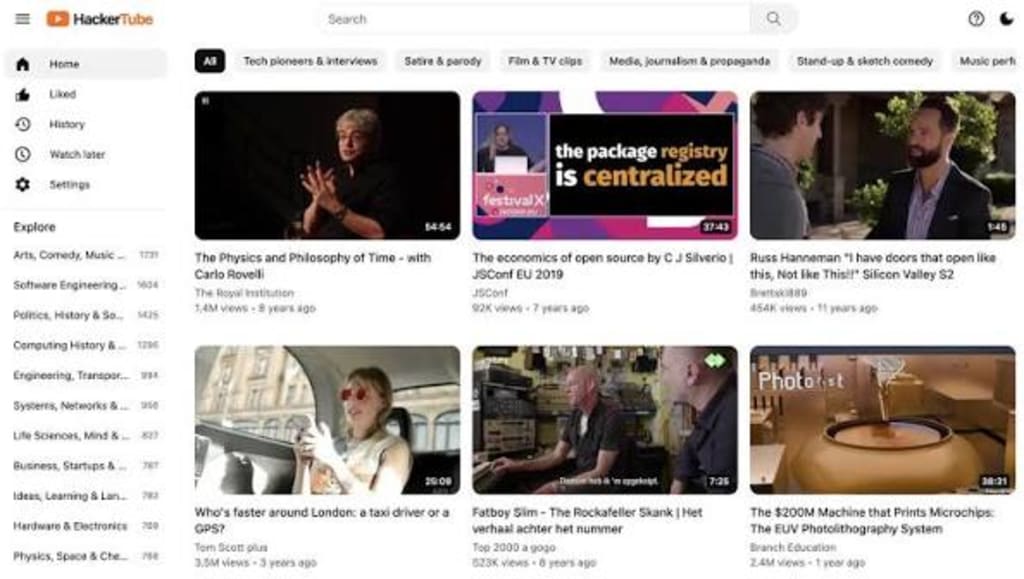
At 11 p.m. on a Friday, Karpathy opened YouTube and tried to find a video. The homepage gave him exaggerated thumbnails and topics he had seen many times. He closed the tab. The next morning he opened Claude and built his own YouTube.
The build took about two hours. He used Claude Opus 5.5 at Medium reasoning strength.
The site is called HackerTube: https://hackertube.org/
It copies YouTube’s layout closely. The left sidebar has liked videos, history, and Watch Later. The right side has a recommendation feed with the same cover size, publish date, and view count. Users can browse by topic: art, software engineering, history, ideas, business, games, and other categories. The site contains 6,454 videos. It also offers personalized recommendations. On a video page, a user can see comments from Hacker News, how many HN users recommended the video, and when those recommendations appeared.
Karpathy gave Claude one prompt. The prompt asked for a YouTube-style site limited to videos that Hacker News users had recommended repeatedly over the years. He told Claude not to make mistakes. Claude wrote the filter, processed the data, built the site, deployed it, and handled security and optimization. Karpathy created a Google Cloud API key for video metadata, started a VPS, and bought a domain. Those were the manual steps.
The reaction on social media focused on two things. One was speed: Claude Code and Opus 5.5 at Medium reasoning produced a working YouTube-style product in two hours. The other was the larger question. If an AI agent can rebuild a product’s interface and replace its ranking rule, what else can be reverse-engineered?
Some users also pointed to Claude’s limits. After the REA reverse-engineering project became popular, users reported hitting safety fences when asking Claude to reverse-engineer software. A PhD student at HKUST said Claude flagged his request to submit jobs and run analysis as “training a competitor” and downgraded Opus 5.5 to Opus 5. The contrast with Karpathy’s build became part of the discussion.
The two-hour build
Karpathy described a narrow workflow. He used Claude Code desktop on a Mac. The default model was Opus 5.5, with reasoning set to Medium. He said he no longer spends much time reading and writing code or running terminal commands. He talks to Claude and lets the agent execute.
In this project, the human work was external account and permission work: a Google Cloud API key for video metadata, a VPS, and a domain. The agent wrote the code, cleaned the data, deployed the site, added security, and optimized it. The two-hour figure is not a benchmark for all projects. It records one project with a narrow scope, a clear data source, and a developer who knew what he wanted.
HackerTube does not host video. It does not handle uploads, copyright claims, creator payouts, or a global content delivery network. It reads YouTube videos and metadata. It stands on Hacker News, a community that has spent nearly twenty years posting links, arguing about them, and recommending them to one another.
Without that history, the site has nothing to rank.
The project is a curation and recommendation layer built on top of existing platforms. It does not replace YouTube’s infrastructure. It replaces the part of YouTube that decides what a user sees first.
Same videos, different ranking rule
YouTube’s recommendation system uses clicks, watch time, retention, and engagement to decide what should be seen. The platform’s goals are growth, time spent, and advertising efficiency. Those goals produce a homepage with optimized thumbnails, repeated topics, and videos selected to win a click.
HackerTube uses a different input: links that Hacker News users posted because they thought a video was worth sharing. That action carries more weight than a click. A person watched or read something, made a judgment, and put it in front of a community that would argue with them if the link was weak.
The result is visible in the AI category. The first recommended video is Karpathy’s own programming course. He builds a small automatic differentiation engine, then a neural network, and explains backpropagation step by step. That video fits the HN audience. It may not win a thumbnail A/B test against a dramatic face and a red arrow, but it does not need to.
HackerTube also removes several default platform tricks. It does not require login. Watch state stays in the local browser. The cover image comes from the middle of the video, not from the uploader’s optimized thumbnail. Users can export the underlying data and hand it to their own AI agent to build another version.
The interface looks familiar. The order of the feed is where the work happens. That order comes from human recommendations collected over years. The algorithm serves a narrower target: the preferences of a user who chose to trust a particular community.
The limit of “rebuilding YouTube”
HackerTube did not reverse-engineer YouTube’s code. It did not crack the recommendation algorithm. It kept YouTube’s content and metadata and replaced the selection and ordering layer with Hacker News data.
That distinction matters. HackerTube builds a personal front page from another community’s public judgment. It does not build a new YouTube.
The limits show up in the data. HN users are not a representative sample of video viewers. A technical community’s taste is not a universal standard for quality. Recommendations carry the biases of era, class, profession, and community norms.
The top-viewed list on HackerTube includes videos that are more than a decade old: Pinkfong’s “Baby Shark,” Psy’s “Gangnam Style,” and the Rickroll clip. HN recommendations do not automatically produce obscure intellectual content. They produce a different mix, shaped by what a technical community found funny, useful, or worth arguing about.
Some users also found that search results included irrelevant videos. Human selection was still needed. The site filters; it does not decide for the user.
Maintenance is another constraint. A commenter brought up arxiv-sanity, an earlier paper tool Karpathy built. Karpathy said he missed it but shut it down because maintenance took too much time. He thinks the same work would be easier today. Easier does not mean free. A site that depends on external APIs, metadata changes, and community data needs someone to watch it.
Reverse-engineering moves up a layer
The phrase “reverse-engineering” usually describes code: decompiling a game, porting software, copying an interface. AI agents are making those projects cheaper. People have used Claude and other models to rebuild app interfaces, port games, recreate television interfaces, and produce Android TV versions of HackerTube. A community-built hackertube.tv exists.
HackerTube sits one layer above code. It reverse-engineers a product’s information structure. It asks which parts of YouTube are infrastructure and which parts are editorial choices. Video hosting is infrastructure. The recommendation feed, the thumbnail, the login requirement, and the order of the homepage are choices.
Once those choices become visible, they become editable. A user can keep the video platform and replace the front page. The same move works for a news source, a book database, or a bestseller list. A user can keep the underlying content and replace the order in which it appears.
Other projects follow the same pattern. Hacker Papers collects more than 1,000 arXiv papers from Hacker News posts. Another project identified more than 15,000 books from HN discussions and built a book recommendation site. These are small projects. They share a method: take a community’s public recommendations, extract the items, and build a different entrance.
The market signal is a personal recommendation algorithm. Platforms own the current recommendation infrastructure. Users can accept it, block individual items, or adjust a few settings. They cannot replace the objective function. An AI agent can read a user’s trusted sources, build a ranking rule, and produce a feed that answers to the user rather than to platform growth.
That possibility comes with costs. A personal feed can become a smaller bubble. A community’s recommendations can carry its blind spots. AI-generated filters can make low-quality content look curated. If everyone builds a private entrance, public discussion may fragment further.
What the two hours actually prove
The two-hour build proves that the cost of making a curation layer has fallen. It does not prove that YouTube has been replaced, that recommendation algorithms are solved, or that every user will build a personal feed.
It proves something narrower and more useful: a developer can take a public community’s recommendation history, combine it with an existing content platform, and ship a working alternative front page in an afternoon. The manual work is account setup, API access, and deployment. The agent handles the engineering chain.
That changes the division of labor. The human sets the target and handles external permissions. The agent writes, deploys, and hardens. The human decides which community’s judgment to trust. The agent turns that judgment into a ranking rule.
For platforms like YouTube, Bilibili, and WeChat, the infrastructure remains necessary. The content remains necessary. The designed entrance becomes optional. A user can still depend on the platform for video delivery and use an agent to decide what appears first.
On a Saturday morning, a user can open Claude, point it at a community whose taste they trust, and ask for a smaller front page. The cost is two hours, one API key, and a domain. The alternative is another Friday night on the default feed.
About the Creator
Jin
Writer of reamstories
https://reamstories.com/jin
Enjoyed the story? Support the Creator.
Subscribe for free to receive all their stories in your feed. You could also become a paid subscriber, letting them know you appreciate their work.
Comments
There are no comments for this story
Be the first to respond and start the conversation.