
He Built a Hoverboard From a Childhood Dream. Then the Internet Called It Fake.
Song Xingyu’s hand-built machine flew over the Yangtze. The harder flight was getting people to believe it was real.
The reporter met Song Xingyu at an industrial park in Yichang. He was wearing flip-flops and loose, clean casual clothes. His hair was fluffy and curly, and acne marks were still visible on his fair face. He trotted over and knocked on the pontoons of two seaplanes in the warehouse. “Bang, bang… Look, these are my treasures! I bought them online for only 20,000 yuan. Do you know how much new ones cost? 200,000! Aren’t I lucky?” He was as excited as a child.
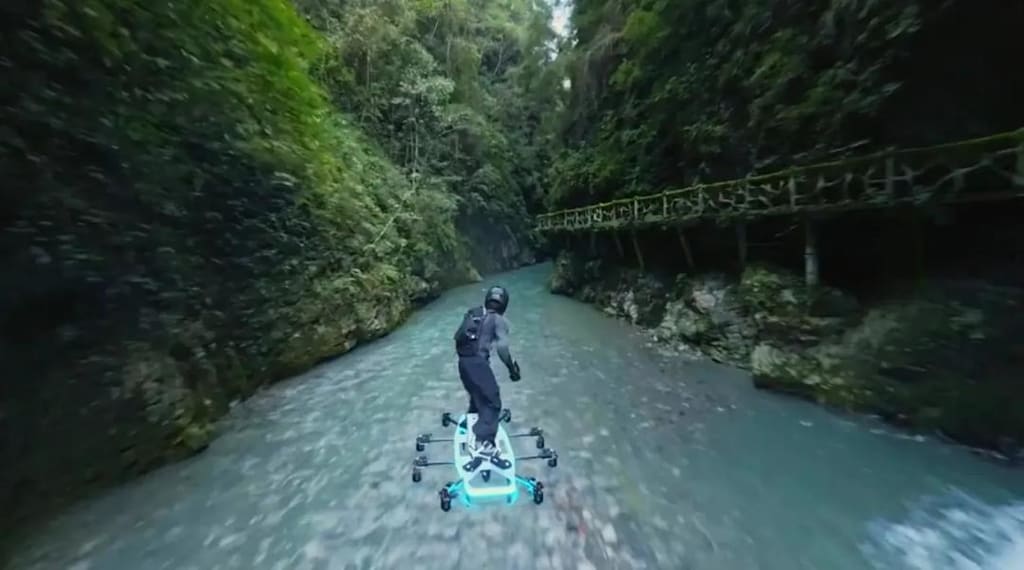
A few minutes later, he changed into a black tight combat suit, a black helmet, and black snow boots. He stood on a white-framed hoverboard glowing blue. Ten electric propellers started, and the whirlwind made the reporters’ trousers flap. He took off inside the warehouse, rising, descending, hovering, and turning. He passed through the warehouse door, flew one circle outside, and landed smoothly in front of the cameras. He released the wired throttle in his right hand. The propellers stopped, the roaring disappeared, and applause broke out. He made a mischievous face and smiled.
This flight was his response to the question “real flight or fake flight.”
Earlier, a video of him riding a Green Goblin-style hoverboard across the Yangtze and over the Baren River Scenic Area in his hometown had gone viral online. Some exclaimed, “He can really fly!” Others mocked, “He can really brag!” Tech bloggers laid out scientific reasoning and said it was impossible. At the height of the controversy, Ayu seemed to disappear. He appeared in person before media cameras on October 22.
“The rumors online are really ridiculous,” he said.
Then he added: “I hope everyone can help me explain that this is not some remarkable technological invention, and I have never said how amazing it is. I just made something I wanted as a child, fulfilled a childhood dream, that’s all.”
The dream started in a remote mountain village in Badong County.
When he was six, his mother, who worked as a domestic helper in the county town, brought home a space shuttle model discarded by an employer’s child. The paint was peeling, and many parts were missing. He cherished it and still keeps it. Even earlier, when he went to the hospital with his mother, the television on the wall was playing Spider-Man. The Green Goblin’s hoverboard in the film seemed cool to him. He fantasized that one day he could have one too.
“My family was very poor when I was little, and sometimes I was bullied at school, so my mind was full of images of myself being very powerful in the future,” Song said.
At 14, in the second year of junior high school, he left school and helped out at his father’s lumber processing workshop. Two years later, he returned home and entered a private high school. In the first semester of the second year, he dropped out again. “I felt I couldn’t learn what I wanted in the classroom,” he said. He worked on construction sites and as a factory apprentice. Electric hammers, drills, saws, electric welding, tin soldering, and laser cutting became familiar tools. Architecture, machinery, electronic information, digital technology, power, materials, and aerospace were subjects he studied through self-teaching and aptitude.
In 2022, he returned home again. He borrowed 19,000 yuan from his father, bought a small truck, and began converting one of his father’s sheds into a studio. For 180 days, alone, he completed the conversion. He made a glowing sign reading “Ayu’s Scientific Adventures” and hung it prominently. Later, he asked his father to help him get another 20,000-yuan loan to buy a computer, a 3D printer, and some tools.
When the reporter visited the studio in Chadianzi Town, 59-year-old father Song Chaofu pulled open the rusty iron gate. A surveillance camera on the neighbor’s eaves warned, “You have entered a monitored area.” The father had installed it specially for his son. The lumber workshop was extremely crude. The damp ground was overgrown with weeds, and wood was piled under the iron-sheet shed. Mother Tan Daqing opened a simple wooden door to the inner room and turned on the light. It was just over 10 square meters, with gray carpet, one wall covered with tools, and a table along the wall holding a 3D printer, a microscope, and a computer. It was a different world from the outside.
With this studio, Song went out less and stayed inside fiddling with his aircraft. Friends from other places came to tinker with him, so he added an attic above with a few beds. Tan silently cooked for them. “Sometimes when the food was ready, they wouldn’t eat, as if possessed,” she said.
In 2024, he spent several months making his first “space shuttle,” named Echo No.1, as an answer to himself 18 years earlier. He drove more than 2,000 kilometers to an uninhabited area in the northwest to carry out his launch plan. The plan was for eight sounding helium balloons to carry Echo No.1 and its launch frame to 40,000 meters, then separate from the frame and fly back by manual remote control or automatic return.
The second day after arriving in the uninhabited area, they encountered strong winds. The launch camp was almost destroyed, and the launch frame and several balloons were damaged. With insufficient supplies, damaged equipment, physical and mental exhaustion, and harsh climate, Song once decided to give up. When he was close to giving up, his companion proposed a bold plan: remove the launch frame and use the remaining balloons to send Echo No.1 up. They took the gamble. Echo No.1 rose in the crudest way. Soon, however, the separation ignition system failed, and then the positioning system lost signal. Echo No.1 disappeared. After a brief panic, Song used the information to find the crashed Echo No.1 on a hillside 600 kilometers away. He was delighted to discover that during the hours it was missing, it had completed part of its mission. The camera it carried had captured the vast and magnificent Earth after ascent.
The first flight failed in the uninhabited area, but Echo No.1 gave him an unprecedented shock and joy. It made him feel that dreams were within reach. The desire to own a Green Goblin hoverboard grew stronger.
In August this year, the hoverboard was put on his work plan. First, he needed a high-power engine. A 163 kW, 80 kg aviation turbojet engine caught his eye, and he also equipped four 40 kg aviation turbojet engines. “Five engines combined gave a total thrust of 240 kg, enough to carry three of me,” he said. Assembly and individual tests were normal. But when the five engines started simultaneously, an accident happened. The engines suddenly caught fire, burning part of the fuel and electrical circuits. He could not figure out why. Through AI, he found the cause: the engine spacing was too narrow, and the nozzles were too close to the ground. When five engines started at once, hot gas sprayed onto the ground and rose, entering the engine intakes. The intake temperature became too high, and the combustion chamber deflagrated. AI also gave him a safer and more reliable plan: use 10 electric propellers instead of five aviation turbojet engines. “This plan has greater thrust, 300 kg, and can carry four people.” In September, the hoverboard was completed. Training and test flights went smoothly.
Facing doubts, he responded item by item. The wired controller in his right hand controls the throttle. The remote in his left hand can control steering, but direction is controlled more by leaning the body left and right, forward and backward. It requires strong vestibular function, balance perception, and body coordination, as well as flight skills and extensive professional training. The earphones and the phone on his wrist are only auxiliary training and data collection systems. They do not participate in flight control. The white frame and some auxiliary parts are 3D printed. The battery heats up during discharge, affecting endurance. Endurance is only 16 minutes. Next, he will cooperate with relevant Chinese battery manufacturers to optimize battery performance and improve endurance. Essentially, it is a “human-carrying FPV drone.” It may be productized in the future, but it is not a mass consumer product. It is an aircraft for extreme sports enthusiasts.
“It has no high-precision technology. The drive chip is an ordinary domestic chip, and the direction remote is also domestic, only more than 100 yuan,” Song said frankly.
But risk does not disappear because it is “not advanced.”
In November 2024, in the night sky over Chongqing, he tried to turn himself into a meteor. He wrote a farewell note and had his companion use a helicopter to take him to 5,000 meters. Then he jumped. A firework carried by his wingsuit streaked across the sky like a meteor. When the fireworks burned out, the “meteor” disappeared into the night sky. For a full 20 minutes there was no news. He survived.
Tan watched and cried, worrying for days and nights without sleep. Talking about it, she cried again. “Before, we didn’t know what he was doing, and we didn’t know it was so dangerous. Every time he went out, he just said ‘bye-bye’ and left. We did try to persuade him: ‘A rural kid, why mess with those life-risking things?’ But it was no use. He was already sunk in. So we had only to support him.”
“When he’s not home, we don’t even dare call him, afraid of disturbing his rest or affecting his work. Sometimes when we can’t help it, we call, but he doesn’t answer. He always replies late at night,” Song Chaofu said.
The couple had little savings. Whenever their son needed help, they helped him get loans, many times. “We never dared borrow much, always 20,000 yuan at a time. When we had money, we paid it back for him,” Song Chaofu said.
This Father’s Day, Song Xingyu transferred 6,666 yuan to his father, with the message “Happy Father’s Day!”
In the warehouse, knocking on the seaplane pontoons, he said: “Even more fortunate, I was born in this great era. It lets me obtain what I want more conveniently, including knowledge and skills. From a small circuit board to complex structural parts, I just send the drawings to relevant factories, and in a few hours or even tens of minutes I can get them. Very efficient.”
The other side was harder. In 2025, he spent all his savings to build an aircraft, and it crashed. Then he built a boat, and it sank. He incurred more than 2.4 million yuan in debt. Fortunately, enterprises helped him repay most of it. In the past two years, through creative flights and commercial advertisements embedded in videos, he has escaped financial trouble. His hand-made hoverboard, “cloud living room,” and other creative flight works have also generated potential commercial value. After the hand-made hoverboard video went viral, institutions and companies seeking cooperation came in an endless stream. The Badong County government also extended an olive branch.
Some netizens praised his courage. Others thought it was not worth risking a young life.
Professor Sun Xianbo of Electronic Information Engineering at Hubei Minzu University said: “Song Xingyu’s innovative enthusiasm and exploratory spirit in independently developing and making a hoverboard deserve protection and encouragement, but we must also clearly see that from carrying objects to carrying people, engineering risks and control difficulties rise accordingly. We should protect the spark of daring to think and try, and also fasten the reins of safety and controllability. We encourage innovative exploration, and we hope even more that folk science innovators will actively connect with regulatory channels and test under safe and controllable conditions, so that trial and error has boundaries and passion has escort. Only then can the ‘hand-made hoverboard’ fly farther and higher.”
Song’s memo contains nearly 300 whimsical ideas. He said: “Once you fly, it’s hard to stop.” He added: “I will try to be safe, because my parents are waiting for me to come home.”
The hoverboard sits on the warehouse floor, its propellers no longer turning. The surveillance camera his father installed still has a small red light on under the eaves.
About the Creator
Jin
Writer of reamstories
https://reamstories.com/jin
Enjoyed the story? Support the Creator.
Subscribe for free to receive all their stories in your feed. You could also become a paid subscriber, letting them know you appreciate their work.
Comments
There are no comments for this story
Be the first to respond and start the conversation.