
Half the Workstations in Bangalore Are Empty
The quiet collapse of India’s $200‑billion IT outsourcing empire — and what it means for millions of engineers.
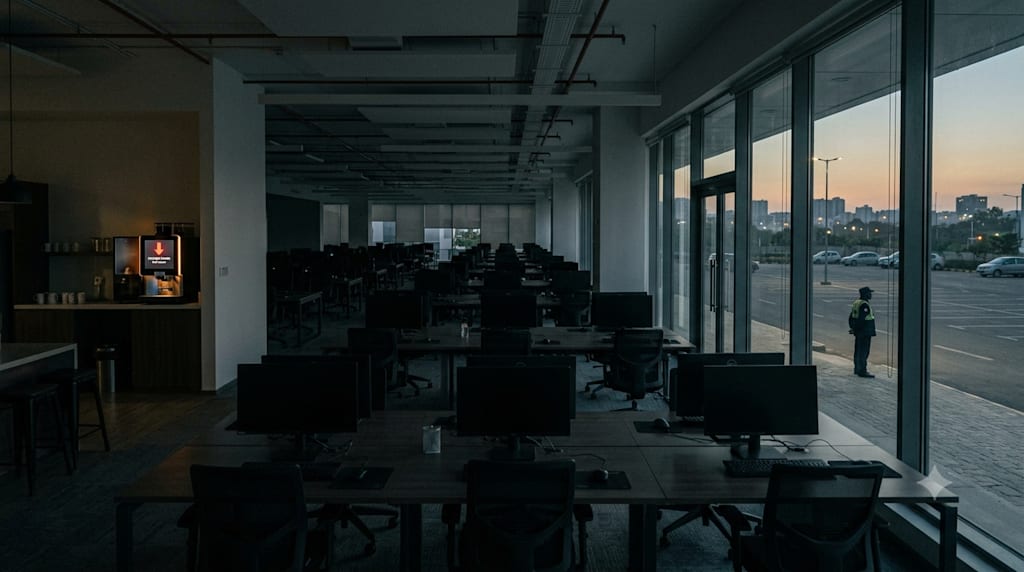
July 2026. The coffee machine in an IT park on the outskirts of Bangalore is dispensing 30% fewer cups than it did a year ago. It’s not a seasonal dip. The security guard says the late‑shift shuttle bus has gone from hourly to every two hours, because two fewer floors of the TCS building are lit at night.
India’s IT industry isn’t facing a cyclical downturn; its business model is collapsing.
I. AI ripped the price tag off the “human wave”
For three decades, Indian IT outsourcing did essentially one thing: it took a US programmer’s $150,000 annual salary and compressed it into a $15,000–$20,000 invoice for an Indian engineer. That spread was the profit. Infosys consistently ran gross margins above 30%, not because of technological moats, but because it could keep 800,000 engineers online simultaneously.
AI rewrote that formula from scratch.
GitHub Copilot costs about $100 per user per year. One AI agent can now handle testing and maintenance work that used to require three junior engineers. A McKinsey report from late 2025 estimated that, across the software development lifecycle, roughly 42% of coding tasks can be fully automated by AI, with another 30% seeing significant time reductions. That means more than half of the “body‑shop” work orders that formed the core of India’s IT outsourcing are losing their economic rationale.
TCS’s 2025 annual report carried a number that was never highlighted: total headcount fell from a peak of 612,000 to 586,000 by March 2026, a net reduction of 26,000 people. In that same filing, AI‑related revenue grew 27%, but still accounted for only 7.5% of total revenue. In other words, no matter how fast the new business grows, it cannot fill the hole left by the old one.
II. Capital fled long before the layoffs hit
The stock market doesn’t wait for unemployment data.
From the end of 2024 to July 2026, the Nifty IT index retreated 49% from its peak. In the first half of 2026 alone, it lost 30%, the worst performance among all sectoral indices in India. Foreign investors sold a net $23 billion worth of Indian IT stocks over those 18 months. The combined market capitalisation of the top four firms (TCS, Infosys, Wipro, and LTIMindtree) evaporated by more than $200 billion. That is roughly equivalent to the entire annual output of India’s automotive manufacturing industry.
This is not panic. It is repricing. The market is saying: the old valuation logic (headcount multiplied by daily billing rates) no longer works.
III. 1.5 million graduates a year, facing a door that is closing
India produces about 1.5 million computer science and related graduates every year. In the past, TCS alone could absorb 50,000 to 80,000 of them through campus hiring annually. In 2026, TCS’s campus recruitment plan has been cut to fewer than 20,000, and those positions are concentrated in new areas like AI operations and data analytics; traditional coding roles are almost frozen.
The deeper crack is on the existing workforce.
A project manager who spent eleven years at Infosys’s Pune campus received an email in April about a “voluntary separation scheme.” He told me his team of thirty is now down to nineteen. The remaining members each have to review three sets of AI‑generated code at the same time. Workload hasn’t dropped, but headcount has, and wages haven’t risen. “AI didn’t replace us,” he said, “but AI makes every one of us feel replaceable at any moment.”
That sentence defines the current mood more accurately than any data point. When the core labour force of an industry is trapped in the anxiety of being perpetually substitutable, consumption contraction is no longer a macroeconomic projection; it is already part of daily life. In the second quarter of 2026, residential sales in India’s seven largest cities fell 6% year‑on‑year, while listings of mid‑to‑high‑end apartments in Bangalore rose 12%, most of them put up by IT workers.
IV. Transition: from selling heads to selling brains, and a whole generation lies in between
India’s IT giants are not standing still.
TCS reported $2.3 billion in annualised AI‑related revenue in Q4 of FY2026, up from $1.8 billion in the previous quarter. At an analyst meeting, executives said they expect AI delivery components to be embedded in all service contracts by 2028. That sounds optimistic, but the numbers don’t lie: $2.3 billion is only 7.5% of TCS’s quarterly total revenue. The remaining 92.5% still comes from traditional time‑and‑materials billing.
The problem is that the traditional business is shrinking faster than the AI business is scaling up. NASSCOM’s latest forecast projects net job growth in India’s IT sector at just 2.3% for FY2026, far below the historical average of 8–10% over the past decade. More aggressive estimates suggest that if AI code‑generation efficiency doubles again, India’s IT industry could shed at least half a million jobs before 2030.
The core obstacle to transformation is not technology; it is people. Indian IT engineers excel at executing specifications, writing documentation, and running test cases: exactly the tasks AI is best at replacing. Moving toward AI solution architecture, algorithm optimisation, and industry consulting no longer requires “good English and the ability to work nights”; it requires mathematical foundations, business domain understanding, and interdisciplinary vision. Most of the current generation of engineers have never been trained for that.
V. A mirror—not for others, but for ourselves
India’s predicament is often cited as a cautionary tale for China. But the more honest framing is that we are all standing in different positions along the same tide.
China’s software industry has the advantage of its own super‑app ecosystem and a vast domestic market, something India lacks. But China also has a large number of low‑value‑added outsourcing, testing, and maintenance jobs, all facing the same spreadsheet pressure of “AI substitution.” The difference is one of proportion and speed, not presence or absence.
The capital market saw India’s IT crisis coming before anyone else did. Stock prices were halved before layoff figures were published; campus recruitment quotas were slashed while graduates were still submitting applications. The market’s sensitivity always outruns policy’s remedies.
The coffee machine in that Bangalore IT park is dispensing 30% fewer cups. Not because the coffee tastes bad; there are fewer people to drink it.
On the same floor, two engineers are sitting at empty workstations, using AI tools to generate a test report that used to take five people a full week. They finish two days early. Their manager pats them on the shoulder and says, “Good efficiency.”
They don’t smile.
Because they know that next month, the company might use the same AI toolkit to hand three people’s work to one. And the two who are left out: where they will go, no one tells them.
About the Creator
Jin
Writer of reamstories
https://reamstories.com/jin
Enjoyed the story? Support the Creator.
Subscribe for free to receive all their stories in your feed. You could also become a paid subscriber, letting them know you appreciate their work.
Comments
There are no comments for this story
Be the first to respond and start the conversation.