
GPT-6.2 Sol Didn't Crush Opus 5.5. It Split the Scorecard.
A first-test breakdown of speed, cost, 3D visuals, code animation, and backend reliability, plus why the right model depends on the job.
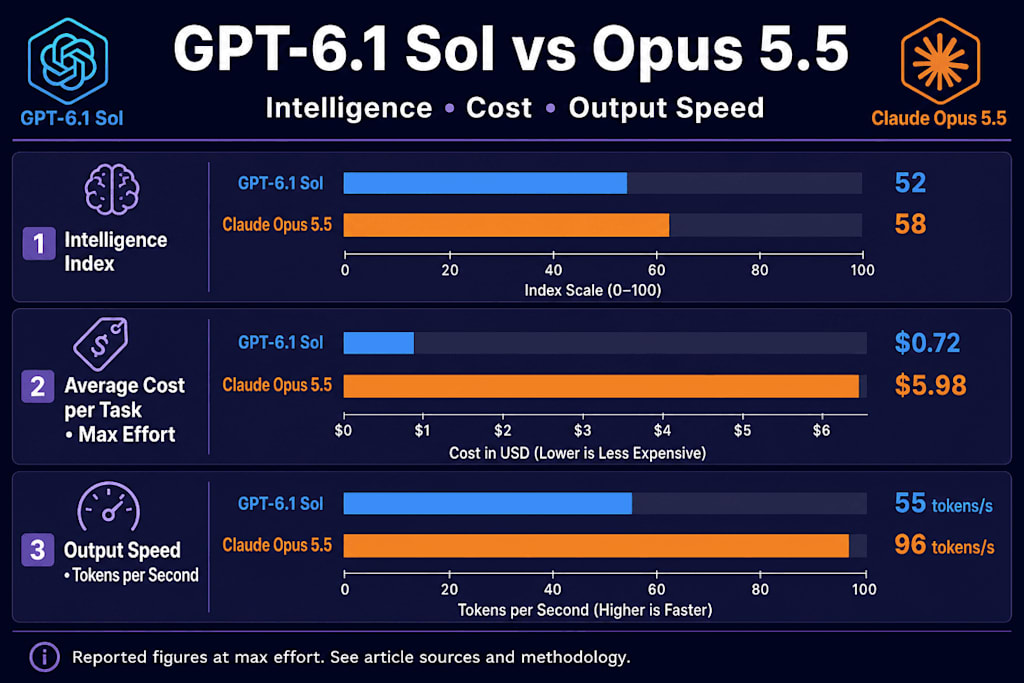
At 00:06, the tester pasted the first prompt into the input box. The prompt was long. Its core was one sentence: use top-tier aesthetic sense, art direction, and 3D programming ability; push composition, lighting, materials, particles, animation, and spatial atmosphere as far as they go. He did not wait long. The page began spitting out code line by line. An hour later, he lined up screenshots, screen recordings, bills, and time costs for several cases in a table and posted it. Cost was the clearest column.
The claims on X were noisier than that table. Token Gremlin first wrote that he had finally seen a model that could go toe-to-toe with Opus 5.5. After playing with it, he changed his tune: “GPT-6.2 Sol has already crushed Opus 5.5.” The black hole demo, the Hokusai masterpiece turned into a 3D scene, and the Ultraman coloring case he posted did push “absurdly powerful” onto the trending list. But after going through the hands-on records from gray-release users, “crushed” only holds on one set of books. On the other set, Opus 5.5 is still sitting where it was.
1. Speed and cost: a table with no suspense
Start with the least controversial part. For the same interactive animation task, GPT-6.2 Sol took about 20 minutes. Opus 5.5 took about 1 hour. Per-task cost was about $1.19 for Sol and about $10.04 for Opus 5.5. Sol’s cost was 11.8% of the latter’s. In more specific 3D front-end generation cases, the previous-generation GPT-6 Sol took under 1 minute and cost $0.08 to $0.11. Opus 5.5 needed 6 to 12 minutes and cost $0.80 to $1.52. GPT-6.2 Sol picked up that cost-performance curve. One heavy user refactored a 2,000-line code project with it and found quota consumption noticeably lower than with earlier versions. His exact words: “About ten runs consumed less than 10% of the $200 Pro plan.”
When that gap lands in a workflow, it is larger than a small price difference. It means the same budget can run a dozen more visual rounds. It means “generate, delete, change the prompt, generate again” can become a daily action instead of something you do the math on before every Enter. Opus 5.5’s single-run quality may be steadier, but Sol makes you willing to run it a few more times. At the creative exploration stage, being willing to run it a few more times is itself a capability.
2. 3D and visuals: structure steals the show, texture leaves space
Most of the “crushed” claims come from here.
GPT-6.2 Sol can, in a single run and with zero external dependencies, build a complete 3D world in pure code inside a single HTML file from one prompt. Pirate ships, 3D restaurants, interactive V8 engine visualizations: none of them need external models or assets. The tester opened the cutaway view of the V8 engine, saw the piston structure, and noticed that Sol had referenced the layout of a four-stroke teaching model. The 6.2 Sol version above had more cohesive modeling texture. The GPT-6 Astra version below offered more reference details and adjustable buttons. Each has its own ledger.
The jelly-shaped valley diorama comparison was more direct. The Opus 5.5 version, made for $18, had the “duang duang” feel of jelly and could display different reservoir levels and peak periods. After GPT-6.2 Sol ran the same prompt, it restored that feel and added sliders for jelly hardness and damping strength. The tester pushed the slider up, and it felt more like a squishy toy. That detail is small, but it shows Sol taking a step forward in interaction depth.
Put the lava lamp and rocket launch cases side by side, and the gap points the other way. In the lava lamp, Sol’s wax blob shapes were clearer and easier to distinguish. Opus 5.5’s treatment of the highlights on the glass body and the warm halo at the base pulled the atmosphere further. In the rocket launch scene, Sol’s color contrast and environmental layering were more striking. Opus 5.5’s palette was more restrained and realistic. One is responsible for blowing up the room at first glance. The other is responsible for holding up on second glance. Which one crushed which depends on whether you want a poster or a photograph right now.
3. Code animation: after catching up, overtaking in places
The “A Paper Ocean” test shows the rhythm difference between the two models most clearly. The prompt asked for a breathing surreal nautical collage made from public-domain whales, old sailing ships, nautical charts, the moon and earth, and natural-history illustrations: 1920×1080, 30fps, 8 seconds. The ship, paper waves, coral, seabirds, star charts, and whale were each to have independent motion and occlusion, not the whole image translating. Objects were to run at 12fps stop-motion with ±2px handheld jitter per beat. The camera was to push in with 24fps parallax.
GPT-6.2 Sol found the assets, made an 8-second code animation, and split it into 21 layers. The tester’s immediate impression was that in Opus 5.5’s 8 seconds, something was moving every second. In Sol’s version, the image only started moving after two or three seconds. The clay animation direction was similar: modeling traces were fairly obvious, and the stop-motion movement stuttered. On immediate dynamic feedback, Sol still has room for polish.
Switch to AI video transitions, and the ledger turns another page. The tester had GPT call Seedance 2.5 to see how it would organize an animation. Sol assigned a different style to each segment. A swimming whale passed through collage style, then stencil style, and finally landed in ink-wash style. The tester’s judgment was that on AI video transition decisions, 6.2 Sol was no longer inferior to Opus 5.5.
The AI editing comparison was finer. The tester gave a common editing script, with a table of subtitles, visuals, and notes, plus live-action and B-roll footage, and let Codex improvise with successful information display as the priority. Sol by default leaned toward 2D flat editing and used less 3D, but its logic of screen allocation caught up with Opus 5.5: when the character should be in a small window, when in a large window; whether material should go in the upper left corner or serve as the main display screen; how to place two or more assets when one sentence needs comparison. Even when two parallel sentences needed consistent before-and-after visuals to reduce viewer comprehension pressure, Sol performed better than Opus 5.5. In the comparison image with Opus 5.5 on the left and 6.2 Sol on the right, the difference is directly visible.
4. Backend and long-horizon tasks: another ledger
Move the task from “generate a stunning demo” to “build a reliable, maintainable system,” and the gap reverses direction.
Opus 5.5’s strength is long-horizon, ambiguous, high-risk complex tasks. It is steadier in Agentic Coding scenarios that require deep planning and multi-step execution. The test notes cited a case in which Opus 5.5 audited 200,000 lines of code in three hours. Earlier models needed more than 20 hours. That number does not come from one stunning generation. It comes from staying logically consistent, on track, and complete over a long period.
In early gray-release user feedback, GPT-6.2 Sol has a weak spot in backend logical rigor. Some developers reported logical inconsistency, misreading requirements, and adding unnecessary boundary restrictions on its own, which instead interfered with functionality. Its generated code also has room to improve in human readability and maintainability. It can quickly produce a runnable functional prototype. Polishing that into production-grade code will require manual intervention.
Sol can write backend code. Its strength is elsewhere. It is like a creative quick-draw with strong burst power: in a short time, it gives you something viewable, interactive, and demonstrable. Opus 5.5 is like a system architect: it stays stable across long, multi-step tasks. They solve problems at different stages.
5. The gray release itself is also information
One detail should not be buried by the flood of posts. This gray release was not stable. One user reported that after experiencing the Sol whose “code got cleaner,” the model was switched back to the old version. Someone who did not get selected before midnight posted anxiously on X. After getting selected, he ran through cases for an hour before daring to say “there is a fairly high probability I was using 6.2 Sol.” The benchmarks and experiences circulating now describe a competitor with great potential but not yet fully settled. They do not describe a mature, fully deployed product.
The OpenAI Dev account posted a video titled “Tomorrow.” Soon, but not yet.
6. Putting the two ledgers together
If you have to choose now:
If you need to explore a large number of 3D and visual ideas quickly at extremely low cost, generate impressive interactive demos, or do AI editing that demands visual continuity, GPT-6.2 Sol’s ledger looks better. It is fast, cheap, willing to give you structure, and its interaction depth is starting to climb.
If you need to handle architecturally complex, long-cycle backend systems where failure is not acceptable, or pursue finely textured materials and lighting, Opus 5.5’s ledger is steadier. It is not fast and not cheap, but it does not easily drift off course on long-horizon tasks.
The sentence “GPT-6.2 Sol crushed Opus 5.5” only holds with qualifications. In contexts that are cost-sensitive, chase visual impact, and need rapid prototype validation, it did pull the table a bit toward its side. In another context, the table gets pulled back. The first test rewrote the answer to “when to use which.” It did not settle who replaces whom.
The tester pushed the jelly hardness slider from 0.6 to 0.8, then back to 0.6. The valley on screen wobbled twice and stopped. The gray-release notice was still lit. He pasted the same prompt into the input box and pressed Enter.
About the Creator
Jin
Writer of reamstories
https://reamstories.com/jin
Enjoyed the story? Support the Creator.
Subscribe for free to receive all their stories in your feed. You could also become a paid subscriber, letting them know you appreciate their work.
Comments
There are no comments for this story
Be the first to respond and start the conversation.