
Good Enough Is the New Best: How China’s AI Just Broke the Rules of the Tech War
Silicon Valley still builds the smartest models. The rest of the world just stopped caring – and that’s worth trillions.
Introduction
On July 17, 2026, Axios ran a headline that shook the tech world: “China just erased America’s AI lead.” The Reddit thread on r/ArtificialIntelligence erupted with hundreds of comments—a mix of anxiety, skepticism, and technical dissection—that drew over a thousand interactions in days. But to frame this as “has China’s model surpassed America’s?” misses the real shift. Beneath the benchmark battles and national pride, the fight is about pricing power, commercial deployment speed, and the shape of the global market. This contest challenges the AI industry’s business model at its foundation.
1. The misread “overtaking”: from an IQ contest to a cost war
1.1 The cost gap—a metric that stings more than any benchmark
A highly upvoted Reddit comment by TheLinedDominick got straight to the point: “The 40% cost gap is the part that should worry US labs more than any benchmark score.” That hits the weakest spot of Silicon Valley’s AI giants. For years, the capital story of frontier labs like OpenAI and Anthropic rested on an assumption that absolute performance superiority would justify premium pricing.
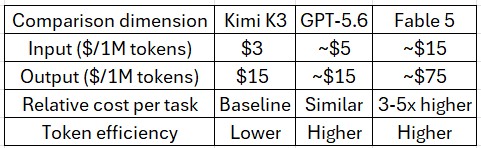
Moonshot AI’s Kimi K3 entered the market at $3 per million input tokens and $15 per million output tokens, pricing it directly against—and sometimes below—Claude Sonnet 5/5.6 Terra (around $2.5/$10), while staying far under the flagship premiums of Opus and Fable. This isn’t a one‑off; it’s the accumulated result of scale and engineering optimization inside China’s AI industry.
1.2 Shift: from “generalist” to “task‑specific”
User jekpopulous2 shared hands‑on experience: “Cursor Composer which is built on Kimi 2.5 trades blows with Opus 4.8 in some coding benchmarks for 90% less money.” That points to a deeper reorientation.
American models pursue the “generalist” ideal—one model handling everything from poetry to quantum physics. Chinese models, meanwhile, are proving that the “task‑specific” path is commercially more sustainable.
For most enterprise uses—code generation, automated support, data wrangling, document summarization—AI models are becoming commodities. When a Chinese model delivers “good enough” reasoning at half the price, the much‑vaunted absolute performance lead of US labs looks hollow next to commercial return on investment.
1.3 Cracks in the valuation story
Capital markets have valued Anthropic or OpenAI at tens of billions of dollars because they anchor on high profit margins, not on raw technical scores. If open‑source or low‑cost alternatives hollow out that margin foundation, the valuation edifice built on sand becomes precarious. This valuation wobble is already triggering a chain reaction:
Primary‑market stall: VCs now demand evidence of defensible pricing power, not just model scores.
Secondary‑market repricing: Investors are beginning to measure AI companies by “cost per task” rather than “IQ per parameter.”
Talent flow reversal: When Chinese AI firms can offer superior commercial returns, the direction of top research talent may flip.
2. The fog of efficiency—token price ≠ task cost
2.1 The hidden token‑burn trap
The more technically minded Reddit participants didn’t get swept up by the price war. Users rasp215 and -Crash_Override- raised an important counter‑perspective: “Tokens don’t mean anything if it uses more tokens per task.”
This pulls us back from simple arithmetic to engineering reality. Early testers reported that Kimi K3 shows higher redundancy in its chain‑of‑thought or context padding on complex logic. If a task that cost $1 on GPT‑5.6 ends up costing roughly the same on Kimi K3 because of swollen token consumption, then the touted “70% price advantage” is a marketing illusion.
2.2 The real efficiency yardstick
User Due_Entertainer7965 went further: “Cost per task is about the same as GPT 5.6 actually. 5.6 is often even cheaper.” When you reframe the comparison around “cost per task,” Kimi K3 and GPT‑5.6 are broadly comparable in real‑world use. That carries deep industry implications:
2.3 Deeper questions about cost structure
This raises a far more profound question: Does China’s AI competitiveness come from genuine architectural breakthroughs, or from brute‑force compute subsidies and market‑share dumping?
User -Crash_Override- voiced an unavoidable doubt: “Token cost isn’t an accurate barometer of the underlying model. For all we know, Moonshot could be hemorrhaging money to make this economical and competitive.”
In other words, Kimi K3’s low price may not be the fruit of technological leaps, but of:
State subsidies: government‑backed compute infrastructure lowering marginal costs;
Loss‑leading pricing: sacrificing short‑term profit for market share;
Architectural trade‑offs: cost‑friendly configurations that hurt inference quality.
User OracleofFl added a more strategic observation: “China’s big win is going to be using solar/wind to have a lower cost per kilowatt hour.” If China can sustain a lower per‑kWh cost through renewable energy, then even at identical algorithmic efficiency, Chinese models hold a long‑run cost advantage. That would be a true structural moat.
3. The myth of open‑source democratization and the “cloud arms race”
3.1 The hardware reality of local deployment
One of the most technically grounded exchanges revolved around the ideal of “open‑source for all.” Some optimists argued that if Kimi were open‑sourced, any enterprise could run it on its own servers, dodging geopolitical risks. User whoknowsifimjoking doused that fantasy with cold hardware numbers:
“To run Kimi K3 locally you would need 1000GB of VRAM, ideally more. Just for the GPUs you would spend almost half a million dollars, but there’s more. If you rent the server you would still spend around 100‑200k per year for everything plus electricity. That would mean you have to use 50 to 100 billion tokens per month just to break even compared to the API pricing.”
This reality check declares “local deployment of open‑source large models” a non‑starter for 99.9% of enterprises. The hardware barriers break down as:
GPU requirements
At least 8× H100 or A100 (80GB) cards
Or an AMD MI300X cluster of equivalent compute
High‑speed NVLink interconnection
Infrastructure costs
Hardware procurement: $400,000 – $600,000
Facility retrofitting: $50,000 – $100,000
Annual electricity: $30,000 – $60,000
Operations team: $200,000+/year
Breakeven threshold
Monthly token consumption ≥ 50‑100 billion
Equivalent to ~30 million medium‑length queries per day
Only top‑tier tech companies and financial institutions can hit that scale
3.2 The battlefield moves up: hyperscalers
This doesn’t spell failure for Chinese open‑source models; it signals that the fight is shifting upward to hyperscale cloud providers. As user casce noted, AWS, Microsoft Azure, or Google Cloud can readily host these open‑source models and resell them at low service fees to ordinary enterprises.
This trend is reshaping the cloud services landscape:
Compute arbitrage: cloud providers offer both US and Chinese models, letting customers choose by task and budget;
Geopolitical hedging: enterprises avoid direct transactions with Chinese firms, reducing compliance risk;
Price leverage: the aggregation power of cloud platforms weakens individual model vendors’ pricing power.
3.3 A strategic blow to the US AI industry
This creates an even more lethal “price ceiling” for US frontier AI labs: even if the US government bans domestic enterprises from buying Chinese AI services directly, arbitrage opportunities in the global cloud market let US companies access cheap Chinese AI compute through cloud intermediaries.
US labs are forced into a triple bind:
First: margin compression
Unable to sustain current high‑pricing strategies
Growing disconnect between R&D investment and commercial returns
Second: market stratification
Forced exit from mid‑ and low‑tier enterprise markets
Retreat to a few irreplaceable verticals—high‑end research, defense, etc.
Third: distorted innovation incentives
Shrinking economic returns on massive investments in “absolute leadership”
Business models pivoting from “pursuing the best” to “pursuing good enough”
3.4 The double‑edged sword of open source
An open‑source strategy is equally double‑edged for Chinese AI:
Upside
Speeds up technology diffusion and developer community growth
Lowers adoption barriers for global developers
Community contributions can improve model quality
Downside
Core technology leakage
Loss of control over usage scenarios
Hard to build a sustainable commercial monetization model
4. The forgotten “global south”—America is only 20% of the world economy
4.1 A sober geoeconomic insight
Amid the US‑China AI showdown, Reddit user ExerciseFickle8540 offered a strikingly sober observation:
“Why people are equating enterprise with American enterprise? US is only 20% of world economy. Chinese EVs are blocked in the US but that doesn’t prevent China from being the No1 in EV.”
The same logic applies in AI. If the US were to follow the semiconductor playbook and strictly restrict Chinese AI models from its domestic market, the direct consequence would not be strangulation of Chinese AI, but the sealing off of the US and a few allies from the world’s largest AI application markets.
4.2 The global market’s choice logic
Southeast Asia, the Middle East, Africa, Latin America, and even parts of Europe, when faced with American AI that is “10% better but 200% more expensive” versus Chinese AI that is “on par in performance but far cheaper,” will let market rationality drive them unhesitatingly toward the latter.
The decision logic of these markets includes:
Infrastructure fit: Chinese models are often better optimized for lower‑compute environments;
Localization support: stronger adaptation to low‑resource languages and local regulations;
Political neutrality: immune to US export controls and national security reviews;
Price sensitivity: for emerging economies, cost is the paramount consideration.
4.3 A bifurcated global AI landscape
At that point, the global AI industry splits into two parallel worlds:
The US bloc (walled garden)
High‑priced, closed ecosystem
Exclusively for North American elites
Emphasizing security and compliance
Serving high‑value‑added industries
The Chinese bloc (world factory)
Cost‑friendly, technology‑diffusing
Deeply embedded in manufacturing and services
Emphasizing practicality and accessibility
Serving large‑scale deployment scenarios
4.4 The flywheel effect of long‑term evolution
In the long run, the flywheel of data accumulation and scenario iteration inside the Chinese bloc may feed back into the models themselves, enabling a genuine reverse technological catch‑up:
User base expansion → More usage scenarios → More data feedback → Faster model iteration →
Performance improvement → Attracting more users → Further scale expansion
When Chinese AI models serve billions of users, millions of enterprises, and thousands of industries, their real‑world learning capability and adaptive speed may eventually surpass that of US models optimized solely in labs. This is not just quantitative accumulation; it is a qualitative leap—from a “data scale” advantage to a “scenario intelligence” advantage.
5. Conclusion—leadership not yet lost, but the foundations are shaking
5.1 A balanced judgment
Synthesizing the Reddit discussion and the Axios report, a balanced conclusion emerges: In sheer “intellectual peak,” the US (Opus 4.8 / Sol / O4.8) may still wear the crown; but in “economic leadership” and “industrial penetration,” China has erased the gap.
5.2 The nature of the eroded advantage
America’s AI lead is degenerating from a generational gap into a slim margin. That margin is enough to publish papers in labs, but on the commercial battlefield it is highly vulnerable to cost leverage. If US frontier labs cannot, within the next 12 to 18 months, cut inference costs by an order of magnitude through architectural innovations (e.g., test‑time training or novel MoE routing), they will watch their pricing power converge with that of Chinese models on a “cost‑per‑task” basis.
5.3 The deeper industrial shift
At a deeper level, the very nature of this race is shifting:
Old model (2018‑2025)
Bigger models are always better
Benchmark scores dictate everything
The winner takes all
Technical barriers are the moat
New model (2026‑ )
“Good enough” carries more commercial value than “best”
Cost per task becomes the core KPI
Market stratification, multipolar coexistence
Engineering optimization and scale effects are the true moats
5.4 Beyond technology: the commercial tide of globalization
Chinese AI did not become smarter overnight, but it has made the world realize that in the second half of the AI race, the winner is not necessarily the one who builds the smartest brain, but the nation that can run that smartest brain at the lowest cost.
When “good enough” becomes the market’s dominant yardstick, Silicon Valley’s much‑touted technological moats will be washed away by the commercial tide of globalization. This is not merely a technology contest; it is a multi‑dimensional battle of business models, energy strategies, industrial policy, and global market positioning. In that competition, a one‑dimensional “technology lead” is no longer enough to sustain industrial hegemony.
5.5 The final warning
This is the cold, sleepless reality behind the phrase “China just erased America’s AI lead”—the reality that keeps Wall Street awake at night. It implies:
For investors: Re‑evaluate AI company valuation models, shifting from “technology premium” to “cost competitiveness”;
For entrepreneurs: In the “good enough” era, find an irreplaceable value anchor;
For policymakers: Confront the complexity of global competition—simple blockades cannot stop the diffusion of technology;
For everyone: AI is no longer a luxury item for a small elite club; it is becoming infrastructure, like electricity, and the winner in infrastructure is always the one who makes it the cheapest and most accessible to all.
About the Creator
Jin
Writer of reamstories
https://reamstories.com/jin
Enjoyed the story? Support the Creator.
Subscribe for free to receive all their stories in your feed. You could also become a paid subscriber, letting them know you appreciate their work.
Comments
There are no comments for this story
Be the first to respond and start the conversation.