
Global Water Purifier Market Expands Rapidly as Health Awareness, Urbanization, and Water Contamination Concerns Intensify
Rising demand for safe drinking water, technological advances in purification systems, and increasing awareness of waterborne diseases are accelerating growth across the global water purifier industry.

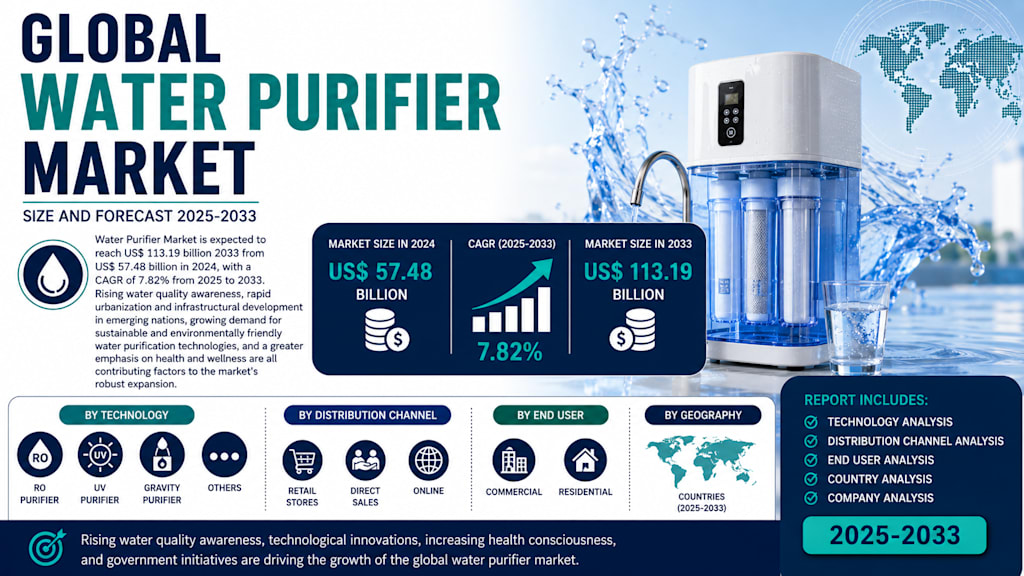
Global water purifier market enters a strong growth phase
The global water purifier market is experiencing significant expansion as consumers, businesses, and governments place greater emphasis on access to safe and clean drinking water. According to the latest industry analysis, the Water Purifier Market is projected to grow from US$ 57.48 billion in 2024 to US$ 113.19 billion by 2033, registering a CAGR of 7.82% between 2025 and 2033.
The industry’s growth is being fueled by multiple long-term trends, including rising health consciousness, increasing urbanization, growing concerns about water contamination, and rapid technological innovation in purification systems. Consumers are becoming more aware of the health risks associated with untreated water, while governments and environmental organizations continue promoting clean water access and sustainable consumption practices.
At the same time, manufacturers are investing heavily in advanced filtration technologies such as reverse osmosis (RO), ultraviolet (UV) purification, IoT-enabled smart systems, and environmentally friendly purification methods designed to meet evolving consumer expectations.
Why water purifiers have become essential household appliances
Water purifiers are no longer considered luxury products in many parts of the world. They have increasingly become essential appliances for households and commercial establishments seeking protection against contaminated water supplies.
Modern purification systems are designed to eliminate impurities such as sediment, bacteria, viruses, heavy metals, chemicals, and unpleasant odors from water. These systems improve water quality not only for drinking but also for cooking, cleaning, and bathing.
The market broadly includes two major categories:
Point-of-entry systems, which purify water at the source where it enters a building.
Point-of-use systems, which filter water directly at the location where it is consumed.
Together, these solutions help ensure comprehensive water treatment and safer daily consumption.
The increasing reliance on filtration systems reflects a broader consumer shift toward preventive healthcare and wellness-focused lifestyles.
Health consciousness continues to drive demand
One of the strongest forces supporting market growth is the growing awareness of health and wellness worldwide. Consumers are increasingly recognizing the connection between clean drinking water and long-term health outcomes.
Concerns about bacteria, viruses, industrial pollutants, heavy metals, and chemical contaminants in water supplies are encouraging households to invest in reliable purification systems. Many consumers now view water filtration as an essential health safeguard rather than an optional appliance.
The report highlights that awareness regarding the health benefits of filtered water is significantly influencing purchasing behavior. Consumers understand that removing harmful contaminants can support digestion, immunity, hydration, and overall well-being.
Environmental concerns are also playing an important role. Many consumers are reducing dependence on bottled water because of rising awareness about plastic waste and sustainability issues. This trend is increasing demand for in-home purification systems that provide safe water while minimizing environmental impact.
Urbanization and industrial growth are increasing water quality concerns
Rapid urbanization and industrialization, particularly across emerging economies, are intensifying demand for advanced water filtration systems. As cities grow and industrial activity expands, pressure on municipal water infrastructure continues to rise.
Urban populations frequently face concerns related to aging pipelines, industrial wastewater discharge, and inconsistent municipal water quality. Even in cities with developed infrastructure, consumers often remain skeptical about tap water safety due to concerns involving taste, odor, contamination, and chemical treatment residues.
Industrial expansion further complicates the issue by introducing pollutants and contaminants into natural water sources. These environmental pressures are encouraging households and businesses to adopt additional filtration systems beyond municipal treatment processes.
The result is a steadily increasing reliance on home and commercial water purification technologies across both developed and developing markets.
Concerns about water contamination remain a major market catalyst
Growing fears surrounding water contamination are one of the biggest contributors to market expansion. Public awareness regarding waterborne diseases, industrial pollution, and toxic contaminants has increased significantly over the past decade.
Consumers are becoming increasingly cautious about pollutants such as lead, arsenic, pesticides, bacteria, and viruses that may be present in untreated or poorly treated water supplies. As regulatory scrutiny around water quality intensifies globally, demand for advanced purification technologies is rising accordingly.
Manufacturers are responding with sophisticated filtration systems capable of removing a wide range of contaminants through technologies such as:
Reverse osmosis (RO)
Ultraviolet (UV) purification
Activated carbon filtration
Alkaline purification systems
Multi-stage purification processes
As contamination concerns continue to grow globally, water purifiers are becoming increasingly central to public health and household safety strategies.
Reverse osmosis systems continue leading the market
Among available technologies, reverse osmosis systems continue to dominate the global market due to their effectiveness in removing dissolved impurities, heavy metals, and harmful microorganisms.
RO systems are particularly popular in regions facing severe water contamination or hard water problems. Consumers value these systems because they provide highly purified drinking water suitable for long-term daily use.
At the same time, UV purification technologies are gaining traction because they effectively eliminate bacteria and viruses without relying on chemicals. Gravity purifiers also remain important in regions with inconsistent electricity access, especially in rural and semi-urban markets.
Manufacturers are increasingly integrating multiple purification technologies into single systems to improve efficiency and address diverse water quality conditions.
Online sales channels are reshaping market competition
The rise of e-commerce and direct-to-consumer retailing is changing how water purification products are sold globally. Consumers increasingly research and purchase purifiers online because of convenience, broader product selection, and competitive pricing.
Digital retail platforms are helping manufacturers reach underserved markets while improving customer awareness about purification technologies and maintenance requirements.
At the same time, retail stores and direct sales channels continue playing important roles, particularly in regions where consumers prefer in-person demonstrations and installation support before making purchasing decisions.
The combination of online and offline sales strategies is creating a highly competitive and rapidly evolving distribution environment.
High maintenance costs remain a significant challenge
Despite strong growth momentum, the market continues to face challenges related to maintenance and replacement costs. Water purification systems require regular servicing and periodic filter replacement to maintain purification quality.
Components such as RO membranes and UV lamps can be expensive, particularly for price-sensitive consumers in developing markets. Point-of-use systems often require filter replacements every six to twelve months, while commercial filtration systems may require even more frequent servicing.
These recurring expenses can discourage some consumers from investing in purification systems or maintaining them properly over time.
Manufacturers therefore face growing pressure to improve affordability, durability, and maintenance efficiency.
Rural awareness gaps continue to limit adoption
Limited awareness in rural and remote areas remains another major challenge for the industry. Many consumers in underserved regions remain unaware of the health benefits associated with filtered drinking water.
Factors such as low education levels, limited infrastructure, cultural preferences for traditional water sources, and affordability constraints continue to slow adoption in certain markets.
Expanding public education campaigns, improving rural distribution networks, and introducing low-cost purification systems will be essential for increasing penetration in these underserved regions.
Asia-Pacific remains the largest regional market
Asia-Pacific currently represents the largest share of the global water purifier market due to rapid urbanization, rising disposable incomes, and widespread concerns regarding water contamination.
Countries such as India and China are witnessing especially strong demand growth because of expanding middle-class populations, worsening water quality issues, and increasing awareness of waterborne illnesses.
The region’s large population base and infrastructure development activities make it one of the most important long-term growth opportunities for global manufacturers.
United States market driven by health awareness and regulation
The United States water purifier market continues to expand because of strong consumer awareness regarding water safety and strict government regulations governing water quality standards.
Demand is particularly high in urban areas where industrialization and aging infrastructure contribute to concerns regarding water contamination.
The report highlights several important corporate developments in the U.S. market:
In June 2022, A.O. Smith Corporation acquired Florida-based Atlantic Filter to strengthen its capabilities and expand its water treatment presence.
In December 2021, Culligan and Waterlogic Group Holdings formed a strategic partnership focused on environmentally friendly water filtration solutions.
These developments reflect the increasing competitiveness and growth potential within the U.S. water treatment industry.
India emerges as one of the fastest-growing markets
India’s water purifier market is expanding rapidly because of worsening water quality concerns, rising urbanization, and growing public awareness regarding waterborne diseases.
Increasing disposable incomes and a growing middle class are helping drive adoption across residential and commercial sectors. Government initiatives focused on clean drinking water access are also contributing to market growth.
The report additionally notes that Whirlpool Corporation relocated its Global Technologies & Engineering Center to Pune in January 2022 to support development of advanced technologies including IoT and Industry 4.0 applications.
Saudi Arabia market grows amid water scarcity concerns
Saudi Arabia’s market is expanding because of severe water scarcity, rising consumption rates, and growing demand for reliable water treatment systems.
Since natural freshwater availability is limited, advanced purification technologies such as RO and UV systems are increasingly important across residential and commercial applications.
Government sustainability initiatives and public awareness regarding waterborne diseases are also supporting demand growth.
Key companies continue investing in innovation
The market remains highly competitive with several major multinational companies actively investing in filtration technologies, smart appliances, and sustainable purification solutions. Key players highlighted in the report include:
- Panasonic Corporation
- Honeywell International Inc.
- AO Smith Corporation
- Unilever Plc
- Pentair
- Helen of Troy Limited
- Koninklijke Philips N.V.
- 3M Corporation
Ten recent developments shaping the water purifier industry
- A.O. Smith acquired Atlantic Filter to expand water treatment operations in Florida and beyond.
- Culligan and Waterlogic partnered to develop environmentally friendly filtration systems.
- Whirlpool expanded innovation capabilities through its Pune Global Technologies & Engineering Center.
- Increasing adoption of RO purification technologies worldwide.
- Rising demand for smart IoT-enabled water purification systems.
- Growing preference for sustainable alternatives to bottled water.
- Manufacturers are introducing multi-stage purification technologies.
- Commercial demand for advanced filtration systems continues rising globally.
- Governments are strengthening clean water awareness initiatives.
- Increasing urbanization continues driving residential purifier adoption in emerging economies.
Final thoughts
The global water purifier market is becoming increasingly important as health concerns, urbanization, environmental pollution, and water scarcity reshape consumer behavior worldwide. Access to clean drinking water is now viewed as both a public health necessity and a lifestyle priority.
With the market projected to grow from US$ 57.48 billion in 2024 to US$ 113.19 billion by 2033, the industry is expected to remain one of the fastest-growing segments within consumer health and environmental technology. Companies capable of delivering affordable, efficient, sustainable, and technologically advanced purification solutions are likely to define the next phase of market leadership.
About the Creator
Enjoyed the story? Support the Creator.
Subscribe for free to receive all their stories in your feed.
Comments
There are no comments for this story
Be the first to respond and start the conversation.