
Global Watch Market to Reach US$ 123.53 Billion by 2034 as Luxury Craftsmanship and Smartwatch Innovation Drive Industry Growth
Rising Demand for Premium Mechanical Watches, Health-Focused Smartwatches, and Connected Wearables Accelerates Global Market Expansion

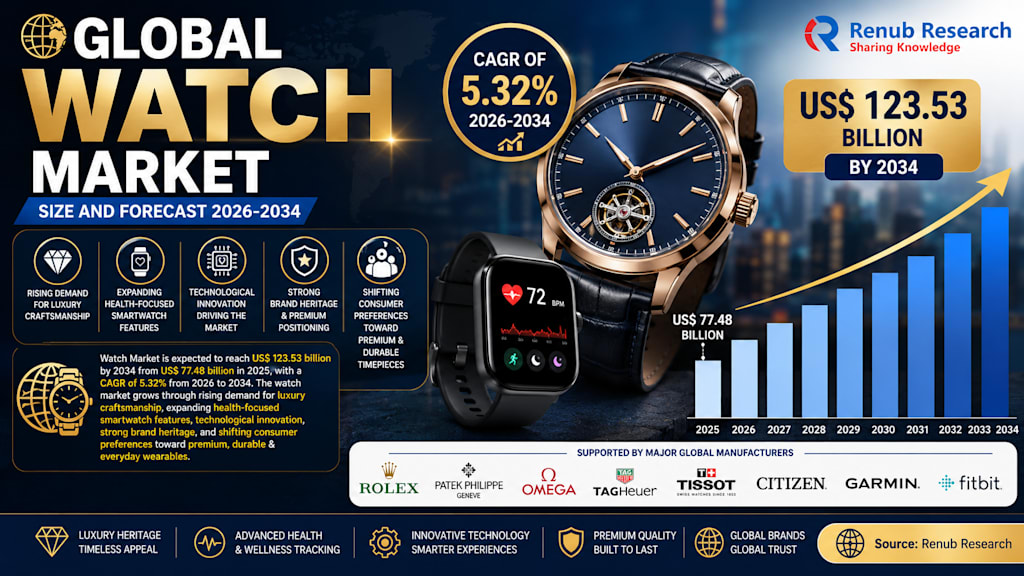
The global watch industry is experiencing significant transformation as traditional craftsmanship merges with advanced digital technology to reshape consumer preferences worldwide. According to Renub Research, the Watch Market is projected to grow from US$ 77.48 billion in 2025 to US$ 123.53 billion by 2034, expanding at a CAGR of 5.32% from 2026 to 2034.
The market is being fueled by rising demand for luxury mechanical timepieces, rapid advancements in smartwatch technology, expanding wellness-focused wearable features, and growing consumer interest in premium lifestyle accessories. From traditional Swiss craftsmanship to AI-powered smartwatches, the watch industry is evolving into a diverse ecosystem that blends fashion, technology, fitness, and personal expression.
Watches Continue to Blend Fashion, Technology, and Personal Identity
Watches have evolved far beyond basic timekeeping devices. Modern watches serve as fashion statements, status symbols, fitness companions, and connected digital devices. The industry spans traditional mechanical watches, quartz models, electronic timepieces, and highly advanced smartwatches.
Mechanical watches remain highly valued for their craftsmanship, intricate engineering, and collectible appeal. Enthusiasts often view luxury timepieces as wearable art and long-term investment assets.
Quartz watches continue to dominate the affordable everyday category because of their reliability, accuracy, and accessibility.
Meanwhile, smartwatches have transformed the wearable landscape by integrating health tracking, smartphone connectivity, notifications, GPS navigation, and fitness monitoring into compact wrist-worn devices.
This combination of functionality, style, and innovation continues to expand the global consumer base across all watch segments.
Luxury Mechanical Watches Continue to Attract Collectors
One of the strongest growth drivers in the global watch market is the enduring appeal of luxury mechanical timepieces.
Consumers increasingly value heritage, artisanal craftsmanship, exclusivity, and engineering precision. Luxury watchmakers continue introducing advanced movements and limited-edition collections that attract collectors and high-net-worth buyers worldwide.
In March 2025, A. Lange & Söhne, under Compagnie Financière Richemont, introduced the Calibre L021.150 automatic movement featuring an impressive 150-hour power reserve.
This innovation reflects the growing emphasis on high-performance mechanical engineering and reinforces consumer demand for technically sophisticated timepieces.
Luxury watches also benefit from strong resale markets and collectible value, making them attractive both as personal accessories and investment assets.
As brands continue pushing the boundaries of horology, demand for premium craftsmanship and limited-edition mechanical watches is expected to remain strong.
Smartwatch Innovation Is Reshaping the Industry
The smartwatch segment continues to drive substantial growth across the global watch market.
Consumers increasingly view smartwatches as essential lifestyle and wellness devices that combine communication, fitness tracking, and health monitoring into a single wearable platform.
Major technology companies are rapidly improving smartwatch capabilities through advanced sensors, AI-powered insights, faster processors, and deeper integration with digital ecosystems.
In September 2024, Apple introduced the Apple Watch Series 10 and the updated Apple Watch SE with advanced features including sleep apnea alerts, fast charging, water depth measurement, temperature sensing, and enhanced wellness analytics powered by watchOS 11.
These innovations are strengthening the role of smartwatches as health-focused wearable companions rather than simple notification devices.
Growing interest in wellness, preventive healthcare, and fitness tracking is significantly expanding smartwatch adoption among younger and health-conscious consumers.
Health and Wellness Features Are Becoming Key Purchase Drivers
Health monitoring has emerged as one of the most influential factors driving smartwatch demand globally.
Modern smartwatches now offer features such as heart-rate monitoring, ECG analysis, blood oxygen tracking, sleep analysis, stress management tools, and activity coaching.
Consumers increasingly use wearable devices to monitor long-term health conditions, track fitness goals, and improve overall wellness routines.
AI-powered health analytics are further improving the user experience by delivering personalized insights and recommendations.
As healthcare and wearable technology continue converging, smartwatches are expected to become even more deeply integrated into preventive healthcare ecosystems over the coming decade.
Market Realignment Is Creating Specialized Opportunities
Strategic restructuring among watch manufacturers is reshaping the competitive landscape and creating clearer segmentation across luxury, fashion, and technology categories.
In January 2025, Fossil Group announced its decision to exit the smartwatch segment and refocus on traditional watches, jewelry, and leather goods.
This move highlights how companies are increasingly concentrating on their core strengths rather than competing across all categories.
Luxury watchmakers are focusing on premium craftsmanship and exclusivity, while technology companies continue investing heavily in connected wearable ecosystems.
This specialization allows brands to improve product quality, strengthen identity, and better target specific consumer groups.
E-Commerce and Digital Retail Channels Are Expanding Market Reach
Digital retail transformation continues playing a major role in watch industry growth.
Consumers increasingly purchase watches online through official brand websites, e-commerce marketplaces, and luxury resale platforms. Online retail provides broader product access, competitive pricing, customization options, and convenience.
Social media marketing, influencer partnerships, and digital storytelling are also shaping purchasing decisions, especially among younger demographics.
Luxury brands are expanding omnichannel strategies that combine online experiences with premium in-store service and personalized consultations.
The rise of certified pre-owned luxury watch platforms is also contributing to market expansion by attracting first-time buyers and collectors seeking investment-grade timepieces.
Challenges Continue to Impact the Watch Industry
Despite strong growth prospects, the global watch market still faces several important challenges.
Competition Between Smartwatches and Traditional Watches
One of the biggest industry challenges is balancing consumer demand between traditional watches and increasingly advanced smartwatches.
Smartwatches offer multifunctionality, regular software updates, and seamless digital integration that appeal strongly to younger consumers.
Traditional brands, especially in the mid-range category, often struggle to compete against rapidly evolving wearable technology.
Luxury watchmakers must continuously maintain cultural relevance while preserving traditional craftsmanship and exclusivity.
Economic Uncertainty and Price Sensitivity
Economic fluctuations and inflation continue affecting discretionary consumer spending globally.
Luxury watches depend heavily on high-income consumer confidence, tourism, and premium purchasing behavior. Rising production costs for materials, packaging, and logistics are also pressuring profit margins.
Meanwhile, price-sensitive consumers may shift toward affordable digital alternatives during periods of economic uncertainty.
United States Watch Market
The United States remains one of the largest and most diversified watch markets globally, spanning luxury mechanical watches, fashion brands, and advanced smartwatches.
Apple and Garmin continue dominating the smartwatch category through strong health-monitoring ecosystems, while luxury demand remains supported by collectors, affluent consumers, and a thriving resale market.
Strong retail infrastructure and growing e-commerce adoption further strengthen the U.S. market.
Germany Watch Market
Germany’s watch market benefits from strong appreciation for precision engineering, durability, and high-quality craftsmanship. Consumers prefer reliable mechanical and quartz watches while also gradually adopting health-focused smartwatches.
The country’s stable economy, high purchasing power, and engineering-oriented culture continue supporting steady demand for both traditional and modern watch categories.
China Watch Market
China is one of the fastest-growing watch markets globally due to rising disposable incomes, urbanization, and growing interest in both luxury mechanical watches and wearable technology.
Luxury Swiss brands benefit from expanding collector culture, while younger consumers drive rapid smartwatch adoption through fitness trends and digital lifestyle integration.
E-commerce and social-commerce platforms play a major role in shaping purchasing behavior across the country.
Saudi Arabia Watch Market
Saudi Arabia’s watch market is expanding due to rising disposable incomes, strong luxury brand affinity, and growing interest in fashion and wellness wearables.
Luxury Swiss watches remain highly popular for gifting and status purposes, while younger consumers increasingly adopt smartwatches for health tracking and digital convenience.
Vision 2030 modernization initiatives are also supporting long-term retail and lifestyle market expansion.
Recent Developments from Major Companies
Fossil Group Inc. exited the smartwatch segment in January 2025 to refocus on traditional watches, jewelry, and leather goods.
Titan Company Limited expanded premium and fashion-focused watch collections targeting younger consumers across Asia-Pacific markets.
LVMH Group continued strengthening its luxury watch portfolio through innovation in high-end mechanical movements and exclusive limited editions.
Apple Inc. launched the Apple Watch Series 10 and updated Apple Watch SE featuring advanced health-monitoring capabilities and enhanced watchOS 11 integration.
Compagnie Financière Richemont introduced the A. Lange & Söhne Calibre L021.150 movement with a 150-hour power reserve in March 2025.
The Swatch Group Ltd. introduced a new eco-focused Swatch collection made from “Bioreloaded” sustainable materials in May 2025.
Citizen Watch Co. Ltd. continued investing in energy-efficient Eco-Drive technologies and durable sports watch collections.
Seiko Group Corporation expanded its premium mechanical watch lineup featuring enhanced craftsmanship and heritage-inspired designs.
Samsung launched the Galaxy Watch 8 in July 2025 with improved Galaxy AI integration and enhanced durability features.
Casio India introduced a new lineup of locally manufactured watches in August 2025 to strengthen its presence in the Indian market.
Product Segmentation Highlights
The watch market includes quartz watches, electronic watches, and mechanical timepieces.
Product categories are divided across men’s, women’s, and unisex segments, while pricing ranges from luxury watches to affordable non-luxury models.
Distribution channels continue expanding through hypermarkets, convenience stores, specialty retailers, official brand boutiques, and online platforms.
Luxury mechanical watches and premium smartwatches remain among the fastest-growing categories globally.
Final Thoughts
The global watch industry is evolving into a highly dynamic market where traditional craftsmanship and digital innovation coexist side by side. Luxury mechanical watches continue attracting collectors and enthusiasts through precision engineering, exclusivity, and heritage value, while smartwatches redefine wearable technology through advanced health and connectivity features.
Consumer demand is increasingly shaped by wellness tracking, personalization, premium lifestyle branding, and digital integration. As brands continue innovating across both traditional and connected watch categories, the industry is expected to experience sustained long-term growth.
With expanding e-commerce channels, rising global disposable incomes, and continuous technological advancements, the global watch market is well-positioned for strong expansion throughout the next decade.
About the Creator
Enjoyed the story? Support the Creator.
Subscribe for free to receive all their stories in your feed.
Comments
There are no comments for this story
Be the first to respond and start the conversation.