
Global Surgical Robots Market Expected to Reach US$15.89 Billion by 2034 as Demand for Minimally Invasive Surgery Accelerates
Rising adoption of robotic-assisted procedures, advancements in AI-powered surgical systems, and growing healthcare investments are transforming the future of modern surgery

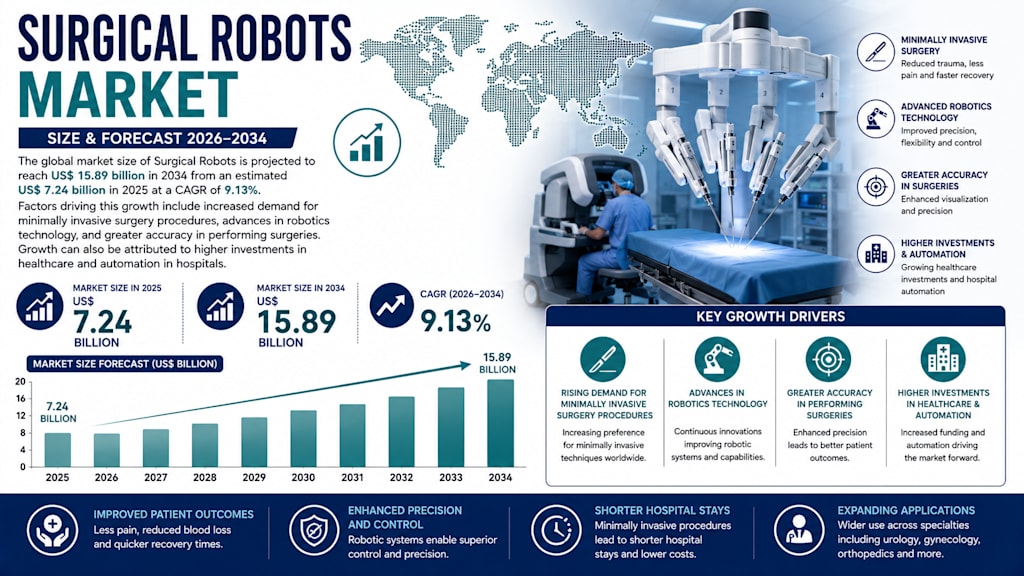
The global surgical robots market is entering a transformative phase as healthcare providers increasingly adopt robotic-assisted technologies to improve surgical precision, reduce patient recovery times, and enhance overall clinical outcomes. Once limited to specialized medical institutions, robotic surgery systems are now becoming a major component of modern healthcare infrastructure across developed and emerging economies alike.
According to Renub Research, the global surgical robots market is projected to grow from US$7.24 billion in 2025 to approximately US$15.89 billion by 2034, expanding at a compound annual growth rate (CAGR) of 9.13% between 2026 and 2034.
The market’s growth is being fueled by increasing demand for minimally invasive surgeries, continuous advancements in robotic technologies, rising healthcare investments, and growing hospital automation worldwide.
As surgical precision and patient safety become increasingly important priorities in healthcare systems, robotic-assisted surgery is rapidly reshaping the future of medical treatment globally.
Surgical Robots Are Revolutionizing Modern Operating Rooms
Surgical robotic systems are highly advanced medical technologies designed to assist surgeons in performing complex procedures with greater precision, flexibility, and control than conventional surgical methods.
These systems generally consist of:
Robotic arms, 3D high-definition imaging systems, specialized instruments, and surgeon-controlled computer consoles.
Unlike autonomous robots, surgical robots do not make independent decisions. Instead, they translate surgeons’ hand movements into highly precise micro-movements during procedures.
The use of robotic systems allows surgeons to perform minimally invasive operations through smaller incisions, leading to:
Reduced blood loss, lower pain levels, shorter hospital stays, minimized scarring, and faster patient recovery times.
Robotic-assisted surgeries are now widely used in specialties such as:
Urology, gynecology, cardiology, orthopedics, neurosurgery, and laparoscopy.
As technology continues evolving, robotic surgery systems are becoming increasingly efficient, accurate, and accessible across healthcare institutions worldwide.
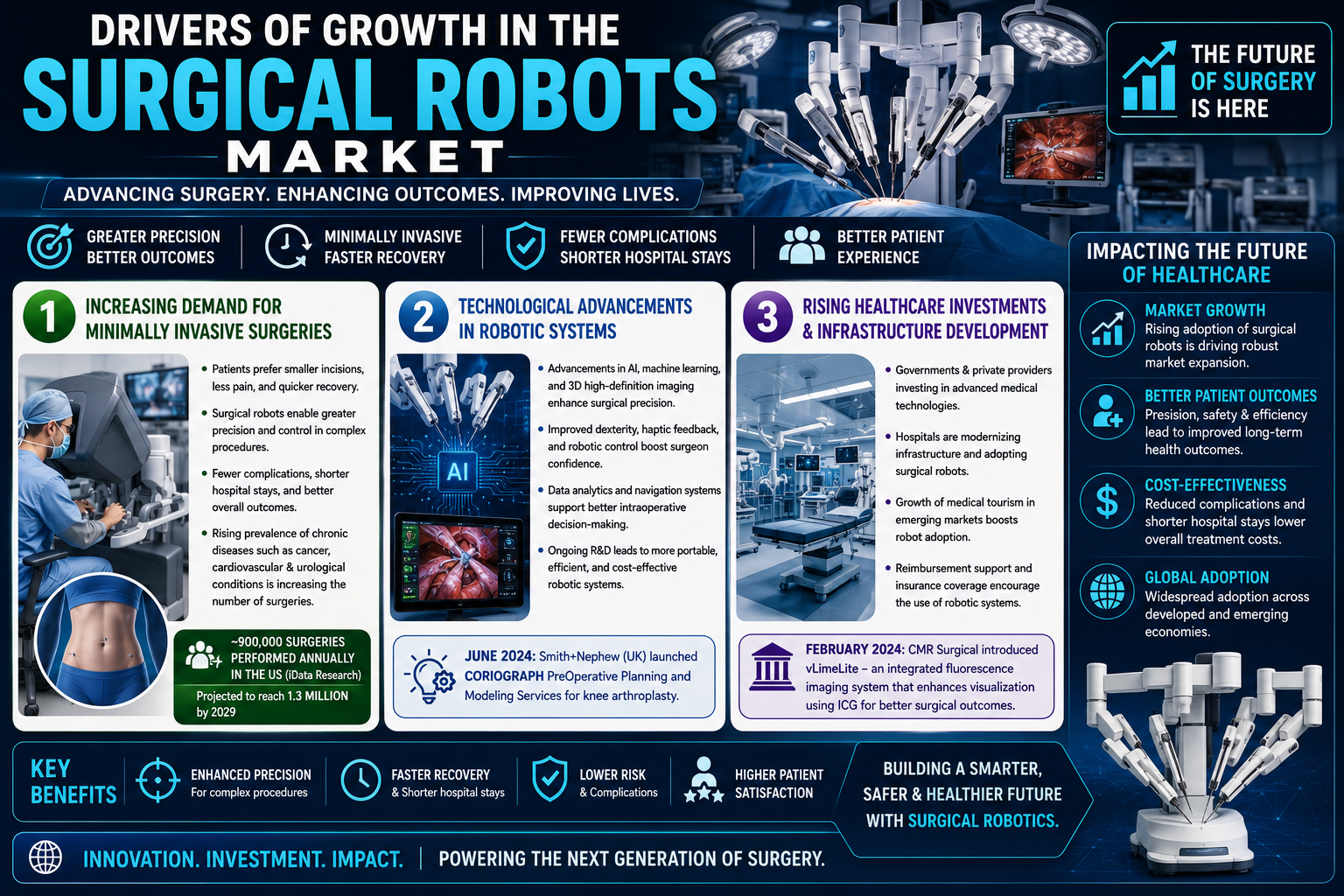
Rising Demand for Minimally Invasive Surgeries Is Driving Market Growth
One of the strongest growth drivers behind the surgical robots market is the rapidly increasing demand for minimally invasive surgical procedures.
Patients increasingly prefer surgeries involving:
Smaller incisions, reduced pain, lower complication risks, and faster recovery periods.
Robotic-assisted surgical systems enable healthcare providers to achieve greater precision and control during delicate operations, making minimally invasive procedures more effective and reliable.
The growing prevalence of chronic diseases requiring surgery is also accelerating market demand.
Conditions such as:
Cancer, cardiovascular diseases, urological disorders, obesity-related conditions, and gynecological illnesses are contributing to the increasing volume of surgical procedures globally.
According to iData Research, approximately 900,000 robotic-assisted surgeries are currently performed annually in the United States, with the number expected to reach approximately 1.3 million procedures by 2029.
This growing surgical volume is directly supporting rising demand for robotic surgical systems and related technologies.
Technological Advancements Are Enhancing Robotic Surgery Capabilities
Rapid technological innovation remains one of the most important factors shaping the future of the surgical robotics industry.
Modern robotic systems increasingly incorporate:
Artificial intelligence, machine learning, advanced imaging technologies, data analytics, and enhanced navigation systems.
These innovations provide surgeons with:
Improved 3D visualization, greater dexterity, enhanced precision, and better decision-making support during operations.
Advanced imaging technologies now allow surgeons to perform highly complex procedures with greater confidence and accuracy.
Improvements in haptic feedback systems and robotic controls are also reducing training requirements and improving surgeon adoption rates.
Continuous research and development activities are helping manufacturers create robotic systems that are:
More compact, efficient, user-friendly, and cost-effective.
In June 2024, Smith & Nephew introduced the CORIOGRAPH PreOperative Planning and Modeling Services for knee arthroplasty procedures.
These innovations continue expanding the role of robotics across multiple surgical specialties.
Rising Healthcare Investments Are Accelerating Adoption
Growing investments in healthcare infrastructure and medical technology modernization are significantly boosting adoption of surgical robots worldwide.
Governments and private healthcare organizations are increasingly allocating funding toward:
Hospital modernization, digital healthcare systems, advanced surgical infrastructure, and robotic technologies.
Emerging economies are also witnessing increased investments in healthcare infrastructure as medical tourism and patient demand for advanced procedures continue growing.
Some healthcare systems now offer reimbursement support for robotic-assisted surgeries, further encouraging adoption among hospitals and patients.
In February 2024, CMR Surgical introduced its innovative fluorescence imaging system called vLimeLite, designed to improve surgical visualization using Indocyanine Green imaging technology.
As hospitals increasingly prioritize precision-based treatment solutions, investments in robotic surgical systems are expected to rise steadily.
High Equipment Costs Remain a Major Challenge
Despite strong market growth, the high cost of robotic surgical systems continues presenting one of the industry’s biggest obstacles.
Purchasing and implementing surgical robotic systems requires substantial financial investment involving:
Equipment acquisition, installation, maintenance, software upgrades, and staff training.
Additional operational costs include:
Disposable surgical instruments, longer setup times, and specialized support services.
These high costs can make robotic systems difficult to afford for smaller hospitals and healthcare facilities operating under limited budgets.
As a result, adoption remains concentrated primarily among large hospitals and premium healthcare institutions.
Although manufacturers continue working to reduce system costs, affordability remains a major issue across many developing markets.
Shortage of Skilled Professionals Limits Expansion
Another major challenge affecting the surgical robots market is the shortage of trained professionals capable of operating robotic surgical systems effectively.
Robotic-assisted surgeries require specialized training in:
Robotic controls, advanced visualization systems, surgical navigation, and procedure-specific techniques.
Hospitals without adequate training infrastructure may struggle to fully integrate robotic systems into clinical practice.
Continuous technological updates also require surgeons and operating teams to undergo ongoing training and certification programs.
Addressing this workforce challenge will require stronger collaboration between:
Healthcare institutions, technology companies, universities, and governments.
Training accessibility will play a major role in determining the long-term scalability of robotic surgery adoption globally.
Surgical Robot Systems Continue Dominating Market Demand
The surgical robot systems segment represents the core of the global market.
These integrated systems combine:
Robotic arms, surgeon consoles, imaging technologies, and computerized control platforms.
Such systems are increasingly used across hospitals and specialized surgical centers because they improve surgical precision and support minimally invasive treatment approaches.
Manufacturers continue investing heavily in:
Artificial intelligence integration, digital imaging improvements, and robotic mobility enhancements.
The increasing demand for highly accurate surgical procedures is expected to continue driving expansion within this segment.
Surgical Robot Accessories Are Becoming Increasingly Important
The accessories segment plays a critical role in supporting robotic-assisted surgeries.
This category includes:
Robotic instruments, sensors, imaging systems, disposable tools, and replacement components.
Accessories require frequent replacement and upgrades, creating recurring revenue opportunities for manufacturers.
Healthcare providers increasingly prioritize accessories that offer:
Reliability, precision, sterility, and cost efficiency.
As robotic surgery adoption expands globally, the demand for high-performance accessories is expected to grow steadily.
Gynecological Surgical Robots Are Seeing Rapid Adoption
The gynecological surgical robots segment is experiencing strong growth due to rising use of robotic-assisted procedures for women’s health conditions.
Robotic systems are increasingly used in surgeries such as:
Hysterectomy, myomectomy, and endometriosis treatment.
The precision and enhanced visualization capabilities provided by robotics help surgeons perform delicate procedures with lower complication risks and improved patient outcomes.
Growing awareness around minimally invasive treatment options is also encouraging adoption among both healthcare providers and patients.
Cardiovascular Surgical Robots Are Improving Surgical Precision
Cardiovascular robotic surgery is becoming increasingly important because heart-related procedures require extremely high levels of precision.
Robotic-assisted systems are now used for:
Coronary artery bypass grafting, heart valve repair, and other complex cardiovascular interventions.
These systems reduce surgical trauma while improving accuracy and minimizing recovery times.
The increasing prevalence of cardiovascular diseases globally continues driving demand for advanced robotic-assisted cardiac procedures.
Laparoscopy Surgical Robots Continue Expanding
Laparoscopy robotic systems are witnessing rising demand because of their ability to support minimally invasive surgeries across multiple medical specialties.
Robotic-assisted laparoscopy is widely used in:
General surgery, gastroenterology, urology, and obesity-related procedures.
Compared to traditional open surgeries, robotic laparoscopy offers:
Reduced pain, minimal scarring, shorter hospital stays, and lower complication rates.
The increasing prevalence of hernias, gallbladder diseases, and obesity-related conditions continues supporting long-term demand in this segment.
United States, France, India, and Brazil Lead Market Expansion
United States
The United States remains the largest global market for surgical robots because of advanced healthcare infrastructure and strong adoption of robotic-assisted procedures. In April 2024, Stryker expanded its healthcare infrastructure capabilities through the acquisition of mfPHD.
France
France continues witnessing strong robotic surgery adoption due to healthcare digitalization and increasing use of minimally invasive procedures. French company Quantum Surgical secured a €30 million loan from the European Investment Bank to support commercialization of cancer treatment technologies.
India
India’s market is growing rapidly because of rising healthcare investments and increasing medical tourism. In December 2024, the CDSCO approved telesurgery and teleproctoring capabilities for the SSI Mantra Surgical Robotic System developed by SS Innovations.
Brazil
Brazil’s surgical robotics market continues expanding through increased healthcare investments and technological approvals. In December 2024, MicroPort MedBot received ANVISA approval for its Toumai Laparoscopic Surgical Robot.
Major Companies Intensify Competition
Competition within the global surgical robots market remains highly intense as manufacturers focus on innovation, AI integration, and minimally invasive technologies.
Leading companies include:
Intuitive Surgical, Stryker, Johnson & Johnson, Renishaw, Accuray, Titan Medical, Medtronic, Smith & Nephew, and Zimmer Biomet.
Companies continue competing through AI-powered innovations, advanced imaging systems, improved robotics software, and enhanced surgical precision technologies.
Final Thoughts
The global surgical robots market is rapidly transforming the future of healthcare through increased surgical precision, minimally invasive procedures, and advanced robotic-assisted technologies.
With the market projected to reach approximately US$15.89 billion by 2034, roboticurgery is expected to become an increasingly important part of modern operating rooms worldwide.
However, long-term industry success will depend on addressing challenges related to affordability, workforce training, and equitable access to advanced medical technologies.
As artificial intelligence, imaging systems, and robotics technologies continue evolving, surgical robots are likely to play an even larger role in improving patient outcomes and reshaping the future of global healthcare.
About the Creator
Enjoyed the story? Support the Creator.
Subscribe for free to receive all their stories in your feed.
Comments
There are no comments for this story
Be the first to respond and start the conversation.