
Global Smart Speaker Market Expected to Reach US$47.81 Billion by 2034 as AI Voice Assistants Become Everyday Essentials
Rising adoption of smart home ecosystems, advancements in artificial intelligence, and growing demand for voice-enabled digital services are transforming the future of smart speakers worldwide

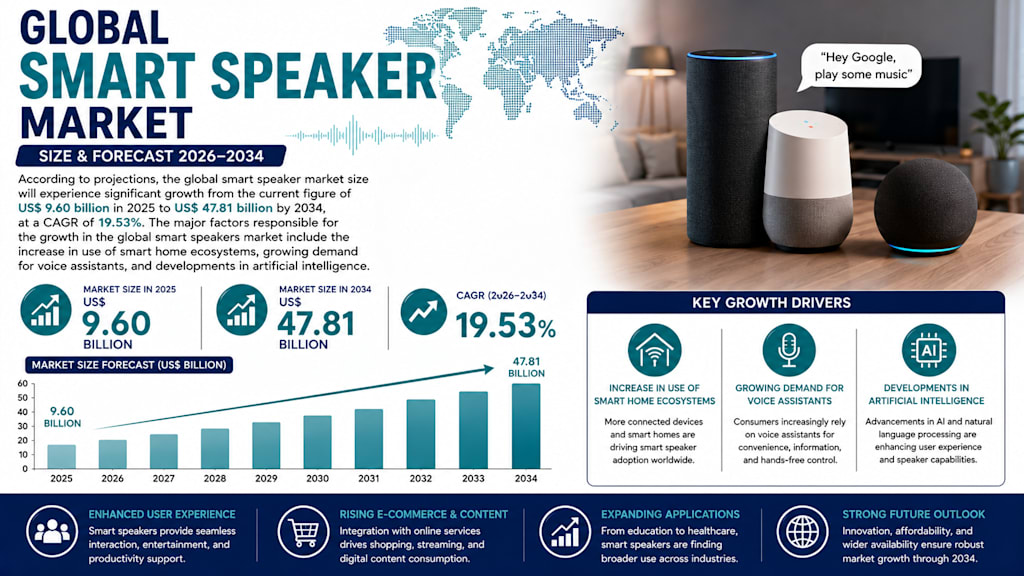
The global smart speaker market is entering a period of explosive growth as consumers increasingly embrace voice-controlled technology and connected smart home ecosystems. Once considered novelty gadgets, smart speakers have evolved into central control hubs for entertainment, home automation, productivity, and digital services.
According to Renub Research, the global smart speaker market is projected to grow from US$9.60 billion in 2025 to approximately US$47.81 billion by 2034, expanding at an impressive compound annual growth rate (CAGR) of 19.53% between 2026 and 2034.
The market’s remarkable expansion is being fueled by rising adoption of smart homes, increasing demand for AI-powered voice assistants, and continuous advancements in artificial intelligence and natural language processing technologies.
As consumers increasingly seek convenience, automation, and hands-free digital experiences, smart speakers are rapidly becoming essential components of modern connected lifestyles.
Smart Speakers Are Becoming Central to Connected Living
Smart speakers are voice-controlled devices equipped with virtual assistants capable of understanding and responding to spoken commands using artificial intelligence and cloud computing technologies.
Popular smart speaker ecosystems include:
Amazon Alexa, Google Assistant, and Apple Siri.
These devices can perform a wide range of functions such as:
Playing music, setting reminders, answering questions, providing weather updates, controlling smart home devices, managing schedules, and enabling online shopping.
Smart speakers are increasingly being integrated into daily life because they simplify interactions with technology while providing seamless access to digital services.
Countries such as the United States, China, and the United Kingdom remain among the largest adopters of smart speaker technology due to widespread smart home penetration and strong consumer interest in connected living solutions.
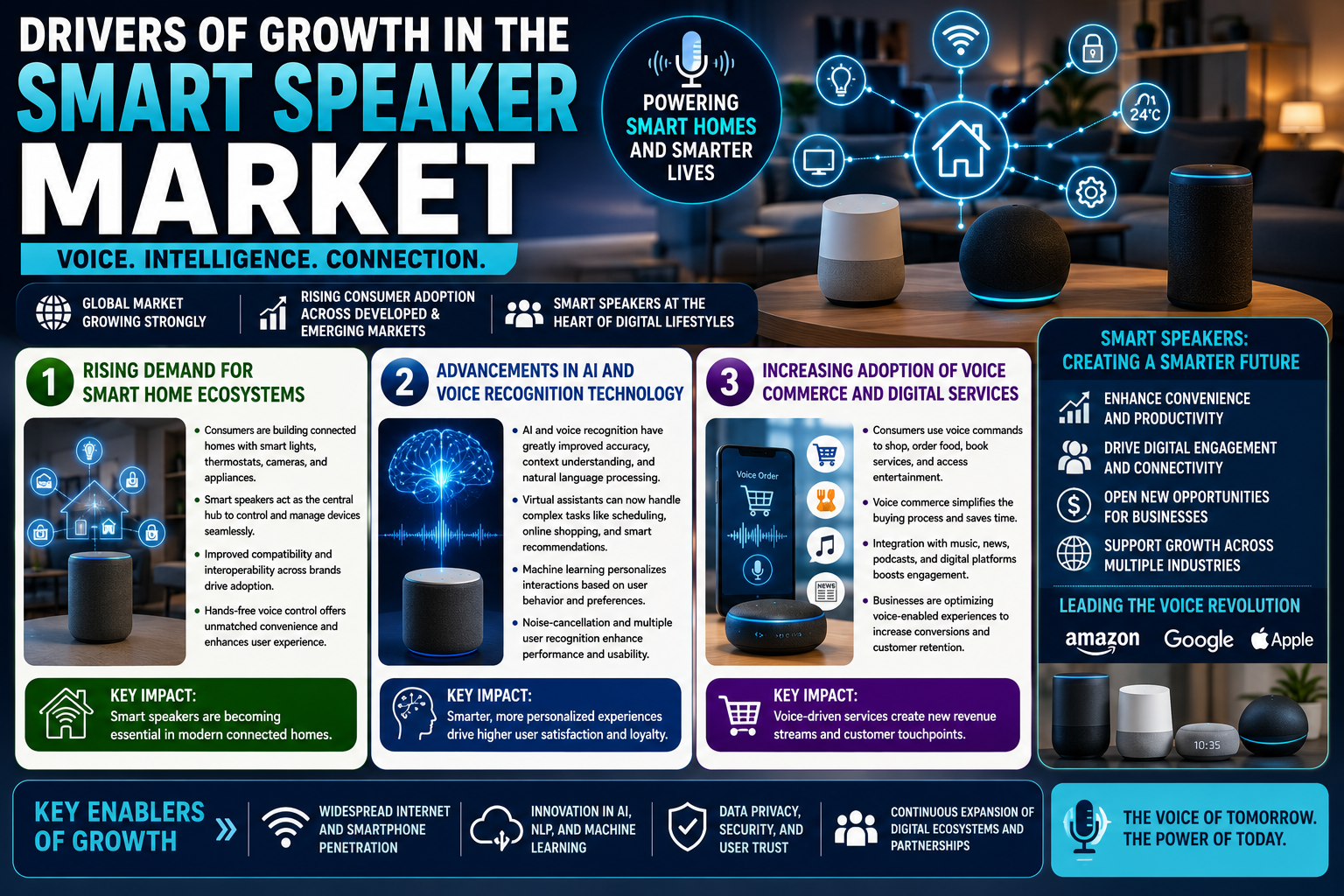
Smart Home Ecosystems Are Driving Massive Demand
One of the biggest growth drivers behind the global smart speaker market is the rapid expansion of smart home ecosystems.
Consumers increasingly use connected devices such as:
Smart lights, thermostats, surveillance cameras, entertainment systems, appliances, and home security solutions.
Smart speakers act as centralized hubs that allow users to manage these devices through voice commands.
The convenience of hands-free control remains one of the most attractive features for consumers.
Technology companies are also working aggressively to improve interoperability between devices from different manufacturers, making smart home integration easier and more accessible.
As the Internet of Things (IoT) ecosystem continues expanding, smart speakers are expected to play an even larger role in coordinating connected household environments.
Artificial Intelligence Is Transforming Voice Interaction
Artificial intelligence and voice recognition technologies are revolutionizing the capabilities of smart speakers.
Modern AI-powered virtual assistants are becoming increasingly sophisticated in their ability to:
Understand natural language, recognize accents, interpret contextual commands, and deliver personalized responses.
Machine learning systems enable smart speakers to adapt based on user behavior, improving the accuracy and relevance of interactions over time.
Advanced AI capabilities now support functions such as:
Scheduling, personalized recommendations, online shopping assistance, contextual search, automation routines, and productivity management.
Noise-cancellation technologies and multi-user voice recognition systems are also improving performance in noisy or multi-person environments.
As AI technology continues advancing rapidly, smart speakers are becoming more conversational, intuitive, and human-like in their interactions.
Voice Commerce and Digital Services Are Expanding Rapidly
The rise of voice commerce is creating entirely new growth opportunities within the smart speaker market.
Consumers increasingly use voice commands to:
Order products online, stream entertainment, manage subscriptions, place food delivery orders, and access digital services.
Voice-enabled shopping is becoming particularly popular because it offers a fast and convenient alternative to traditional browsing methods.
Smart speakers are also deeply integrated with:
Music streaming services, podcasts, news platforms, online learning systems, and smart entertainment ecosystems.
Companies operating in e-commerce and digital services are increasingly optimizing platforms for voice-enabled interactions to improve customer convenience and engagement.
As voice recognition becomes more accurate and personalized, voice commerce is expected to become a major pillar of future digital retail experiences.
Hardware Innovation Is Improving User Experience
Continuous hardware innovation is significantly improving smart speaker functionality and consumer appeal.
Manufacturers are investing heavily in:
Advanced microphone arrays, high-quality audio systems, improved processors, stronger bass capabilities, and portable battery-powered designs.
Modern smart speakers can now recognize voice commands more accurately even in noisy environments.
Companies are also focusing on compact and aesthetically attractive designs that blend seamlessly into modern home interiors.
Portable smart speakers with longer battery life are becoming increasingly popular because they allow users to access voice assistants in multiple environments beyond the home.
The growing emphasis on sound quality is also encouraging premium audio-focused smart speaker development.
Software and AI Platforms Are Becoming Increasingly Sophisticated
Software remains one of the most critical components of the smart speaker ecosystem.
Smart speaker software relies heavily on:
Natural language processing (NLP), machine learning algorithms, cloud computing, and speech recognition technologies.
These technologies enable devices to interpret commands, understand context, and deliver intelligent responses.
Software updates also allow manufacturers to continuously introduce:
New features, third-party app integrations, enhanced security measures, multilingual support, and predictive interaction capabilities.
Multilingual AI support is becoming especially important as smart speaker companies seek to expand into global markets with diverse language requirements.
The increasing sophistication of AI models is making smart speakers significantly more adaptive and personalized.
Privacy and Data Security Concerns Remain Major Challenges
Despite strong market growth, privacy and data security concerns continue posing major challenges for the smart speaker industry.
Because smart speakers constantly listen for activation commands, many consumers remain concerned about:
Unauthorized recordings, data collection practices, surveillance risks, and cloud storage policies.
Regulatory scrutiny surrounding data privacy is also increasing globally.
Manufacturers are therefore investing heavily in:
Encryption systems, transparent data policies, user-controlled privacy settings, and localized data processing technologies.
Apple, for example, strongly emphasizes on-device processing and privacy-focused architecture within its Siri-powered ecosystem.
Building consumer trust around privacy and data protection remains essential for long-term market growth.
Language Compatibility Challenges Limit Global Expansion
Another major challenge involves limited compatibility with regional languages and dialects.
While smart speakers perform exceptionally well in widely spoken languages such as English, performance can decline significantly when dealing with:
Regional dialects, local accents, and lesser-known languages.
This issue creates barriers for expansion into emerging markets with high linguistic diversity.
To overcome these limitations, companies must invest heavily in:
Localized AI training models, multilingual voice recognition systems, and region-specific software customization.
The availability of localized applications and culturally relevant content also plays a major role in user adoption across different markets.
Amazon Alexa Continues Leading the Global Market
Amazon Alexa remains one of the most dominant ecosystems within the global smart speaker market.
Alexa-powered devices such as:
Echo Dot, Echo Show, and Echo Studio have gained widespread popularity because of their broad compatibility with smart home products and third-party applications.
Amazon continues investing heavily in AI enhancements that improve:
Natural language understanding, contextual awareness, and conversational capabilities.
Integration with Amazon’s ecommerce ecosystem also gives Alexa a significant advantage in voice commerce functionality.
The extensive cloud infrastructure provided by Amazon Web Services (AWS) further strengthens the platform’s scalability and reliability.
Apple Siri and Google Assistant Continue Expanding
Siri Smart Speakers
Apple’s HomePod and HomePod Mini focus heavily on premium audio quality, privacy protection, and seamless integration with Apple’s broader ecosystem.
The devices synchronize closely with:
iPhones, iPads, MacBooks, and Apple HomeKit systems.
Apple continues positioning Siri-powered devices as premium lifestyle products emphasizing privacy and high-end sound experiences.
Google Assistant Ecosystem
Google Assistant remains highly competitive because of Google’s strength in search, AI, and cloud technologies.
The platform excels in contextual information retrieval, multilingual capabilities, and integration with Android ecosystems.
Google continues expanding AI-driven conversational abilities and predictive functionality within its smart speaker ecosystem.
Wi-Fi Smart Speakers Are Dominating Connectivity Preferences
Wi-Fi smart speakers are becoming increasingly popular because they provide:
Stable streaming performance, multi-room audio support, and seamless cloud integration.
Leading brands such as Sonos, Bose, and Google Nest rely heavily on Wi-Fi connectivity to deliver uninterrupted music streaming and smart home automation functionality.
Wi-Fi connectivity also supports:
Real-time voice recognition, cloud processing, software updates, and synchronization across multiple devices.
As smart home adoption continues expanding globally, demand for Wi-Fi-enabled smart speakers is expected to remain exceptionally strong.
Offline Smart Speakers Are Emerging as a Privacy-Focused Alternative
Offline smart speaker technology is gaining attention among consumers concerned about privacy and internet dependency.
These devices use:
Local storage, edge computing, and offline AI processing to execute commands without continuously sending data to cloud servers.
Offline systems are especially appealing for users seeking greater data privacy and functionality in areas with unstable internet access.
However, offline smart speakers still face limitations related to:
Real-time information access, streaming capabilities, and third-party integrations.
As edge AI technology advances, offline smart speaker functionality is expected to improve significantly.
Personal Smart Speakers Are Becoming Lifestyle Devices
Personal smart speakers are increasingly being designed for portability and individual productivity.
Students, professionals, and travelers use these devices for:
Scheduling, reminders, communication, entertainment, and personal assistance.
Miniaturization and wearable integration are making personal voice assistants more practical for mobile lifestyles.
Cloud computing and adaptive learning systems are enabling highly personalized user experiences tailored to individual habits and preferences.
USA, India, France, and Saudi Arabia Are Key Growth Markets
United States
The United States remains the largest smart speaker market because of strong smart home adoption and the presence of major technology companies such as Amazon, Apple, and Google.
India
India’s market is growing rapidly due to increasing smartphone penetration and localization of regional language support. Apple’s HomePod Mini expansion into India in 2024 reflects rising consumer demand.
France
France is seeing increased adoption because of AI-driven home automation and localized French-language voice assistants.
Saudi Arabia
Saudi Arabia’s market is expanding rapidly due to smart city initiatives and growing interest in AI-enabled luxury living environments. In 2024, Yango Group introduced Yasmina Mini and Yasmina Midi smart speakers featuring Khaleeji Arabic AI assistance.
Major Companies Intensify Competition
Competition within the global smart speaker market remains extremely intense.
Leading companies include:
Amazon, Apple, Alibaba Group, Baidu, Bose, Lenovo, LG Electronics, Panasonic, and Sonos.
Companies continue competing aggressively through AI innovation, audio quality improvements, ecosystem integration, and smart home compatibility.
Final Thoughts
The global smart speaker market is evolving rapidly as artificial intelligence, voice recognition, and smart home technologies become increasingly integrated into everyday life.
With the market projected to reach approximately US$47.81 billion by 2034, smart speakers are expected to remain one of the fastest-growing segments within the broader consumer electronics industry.
However, future success will depend heavily on how effectively companies address privacy concerns, language compatibility limitations, and evolving consumer expectations around personalization and interoperability.
As voice-enabled technology becomes more advanced and deeply embedded within digital ecosystems, smart speakers are likely to become even more central to how people interact with technology in homes, workplaces, and daily life.
About the Creator
Enjoyed the story? Support the Creator.
Subscribe for free to receive all their stories in your feed.
Comments
There are no comments for this story
Be the first to respond and start the conversation.