
Global Small Gas Engine Market Set to Reach US$ 6.14 Billion by 2033 as Construction, Landscaping, and Agricultural Mechanization Accelerate
Demand for Outdoor Power Equipment, Infrastructure Expansion, and Rural Mechanization Continues to Drive Growth Across Global Markets

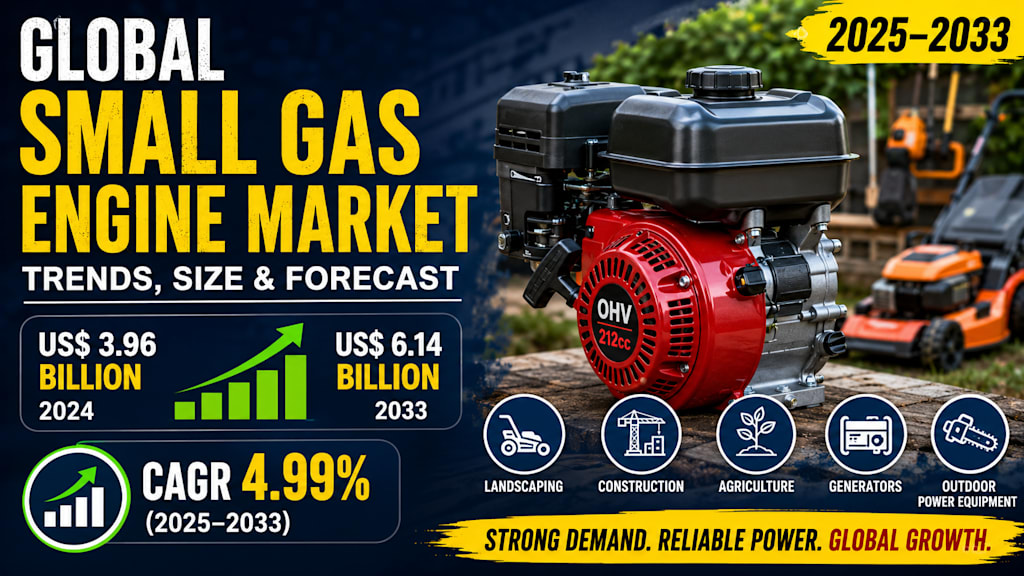
Global Small Gas Engine Market Trends, Size & Forecast 2025–2033
The global small gas engine market continues to play a vital role in powering outdoor equipment, agricultural tools, construction machinery, and emergency backup systems worldwide. Despite the growing popularity of battery-powered alternatives, gasoline engines remain indispensable in applications where reliability, runtime, mobility, and power output are critical.
According to Renub Research, the Global Small Gas Engine Market is projected to increase from US$ 3.96 billion in 2024 to US$ 6.14 billion by 2033, expanding at a CAGR of 4.99% during 2025–2033. Growing demand for outdoor power equipment, rapid infrastructure development, and agricultural modernization across developing nations are expected to sustain market growth throughout the forecast period.
Small Gas Engines Remain Essential Across Industries
Small gas engines are compact internal combustion engines generally ranging from 20cc to 1000cc displacement. These engines are widely used in lawnmowers, chainsaws, leaf blowers, pressure washers, portable generators, trimmers, pumps, and various small construction machines.
Their popularity stems from several practical advantages. They provide a high power-to-weight ratio, require minimal charging infrastructure, offer extended operating periods, and can function effectively in remote locations. These features make them highly attractive for residential, commercial, industrial, and agricultural applications.
While battery-powered technologies continue to advance, many users still prefer gasoline-powered equipment for demanding jobs requiring uninterrupted operation and higher power output.
Rising Demand for Outdoor Power Equipment Fuels Market Expansion
One of the most important growth drivers for the small gas engine industry is the increasing demand for outdoor power equipment.
Urbanization, rising disposable incomes, and growing attention to landscape aesthetics have encouraged homeowners and commercial property managers to invest in lawn care and garden maintenance equipment. Products such as lawnmowers, hedge trimmers, chainsaws, and leaf blowers continue to experience healthy demand, particularly across North America and Europe.
Commercial landscaping companies also rely heavily on gasoline-powered equipment due to their ability to operate for long hours without downtime associated with battery charging.
Manufacturers continue introducing more efficient products to meet evolving customer expectations. In 2023, DongCheng Tools expanded its garden equipment portfolio with advanced outdoor maintenance products designed to improve convenience and performance, reflecting broader industry efforts toward innovation.
Construction Boom Creates New Opportunities
The global construction industry remains another major contributor to small gas engine demand.
Infrastructure projects, residential developments, road construction, and industrial expansion require portable and reliable equipment capable of operating in locations where electrical infrastructure may be unavailable.
Small gas engines power equipment such as:
Concrete cutters
Plate compactors
Portable generators
Water pumps
Power trowels
Vibratory compactors
Developing economies across Asia-Pacific, Latin America, and the Middle East continue investing heavily in transportation networks, industrial parks, housing projects, and public infrastructure.
As construction activity accelerates globally, demand for rugged, portable, and fuel-efficient gas-powered equipment is expected to remain strong.
Recent innovations, including cleaner and more efficient construction machinery introduced by CASE Construction Equipment, highlight the industry's ongoing focus on balancing performance with environmental compliance.
Agricultural Mechanization Supports Long-Term Growth
Agriculture remains one of the largest application areas for small gas engines, especially in emerging economies.
Farmers increasingly depend on gas-powered equipment such as:
Irrigation pumps
Tillers
Sprayers
Harvesting tools
Portable generators
In countries such as India, Indonesia, Vietnam, and several African nations, small-scale farms are embracing mechanization to improve productivity and reduce labor dependency.
Gasoline-powered engines offer a cost-effective solution for rural regions where electricity access remains inconsistent. Their affordability and ease of maintenance make them particularly attractive for small and medium-sized agricultural operations.
As governments continue promoting agricultural modernization and food security initiatives, demand for small gas-powered farming equipment is expected to rise steadily throughout the forecast period.
Emission Regulations Present Significant Challenges
Although market fundamentals remain positive, the industry faces mounting regulatory pressure.
Governments worldwide are implementing stricter environmental regulations aimed at reducing air pollution and greenhouse gas emissions. Small gas engines contribute to emissions and noise pollution, prompting regulators to establish tighter standards.
Programs such as:
EPA Phase III regulations in the United States
EU Stage V emission standards in Europe
require manufacturers to develop cleaner and more efficient engine technologies.
While compliance improves environmental performance, it also increases manufacturing costs and development expenses. Smaller manufacturers may face challenges adapting to evolving regulatory frameworks, potentially affecting market competitiveness.
Electrification Continues to Reshape Industry Dynamics
The growing adoption of battery-powered equipment represents one of the most significant long-term challenges facing the small gas engine market.
Advancements in lithium-ion battery technology have improved runtime, charging speed, and operational efficiency. Consumers increasingly favor electric alternatives due to:
Reduced maintenance requirements
Lower operating costs
Quieter operation
Zero direct emissions
Municipalities and governments are also promoting cleaner technologies through incentives and restrictions on gas-powered equipment.
However, electric solutions still face limitations in heavy-duty and long-duration applications. Commercial landscapers, construction professionals, and agricultural users often require continuous operation that gasoline engines currently deliver more effectively.
As a result, small gas engines are expected to maintain substantial market share, particularly in professional and industrial applications.
20–100cc Segment Leads Consumer Equipment Applications
Among engine displacement categories, the 20–100cc segment continues to dominate lightweight outdoor equipment.
These compact engines are commonly found in:
String trimmers
Hedge cutters
Leaf blowers
Small cultivators
Consumers value these engines for their portability, affordability, and ease of use.
Manufacturers are focusing on reducing fuel consumption while enhancing durability and meeting increasingly strict emission standards. Strong demand from homeowners and landscaping professionals is expected to support growth within this segment through 2033.
Gardening Applications Maintain Market Leadership
Gardening remains the largest application category for small gas engines.
Suburban expansion, growing interest in outdoor living spaces, and increased spending on property maintenance continue supporting equipment sales worldwide.
Gas-powered lawnmowers, trimmers, and blowers remain popular because they offer:
Greater power output
Longer operating duration
Flexibility in large outdoor spaces
Although battery-powered alternatives are gaining market share, gasoline-powered gardening equipment continues to dominate professional landscaping operations where productivity and runtime remain critical.
Construction Applications Deliver Strong Growth Potential
Construction represents one of the fastest-growing end-use sectors.
Portable power solutions are essential for projects located in remote areas or regions with limited electrical infrastructure.
Gas-powered construction equipment provides:
Reliable performance
High mobility
Robust durability
Continuous operation
Manufacturers are increasingly integrating fuel-efficient technologies and emission-control systems into construction equipment to meet evolving environmental expectations while maintaining productivity standards.
Lawnmower Market Remains a Key Revenue Contributor
Lawnmowers continue to account for a significant portion of global small gas engine demand.
Residential users, commercial landscaping firms, golf courses, sports facilities, and public parks depend on gasoline-powered lawnmowers for large-area maintenance.
Technological advancements have improved:
Fuel efficiency
Operator comfort
Noise reduction
Cutting performance
These improvements help maintain demand despite growing competition from battery-powered alternatives.
Trimmer Market Continues Expanding
Gas-powered trimmers remain highly valued for edging, clearing vegetation, and maintaining difficult-to-reach areas.
Professional landscapers often prefer gasoline-powered models because they provide uninterrupted operation and greater cutting power than many battery-powered alternatives.
The segment is expected to remain particularly strong in rural, agricultural, and commercial landscaping applications where performance requirements are higher.
Regional Market Insights
United States
The United States remains one of the largest markets globally due to strong demand from residential landscaping, construction, and recreational equipment sectors.
A large homeowner base, extensive lawn care culture, and a thriving landscaping industry continue supporting equipment sales. However, increasingly stringent environmental regulations are encouraging manufacturers to develop cleaner technologies and expand electric product portfolios.
Germany
Germany's market is characterized by advanced engineering standards and strict environmental regulations.
While demand remains stable in landscaping and agricultural maintenance applications, the country is gradually transitioning toward electrified equipment. Nevertheless, professional users still rely heavily on gasoline-powered tools for demanding operations.
India
India represents one of the most promising growth markets.
Rapid infrastructure development, expanding agricultural mechanization, and increasing rural equipment adoption are driving demand for small gas engines. Portable generators, water pumps, tillers, and construction equipment remain key application areas.
Growing industrialization and government investment in infrastructure are expected to sustain long-term market growth.
Brazil
Brazil's extensive agricultural sector creates significant opportunities for small gas engine manufacturers.
Farm maintenance, irrigation systems, landscaping activities, and construction projects all contribute to demand. Manufacturers are increasingly focusing on developing cleaner and more efficient solutions to address environmental concerns while maintaining affordability.
Saudi Arabia
Saudi Arabia's Vision 2030 development strategy continues driving investment in infrastructure, construction, and landscaping projects.
Gas-powered equipment remains particularly important in remote and desert environments where reliable portable power solutions are required. The country's ongoing economic diversification efforts are expected to create additional growth opportunities over the coming decade.
Competitive Landscape
The global small gas engine market remains highly competitive, with manufacturers focusing on product innovation, fuel efficiency, emissions reduction, and durability improvements.
Major industry participants include:
Briggs & Stratton Corporation
Kohler Co.
Honda Motor Co. Ltd.
Yamaha Motor Corporation
Kawasaki Heavy Industries
Kubota Corporation
Liquid Combustion Technology
Kipor Power
Champion Power Equipment
These companies continue investing in advanced combustion technologies, cleaner engine platforms, and product diversification strategies to maintain market leadership.
10 Recent Industry Developments
1. Briggs & Stratton Corporation
Expanded development of next-generation fuel-efficient small engines focused on reducing emissions while maintaining power performance.
2. Kohler Co.
Introduced upgraded commercial-grade engine solutions targeting landscaping and construction equipment applications.
3. Honda Motor Co. Ltd.
Continued investment in cleaner engine technologies designed to meet evolving global environmental standards.
4. Yamaha Motor Corporation
Enhanced its outdoor power equipment engine portfolio with improved fuel economy and durability features.
5. Kawasaki Heavy Industries
Expanded commercial landscaping engine offerings with a focus on professional-grade performance.
6. Kubota Corporation
Strengthened agricultural equipment engine integration initiatives to improve productivity and fuel efficiency.
7. Champion Power Equipment
Launched advanced portable generator systems featuring improved engine efficiency and reliability.
8. CASE Construction Equipment
Introduced Stage V-compliant compactors and upgraded construction equipment supporting cleaner operations.
9. AGCO Corporation
Showcased new agricultural machinery and precision farming solutions incorporating advanced engine technologies.
10. Cummins Inc.
Announced the upcoming X10 engine platform designed to meet future emission standards ahead of regulatory deadlines.
Final Thoughts
The global small gas engine market is entering a period of measured but resilient growth. While electrification and stringent environmental regulations create challenges, the fundamental demand for reliable, portable, and powerful equipment remains strong across landscaping, construction, agriculture, and emergency power applications.
With the market forecast to grow from US$ 3.96 billion in 2024 to US$ 6.14 billion by 2033, manufacturers that successfully balance performance, efficiency, and sustainability will be best positioned to capture emerging opportunities. As infrastructure development accelerates and agricultural mechanization expands worldwide, small gas engines will continue serving as a critical power source for millions of users across diverse industries.
About the Creator
Enjoyed the story? Support the Creator.
Subscribe for free to receive all their stories in your feed.
Comments
There are no comments for this story
Be the first to respond and start the conversation.