
Global Printer Market Set to Reach US$80 Billion by 2034 Despite the Rise of Paperless Workplaces
Advancements in printing technology, growing business documentation needs, and expanding home-office culture are driving steady growth in the global printer industry.

For years, experts predicted that printers would gradually disappear from offices, schools, and homes as the world shifted toward digital documentation. The rise of cloud storage, electronic signatures, online collaboration platforms, and paperless workflows seemed to signal the beginning of the end for traditional printing.
Yet the reality has proven far more complex.
While digital transformation has certainly changed the way people work, printers remain an essential part of modern life. Businesses still require contracts, invoices, reports, compliance documents, and marketing materials. Educational institutions continue to rely on printed resources. Healthcare organizations need physical records and documentation. Even households increasingly use printers for remote work, online learning, personal projects, and home-based businesses.
As a result, the printer industry continues to evolve rather than disappear.
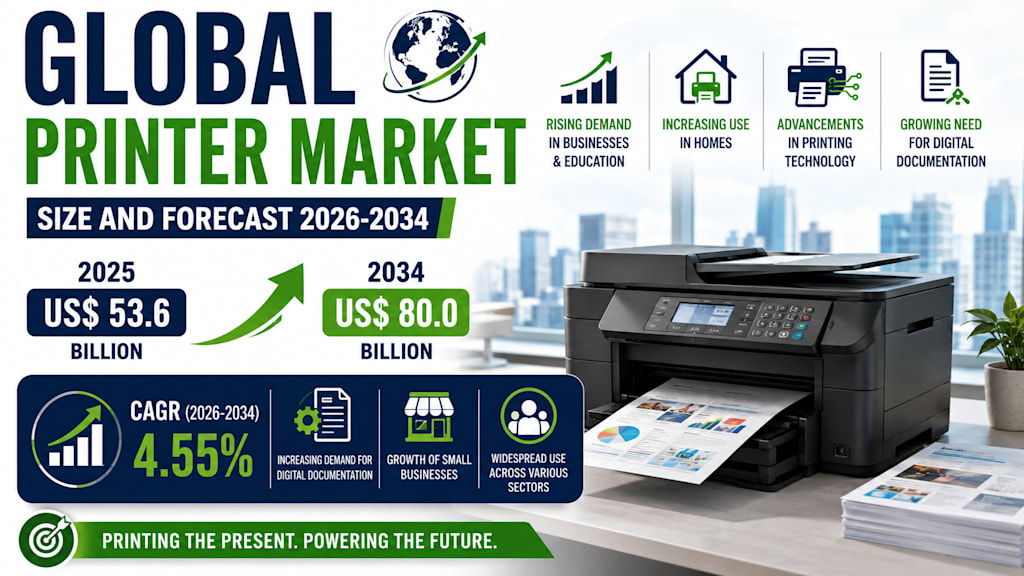
According to Renub Research, the Global Printer Market is expected to grow from US$53.6 billion in 2025 to approximately US$80 billion by 2034, expanding at a compound annual growth rate (CAGR) of 4.55% between 2026 and 2034.
The forecast demonstrates that printers continue to play a vital role in the modern economy, even as digital technologies reshape the way information is created, shared, and stored.
Why Printers Remain Relevant in a Digital World
At first glance, it may seem surprising that the printer market continues to grow in an increasingly digital environment.
After all, businesses today can store documents electronically, conduct virtual meetings, and share files instantly through cloud-based platforms. However, many industries still depend heavily on physical documentation.
Legal firms require signed agreements and court filings. Financial institutions rely on printed records and compliance documents. Healthcare providers maintain patient forms, prescriptions, and reports. Government agencies continue to process large volumes of paperwork.
Beyond institutional use, individuals also rely on printers for everyday tasks. Students print assignments and study materials. Professionals working remotely produce contracts, presentations, and reports. Families print photographs, event materials, and personal records.
Printers have evolved from simple office devices into versatile tools that support productivity across multiple environments.
Rather than being replaced by digital transformation, printers have adapted alongside it.
Business Documentation Continues to Drive Demand
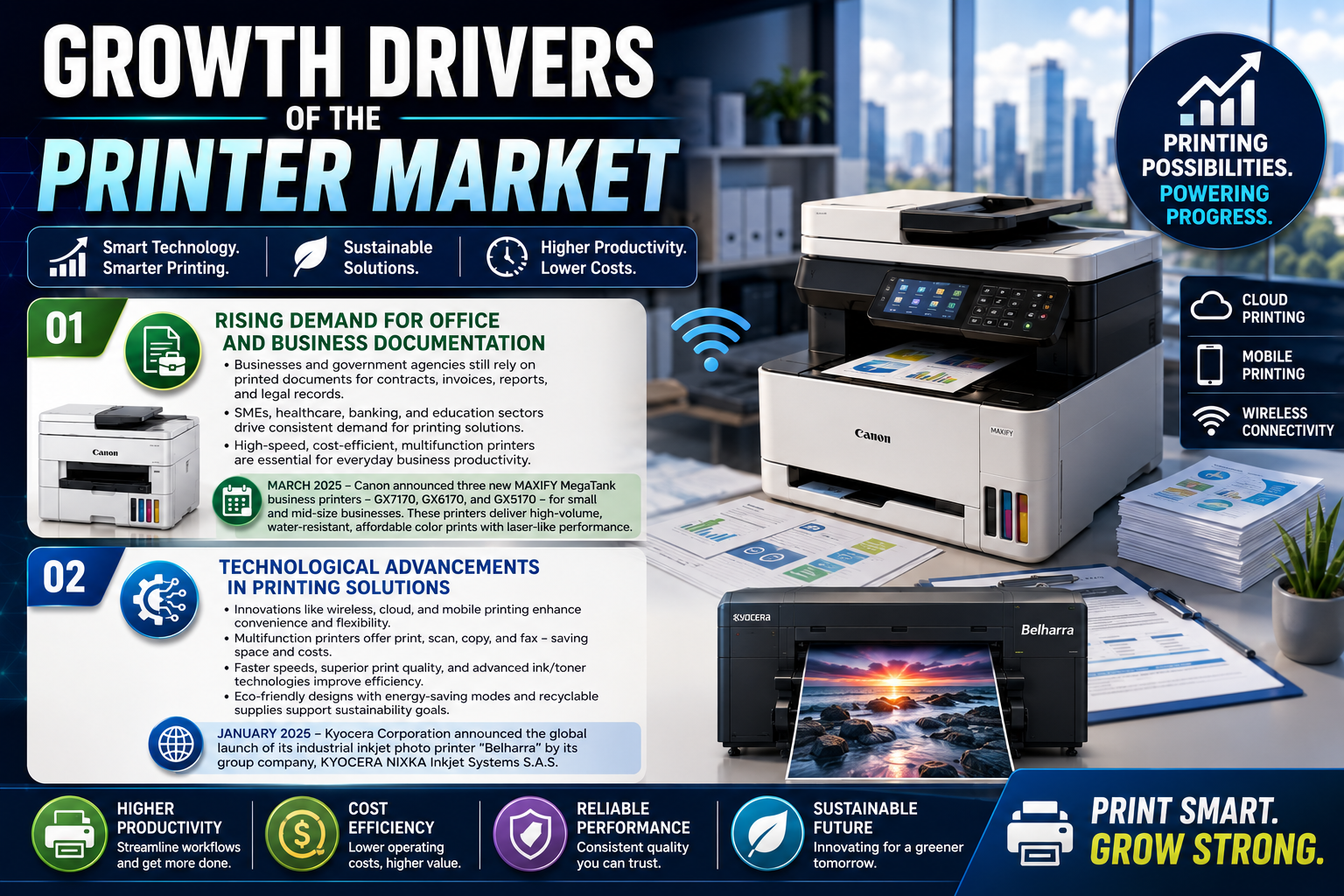
One of the most important factors supporting market growth is the ongoing need for business documentation.
Organizations across industries continue to generate large volumes of information that often require physical copies. Contracts, invoices, purchase orders, compliance reports, presentations, and customer documentation remain essential components of business operations.
Small and medium-sized enterprises (SMEs) are particularly significant contributors to printer demand.
As entrepreneurship grows worldwide, more businesses require affordable and efficient printing solutions to support daily operations. Whether printing marketing materials, administrative documents, or customer communications, printers remain an indispensable tool for many organizations.
The demand for multifunction devices is also increasing.
Businesses increasingly prefer equipment that combines printing, scanning, copying, and document management capabilities within a single machine. These systems help improve efficiency while reducing hardware costs and office space requirements.
As global business activity continues to expand, the demand for reliable and productive printing solutions is expected to remain strong.
Technology Is Transforming the Printer Industry
Today's printers are dramatically different from the devices that occupied offices and homes just a decade ago.
Manufacturers are investing heavily in technological innovation to improve convenience, performance, and sustainability.
Wireless connectivity has become a standard feature in many modern printers. Users can now print directly from smartphones, tablets, laptops, and cloud storage platforms without requiring physical cables or complex setup procedures.
Cloud printing has further simplified workflows by allowing documents to be printed remotely from virtually any location.
For businesses operating hybrid work environments, these capabilities have become increasingly valuable.
Mobile printing is another feature reshaping user expectations. Employees and students can send documents to printers from their devices within seconds, improving flexibility and productivity.
Meanwhile, manufacturers continue improving print quality, print speed, and operational efficiency. Advances in ink technologies, toner systems, and print-head engineering have enabled faster output while maintaining high levels of accuracy and image quality.
These innovations are helping printers remain relevant in an era where convenience and connectivity are critical purchasing factors.
Home Offices Are Creating New Opportunities
The growth of remote work and hybrid employment models has created a new wave of demand for home-office equipment.
Before the widespread adoption of flexible work arrangements, many professionals relied entirely on workplace printers. Today, millions of employees perform at least part of their work from home.
This shift has significantly increased demand for compact, affordable, and multifunction printers suitable for residential environments.
Remote workers often need to print contracts, reports, invoices, client presentations, and administrative documents. Similarly, students participating in online education frequently require printed study materials and assignments.
Home-based entrepreneurs represent another important market segment.
Small business owners increasingly seek printing solutions that combine professional-quality output with affordability and ease of use. Multifunction printers capable of printing, scanning, and copying have become especially popular among this group.
As remote and hybrid work arrangements continue to evolve, home-office printing is expected to remain an important source of market growth.
Inkjet Printers Continue to Dominate Consumer Markets
Among various printer categories, inkjet printers remain one of the most widely used options worldwide.
Inkjet technology offers several advantages that appeal to both households and small businesses. These printers are generally affordable, versatile, and capable of producing high-quality color output.
Consumers often choose inkjet printers for printing photographs, graphics, educational materials, and everyday documents.
The increasing popularity of creative professions and freelance work has further expanded demand for inkjet solutions. Designers, photographers, artists, and content creators frequently rely on advanced inkjet systems to produce detailed and vibrant prints.
Recent innovations have improved print quality while reducing operating costs through more efficient ink usage and refillable ink tank systems.
As manufacturers continue refining inkjet technologies, these printers are expected to remain a cornerstone of the consumer printing market.
Industrial Applications Keep Legacy Technologies Alive
While many consumers associate printers with home and office environments, industrial printing remains a significant market segment.
Dot matrix printers provide a strong example.
Although often viewed as outdated technology, dot matrix systems continue to serve critical functions in industries such as logistics, banking, manufacturing, retail, and government administration.
Their durability and ability to produce multipart forms make them particularly valuable for specialized applications.
Businesses that require invoices, receipts, shipping documents, and carbon-copy forms often continue to rely on dot matrix technology because of its reliability and low operating costs.
This demonstrates an important characteristic of the printer market: different technologies continue to coexist because they serve distinct operational needs.
Rather than replacing older systems entirely, new technologies often complement existing solutions.
Packaging and E-Commerce Fuel Flexographic Printing Growth
The rapid expansion of global e-commerce is creating significant opportunities for industrial printing technologies.
One of the fastest-growing segments is flexographic printing.
Flexographic printers are widely used for packaging materials, labels, food containers, shopping bags, and corrugated boxes. These systems can produce high-quality output at extremely high speeds, making them ideal for large-scale manufacturing environments.
As online shopping continues to expand, companies require increasing volumes of printed packaging and labeling materials.
Consumer goods manufacturers also depend heavily on flexographic printing to create product packaging that supports branding, regulatory compliance, and customer engagement.
The versatility of flexographic technology enables printing on a wide range of materials, further strengthening its value within industrial applications.
With global packaging demand expected to rise steadily, flexographic printing remains an important growth area for the broader printer market.
Commercial Printing Remains Essential for Marketing
Despite the dominance of digital advertising, printed marketing materials continue to play a valuable role in business communication.
Commercial printers support industries such as publishing, advertising, retail, event management, and corporate marketing.
Businesses regularly require brochures, catalogs, banners, promotional materials, business cards, and branded merchandise.
Many organizations view printed materials as a powerful complement to digital campaigns because they provide tangible customer engagement opportunities.
Commercial printing technologies have become increasingly sophisticated, enabling higher-quality output, faster turnaround times, and greater customization options.
Advances in color management, automation, and digital workflows are helping commercial printers remain competitive in a rapidly changing marketplace.
As businesses continue investing in branding and customer outreach, commercial printing services are expected to maintain stable demand.
Sustainability Is Reshaping Industry Priorities
Environmental responsibility is becoming a major focus throughout the printer industry.
Consumers, businesses, and governments increasingly seek technologies that reduce waste, conserve resources, and support sustainability goals.
Printer manufacturers are responding by introducing energy-efficient devices, recyclable cartridges, refillable ink systems, and environmentally responsible production practices.
Many organizations now evaluate printers based not only on performance but also on environmental impact.
Managed print services have also gained popularity because they help businesses optimize printing behavior, reduce unnecessary output, and lower operational costs.
These sustainability initiatives are helping the industry adapt to changing market expectations while addressing concerns about waste generation and energy consumption.
The Challenge of the Paperless Movement
Despite positive growth prospects, the printer industry faces meaningful challenges.
The most significant obstacle remains the ongoing shift toward paperless operations.
Many organizations are actively pursuing digital transformation strategies designed to reduce dependence on printed documents. Electronic signatures, cloud-based document management systems, and digital collaboration platforms continue to reduce certain categories of printing.
Environmental considerations further encourage businesses to minimize paper consumption.
As organizations seek to improve sustainability performance and reduce costs, paperless initiatives are likely to continue expanding.
However, the transition is not occurring uniformly across industries.
Many sectors still require physical documentation for regulatory, operational, or customer-service reasons. As a result, paperless adoption is reducing some printing volumes while creating demand for more specialized and efficient printing solutions.
Operational Costs Remain a Concern
Another challenge facing the industry involves ongoing operational expenses.
While printer hardware has become more affordable in many cases, the total cost of ownership can remain substantial.
Ink cartridges, toner replacements, maintenance services, paper supplies, and technical support contribute significantly to long-term operating costs.
Consumers and businesses increasingly evaluate printers based on overall value rather than initial purchase price alone.
This trend is encouraging manufacturers to develop cost-efficient systems that reduce consumable expenses and improve reliability.
Printers that offer lower operating costs and longer maintenance intervals are becoming increasingly attractive to budget-conscious buyers.
Regional Markets Continue to Expand
The United States remains one of the most technologically advanced printer markets globally, driven by strong demand from businesses, educational institutions, healthcare organizations, and home users.
The United Kingdom continues to experience steady demand as businesses, government agencies, and schools rely on advanced printing technologies to support daily operations.
India represents one of the fastest-growing opportunities due to expanding entrepreneurship, educational development, digital infrastructure growth, and rising home-office adoption.
Saudi Arabia is also witnessing increasing demand as economic diversification, educational expansion, and business development initiatives contribute to greater technology adoption.
These regional trends highlight the global nature of printer demand and the industry's ability to adapt to diverse economic environments.
Final Thoughts
The printer market's future is not defined by decline but by evolution.
While digital technologies continue to transform the way information is shared and managed, printers remain essential tools across businesses, educational institutions, industrial operations, and households. The industry has demonstrated remarkable resilience by adapting to changing consumer expectations and technological advancements.
From wireless connectivity and cloud printing to energy-efficient systems and multifunction devices, manufacturers are reinventing printing for a modern world.
With the global printer market expected to grow from US$53.6 billion in 2025 to US$80 billion by 2034, the industry continues to prove its relevance in an increasingly digital age.
Rather than disappearing, printers are becoming smarter, more connected, and more specialized—ensuring they remain a critical part of the global technology landscape for years to come.
About the Creator
Enjoyed the story? Support the Creator.
Subscribe for free to receive all their stories in your feed.
Comments
There are no comments for this story
Be the first to respond and start the conversation.