
Global Printer Market Expands as Business Documentation and Home Office Demand Continue to Rise
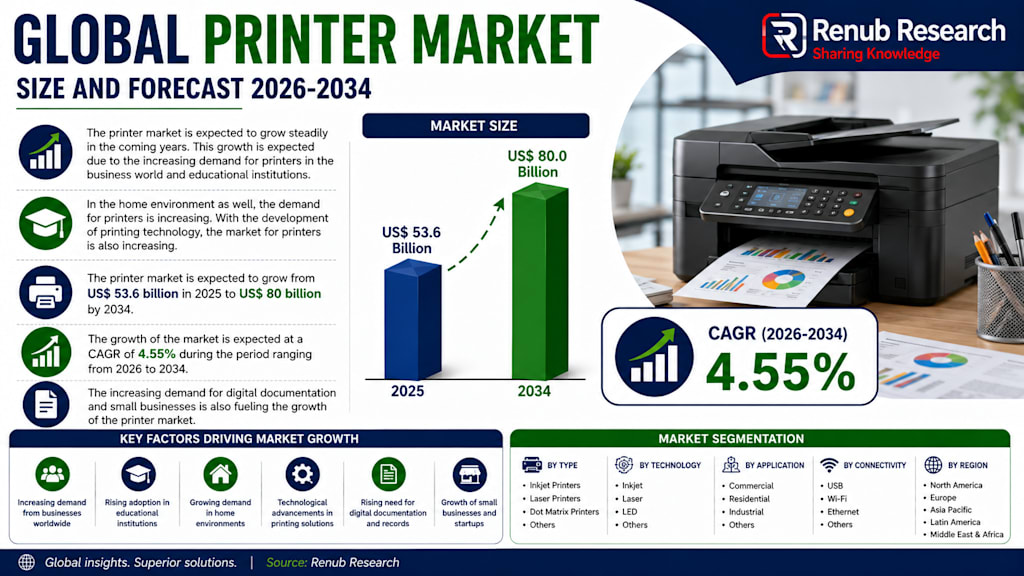
The global printer market is projected to grow from US$ 53.6 billion in 2025 to US$ 80 billion by 2034, driven by business documentation needs, technological innovation, and expanding home office culture.

Printers remain essential despite the rise of digital technologies
In a world increasingly shaped by cloud computing, smartphones, and digital communication, printers continue to play a surprisingly important role. Businesses, schools, healthcare organizations, government offices, and households still rely heavily on printed documentation for contracts, invoices, reports, assignments, packaging, and marketing materials.
According to the latest market outlook, the global printer market is expected to rise from US$ 53.6 billion in 2025 to US$ 80 billion by 2034, growing at a CAGR of 4.55% between 2026 and 2034. The steady growth of the market reflects the continuing importance of printers across commercial, industrial, and residential applications despite the global shift toward digitalization.
Printers remain one of the most widely used office and home devices because they provide physical copies of digital documents, images, and graphical content. Inkjet printers, laser printers, thermal printers, and other advanced printing systems continue evolving to meet changing business and consumer requirements.
Business documentation continues to support printer demand
One of the biggest drivers of the printer market is the ongoing requirement for printed business documentation. Even though digital workflows are expanding, many industries still rely heavily on physical records for contracts, invoices, reports, legal documents, and administrative operations.
Small and medium-sized businesses are also growing globally, increasing demand for affordable and efficient printing solutions. Industries such as healthcare, banking, education, logistics, and government administration continue to depend on printers for documentation, record-keeping, and communication purposes.
Businesses are increasingly seeking multifunction printers capable of printing, scanning, copying, and sometimes faxing within a single device. This combination improves operational efficiency while reducing equipment costs and office space requirements.
The report highlights Canon’s March 2025 launch of three MAXIFY MegaTank business printers designed for small and mid-sized businesses. These systems focus on high-volume color printing, water-resistant output, and productivity improvements, demonstrating how manufacturers are adapting products to evolving office needs.
Technological innovation is reshaping the industry
Technology continues to play a major role in the evolution of the printer market. Modern printers now include wireless connectivity, mobile printing, cloud integration, touch-screen controls, energy-saving modes, and smart management systems.
Consumers and businesses increasingly prefer printers that can connect directly with smartphones, tablets, and cloud storage platforms without complicated cable installations. These features have made printers more accessible and convenient in modern digital environments.
Multifunction printers are also becoming increasingly popular because they combine several office functions into a single device. In homes and offices alike, these systems improve convenience while lowering equipment costs.
Manufacturers are also investing heavily in improving print speed, image quality, toner efficiency, and operating costs. Eco-friendly innovations such as recyclable cartridges and energy-efficient systems are gaining importance as organizations adopt sustainability initiatives.
The report notes that Kyocera Corporation announced plans in January 2026 to launch its industrial inkjet photo printer “Belharra” globally through KYOCERA NIXKA Inkjet Systems. This reflects how innovation continues expanding beyond office printing into industrial and commercial applications.
Home offices and remote work are supporting growth
The expansion of remote work and hybrid working models has significantly boosted demand for home printers. Professionals working from home frequently need printers for contracts, reports, presentations, invoices, and business documents.
At the same time, students and households increasingly use printers for educational assignments, online learning materials, photographs, and personal documentation.
Compact multifunction printers are particularly attractive in home environments because they offer printing, scanning, and copying in a single space-saving device. Wireless connectivity and mobile printing capabilities are also becoming standard expectations among residential users.
The report highlights Canon’s August 2025 launch of compact wireless PIXMA All-in-One printers designed for modern home office environments. These devices combine functionality, compact design, and ease of use, reflecting how manufacturers are targeting growing home office demand.
Inkjet printers continue to dominate residential and small business use
Inkjet printers remain one of the most popular printer categories due to their affordability, flexibility, and ability to produce high-quality color prints. These printers spray microscopic ink droplets onto paper to create sharp text and vibrant images.
They are widely used in homes, small businesses, creative industries, and educational environments. Inkjet systems are especially popular for photo printing, graphic design, and marketing materials because of their strong color reproduction capabilities.
The growth of home-based businesses and flexible working arrangements has also strengthened demand for compact wireless inkjet systems that offer convenience and cost efficiency.
Manufacturers continue improving ink tank technologies and reducing operating costs, helping inkjet printers remain highly competitive in both residential and small office markets.
Dot matrix printers remain relevant in industrial environments
Although often viewed as older technology, dot matrix printers continue to hold value in industries requiring durability, reliability, and multipart printing capabilities.
These printers are commonly used in banking, logistics, government offices, retail operations, and industrial settings where receipts, invoices, and carbon-copy forms remain necessary.
Dot matrix printers are appreciated for their long lifespan, lower operating costs, and ability to function in harsh environments with minimal maintenance. While growth in this segment is slower compared to modern printing technologies, demand remains steady in specialized applications.
Flexographic printing is expanding alongside packaging demand
The flexographic printer market plays an essential role in industrial and commercial packaging. Flexographic printing uses flexible plates and fast-drying inks to print labels, food packaging, shopping bags, corrugated boxes, and various packaging materials.
This technology is especially valuable because it supports high-speed, large-scale production while maintaining print quality across different materials.
The growth of e-commerce and global packaging demand is strongly supporting the expansion of flexographic printing systems worldwide.
Commercial printing remains critical for marketing and branding
Commercial printers continue serving large-scale printing needs for advertising agencies, publishers, corporations, and event management companies. These systems are used for brochures, banners, catalogs, books, magazines, and promotional materials.
Businesses still depend heavily on printed marketing content to support branding and customer engagement strategies. Advances in digital printing, offset printing, and large-format printing technologies are improving production efficiency and color accuracy.
As businesses continue investing in marketing and promotional activities, commercial printing demand is expected to remain stable.
Residential printing is becoming more important
The residential printer market has expanded significantly because printers are now viewed as essential household tools for both personal and educational purposes.
Online education, home businesses, freelance work, and hybrid employment models have all contributed to rising home printer demand. Consumers increasingly prefer multifunction devices capable of handling scanning, printing, and copying needs efficiently.
Wireless printing, cloud integration, and mobile printing are especially important in residential markets where convenience and flexibility strongly influence purchasing decisions.
The shift toward paperless workplaces remains a challenge
Despite positive growth forecasts, the printer industry faces several challenges. One of the biggest is the increasing movement toward paperless workplaces. Many organizations are adopting electronic document management systems to reduce paper consumption, improve efficiency, and support sustainability goals.
Governments and corporations increasingly promote digital documentation as part of environmental responsibility initiatives. This trend has reduced printing volumes in some technology-driven sectors.
To remain competitive, printer manufacturers must continue innovating and expanding into multifunction systems, industrial printing, cloud integration, and specialized printing solutions.
High operating costs remain another major concern
Operational expenses also present a challenge for consumers and businesses. While printers themselves may be relatively affordable, long-term costs related to ink cartridges, toner, paper, servicing, and maintenance can become significant.
Frequent technical issues such as paper jams and hardware malfunctions may also discourage some users. Environmental concerns regarding cartridge waste and paper usage are creating additional pressure on manufacturers to develop more sustainable products.
Energy-efficient designs, refillable ink systems, and recyclable components are therefore becoming increasingly important across the industry.
The United States remains one of the most advanced printer markets
The United States continues to represent one of the most technologically advanced printer markets globally. Businesses, schools, healthcare organizations, and home users all contribute to strong printer demand throughout the country.
Corporate offices require advanced multifunction systems and high-performance laser printers for business documentation and operational efficiency. At the same time, remote work trends have strengthened home printer demand among professionals and students.
The report also highlights Canon U.S.A.’s January 2026 introduction of the Texas LT3 Series UV LED True Flatbed Printers developed in partnership with DigiTech. These systems target high-volume industrial production environments requiring advanced automation and print quality.
India is becoming a fast-growing printer market
India’s printer market is expanding rapidly due to rising business activity, educational demand, digital infrastructure development, and growth in small businesses.
Startups, SMEs, educational institutions, and government offices all contribute to growing printer demand. Remote working and home offices are also increasing residential printer adoption.
The report notes that HP launched new DeskJet All-in-One printers in India in February 2026 targeted at students, parents, and work-from-home professionals. Competitive pricing and multifunction features are helping brands reach broader consumer segments in the country.
Saudi Arabia continues investing in printing infrastructure
Saudi Arabia’s printer market is growing steadily alongside the country’s broader digital transformation and infrastructure development efforts. Government agencies, businesses, educational institutions, and healthcare organizations all require printing solutions for administrative and operational purposes.
The expansion of SMEs and entrepreneurship initiatives is also creating additional demand for office printing equipment throughout the country.
Major companies continue driving innovation
The global printer market remains highly competitive, with major technology companies focusing on performance, sustainability, connectivity, and multifunction capabilities. Key companies mentioned in the report include Canon Inc., FUJIFILM Corporation, Fujitsu Limited, Hitachi Ltd., Honeywell International Inc., HP Inc., Panasonic Corporation, Seiko Epson Corporation, Toshiba Corporation, and Xerox Corporation.
Competition increasingly revolves around cloud integration, wireless functionality, print quality, energy efficiency, and total operating costs.
Final thoughts
The global printer market continues to evolve alongside changing workplace trends, digital infrastructure growth, and technological innovation. While paperless workflows are gradually increasing, printers remain essential tools across businesses, educational institutions, industries, and households worldwide.
The projected rise from US$ 53.6 billion in 2025 to US$ 80 billion by 2034 demonstrates that demand for printing solutions remains resilient. As hybrid work models, digital education, e-commerce packaging, and business documentation continue expanding, the printer industry is expected to maintain steady long-term growth.
About the Creator
Enjoyed the story? Support the Creator.
Subscribe for free to receive all their stories in your feed.
Comments
There are no comments for this story
Be the first to respond and start the conversation.