
Global Printed Circuit Board Market Set to Reach USD 121.72 Billion by 2033 as 5G, Electric Vehicles, and Smart Electronics Accelerate Demand
Consumer Electronics, Automotive Innovation, Industrial Automation, and Healthcare Technologies Drive the Next Phase of PCB Industry Growth

The global electronics industry continues to evolve at a remarkable pace, and at the center of this transformation lies one critical component: the Printed Circuit Board (PCB). Often overlooked by consumers, PCBs form the backbone of nearly every electronic device used today. From smartphones and laptops to electric vehicles, industrial robots, medical devices, and advanced telecommunications infrastructure, PCBs serve as the foundation that enables electronic systems to function efficiently.
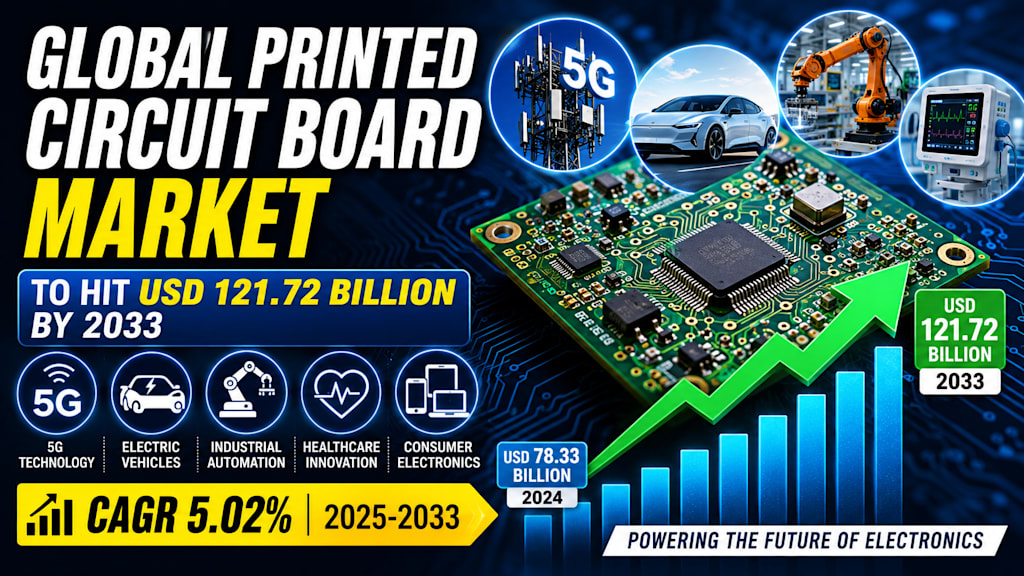
According to Renub Research, the Global Printed Circuit Board Market was valued at USD 78.33 billion in 2024 and is projected to reach USD 121.72 billion by 2033, expanding at a CAGR of 5.02% during the forecast period 2025–2033. The market's growth is being fueled by rising demand across consumer electronics, automotive applications, healthcare technologies, industrial automation systems, and next-generation communication networks.
As the world becomes increasingly connected through digital technologies, the importance of advanced PCB solutions continues to grow, creating significant opportunities for manufacturers, suppliers, and technology innovators worldwide.
Understanding the Importance of Printed Circuit Boards
A Printed Circuit Board is a flat platform that mechanically supports and electrically connects electronic components using conductive pathways etched from copper sheets. These boards provide the structural and electrical framework needed for electronic circuits to operate effectively.
Modern PCBs are available in various configurations, including single-sided, double-sided, multilayer, high-density interconnect (HDI), flexible, rigid, and rigid-flex designs. The increasing complexity of modern electronic devices has significantly elevated the role of advanced PCB technologies.
As industries pursue miniaturization, enhanced performance, greater reliability, and improved energy efficiency, PCB manufacturers are continuously innovating to meet evolving market demands.
Today, PCB technology serves as the invisible engine powering countless innovations across sectors such as telecommunications, aerospace, defense, healthcare, automotive manufacturing, renewable energy, and industrial automation.
5G Deployment Creates Massive Growth Opportunities
One of the most influential factors shaping the PCB market is the global deployment of 5G communication networks.
Unlike previous wireless generations, 5G technology requires significantly higher frequencies, faster data transmission speeds, and lower latency. These requirements place greater demands on PCB performance, particularly regarding signal integrity, thermal management, and high-frequency operation.
Telecommunications infrastructure such as:
5G base stations
Network routers
Small cell installations
Data centers
Edge computing devices
all require sophisticated multilayer and high-frequency PCB solutions.
As governments and telecom operators continue expanding 5G coverage worldwide, PCB manufacturers are experiencing growing demand for specialized products capable of supporting advanced communication technologies.
The expansion of smart cities, connected infrastructure, and digital transformation initiatives further strengthens the long-term outlook for PCB suppliers serving telecommunications markets.
Electric Vehicles Are Reshaping PCB Demand
The automotive industry is undergoing one of its most significant transitions in history as electric vehicles (EVs) gain widespread acceptance.
Modern EVs contain substantially more electronic content than conventional vehicles. Multiple PCB assemblies are required to manage critical functions such as:
Battery management systems
Power conversion
Charging infrastructure
Vehicle infotainment
Autonomous driving systems
Advanced driver-assistance systems (ADAS)
Vehicle connectivity solutions
As governments worldwide introduce stricter emissions regulations and encourage sustainable transportation, vehicle manufacturers are investing heavily in electrification.
Each new generation of EVs incorporates increasingly sophisticated electronics, resulting in greater demand for HDI and multilayer PCB technologies.
Furthermore, autonomous driving capabilities continue to evolve, requiring additional sensors, processors, cameras, and communication modules, all of which depend on advanced PCB architectures.
The automotive segment is expected to remain one of the fastest-growing end-use industries for PCB manufacturers throughout the forecast period.
Consumer Electronics Continue to Dominate Market Revenue
Consumer electronics remain the largest contributor to global PCB demand.
The widespread adoption of smartphones, tablets, laptops, gaming consoles, smart televisions, and wearable devices has created a consistent need for increasingly compact and powerful PCB designs.
Consumers expect products that are:
Smaller
Faster
Lighter
More powerful
Energy efficient
Meeting these expectations requires advanced PCB technologies capable of accommodating greater functionality within limited space.
The rise of wearable devices, including smartwatches and fitness trackers, has accelerated demand for flexible and rigid-flex PCBs.
Additionally, emerging technologies such as augmented reality (AR), virtual reality (VR), foldable smartphones, and smart home ecosystems are creating new opportunities for PCB innovation.
Rapid product refresh cycles within the consumer electronics sector ensure a steady stream of demand for next-generation circuit board technologies.
IoT Revolution Expands PCB Applications
The Internet of Things (IoT) is transforming how devices communicate and interact.
Connected sensors, smart appliances, industrial monitoring systems, healthcare wearables, and smart infrastructure all depend on PCB technology to function effectively.
IoT devices often require compact, lightweight, and highly reliable PCB solutions capable of operating continuously while maintaining low power consumption.
As billions of connected devices enter the global market over the coming decade, PCB manufacturers are expected to benefit from significant volume growth.
Industries embracing IoT-driven digital transformation initiatives include:
Manufacturing
Agriculture
Transportation
Healthcare
Energy
Smart Cities
This broad adoption supports long-term market expansion across multiple sectors.
Industrial Automation Drives High-Reliability PCB Demand
Industry 4.0 initiatives are reshaping global manufacturing through increased automation and intelligent production systems.
Factories are increasingly deploying:
Robotics
Automated control systems
Industrial sensors
Machine vision technologies
Predictive maintenance platforms
These applications require durable and highly reliable PCB solutions capable of operating under demanding industrial conditions.
Unlike consumer electronics, industrial equipment often functions continuously for extended periods in environments characterized by heat, vibration, moisture, and electrical stress.
As manufacturers pursue efficiency improvements and smart factory implementations, demand for industrial-grade PCBs continues to rise.
The industrial electronics segment is expected to generate substantial opportunities for specialized PCB suppliers focusing on high-performance materials and advanced manufacturing processes.
Healthcare Technology Emerges as a Major Growth Segment
Healthcare digitalization has become a powerful growth catalyst for the PCB industry.
Medical devices increasingly rely on sophisticated electronic systems to deliver accurate diagnostics, monitoring, treatment, and patient care.
Applications include:
Wearable health monitors
Portable diagnostic devices
Imaging equipment
Implantable medical devices
Surgical instruments
Remote patient monitoring systems
Medical applications require exceptional reliability, miniaturization, and regulatory compliance.
Rigid-flex and HDI PCB technologies are becoming increasingly important in modern healthcare devices where space limitations and performance requirements are critical.
The aging global population, rising healthcare expenditures, and growing adoption of telemedicine solutions continue to support strong growth prospects for PCB suppliers serving medical markets.
Key Challenges Facing the PCB Industry
Raw Material Price Volatility
PCB production relies heavily on critical materials such as:
Copper foil
Epoxy resins
Specialty laminates
Chemical processing materials
Price fluctuations resulting from supply chain disruptions, geopolitical tensions, and global economic uncertainty can significantly impact manufacturing costs.
Manufacturers must carefully manage procurement strategies and supplier relationships to maintain profitability while ensuring consistent product quality.
Intense Competitive Pressure
The global PCB industry remains highly competitive, particularly across Asia-Pacific markets.
Manufacturers in China, Taiwan, and South Korea benefit from large-scale production capabilities and cost efficiencies.
To remain competitive, companies must continually invest in:
Automation
Research and development
Advanced manufacturing technologies
Quality control systems
Smaller manufacturers often face challenges differentiating themselves in a market characterized by pricing pressure and rapid technological evolution.
Regional Market Insights
United States
The U.S. PCB market focuses primarily on high-value, technologically advanced applications.
Industries driving domestic demand include:
Aerospace
Defense
Medical devices
Telecommunications
Industrial automation
Government initiatives encouraging semiconductor and electronics manufacturing reshoring have renewed interest in domestic PCB production.
Advanced PCB technologies such as HDI, rigid-flex, and specialty defense-grade boards remain key areas of investment.
Germany
Germany's strong automotive and industrial manufacturing sectors support robust PCB demand.
The country's leadership in Industry 4.0, electric mobility, and precision engineering continues to create opportunities for high-performance PCB manufacturers.
German customers typically prioritize quality, reliability, and technical sophistication over low-cost production, encouraging innovation within the regional market.
China
China remains the world's largest PCB manufacturing hub, accounting for more than half of global production.
The country's extensive electronics ecosystem, integrated supply chains, and strong manufacturing infrastructure provide substantial competitive advantages.
Growing investments in electric vehicles, artificial intelligence, telecommunications, and advanced computing continue to strengthen domestic PCB demand.
Chinese manufacturers are increasingly moving beyond volume production toward higher-value HDI, flexible, and advanced packaging solutions.
Saudi Arabia
Saudi Arabia's PCB market remains relatively small but offers significant future potential.
Vision 2030 initiatives promoting economic diversification, digital infrastructure, renewable energy, and smart city development are stimulating electronics demand.
Projects such as NEOM and broader investments in industrial modernization are expected to create new opportunities for PCB suppliers and technology providers in the coming years.
Market Segmentation Highlights
The global PCB market can be segmented by type, substrate, and end-use industry.
By Type
Single-Sided PCBs
Double-Sided PCBs
Multi-Layer PCBs
High-Density Interconnect (HDI) PCBs
By Substrate
Rigid PCBs
Flexible PCBs
Rigid-Flex PCBs
By End Use
Industrial Electronics
Healthcare
Aerospace and Defense
Automotive
IT and Telecommunications
Consumer Electronics
Others
10 Recent Developments Shaping the PCB Industry
1. AdvancedPCB Launches Integrated Manufacturing Platform (June 2024)
AdvancedPCB was launched through the integration of APCT, Advanced Circuits Inc., and San Diego PCB Design, creating a more comprehensive PCB design and manufacturing ecosystem.
2. Thales Expands Circuit Board Production in Germany (April 2024)
Thales increased PCB manufacturing capacity to support growing modernization efforts across European rail infrastructure projects.
3. WUS Printed Circuit Announces Major Expansion (October 2024)
WUS Printed Circuit revealed a CNY 4.3 billion investment aimed at expanding production capacity for advanced computing applications.
4. TTM Technologies Expands Aerospace and Defense Capabilities
TTM Technologies continued investments in secure and high-reliability PCB manufacturing to support defense and aerospace customers.
5. Zhen Ding Technology Strengthens High-End PCB Portfolio
The company increased focus on AI servers, advanced packaging, and high-density PCB solutions supporting next-generation electronics.
6. Unimicron Accelerates AI and Data Center PCB Development
Unimicron expanded production capabilities targeting AI computing infrastructure and advanced server applications.
7. Jabil Enhances Electronics Manufacturing Integration
Jabil strengthened PCB integration services to support customers seeking faster product development and manufacturing scalability.
8. Nippon Mektron Advances Flexible PCB Innovation
Nippon Mektron continued expanding flexible circuit technologies for automotive, medical, and wearable device applications.
9. Würth Elektronik Expands Engineering Support Services
The company increased customer-focused design and prototyping support for industrial and IoT applications.
10. Sumitomo Corporation Invests in Advanced Electronics Supply Chains
Sumitomo expanded strategic investments supporting next-generation electronics manufacturing and component ecosystems.
Competitive Landscape
Leading companies operating in the global PCB market include:
Advanced Circuits Inc.
Zhen Ding Technology Holding Limited
Unimicron Technology Corporation
Würth Elektronik GmbH & Co. KG
Becker & Müller Circuit Printing GmbH
Jabil Inc.
Murrietta Circuits
Nippon Mektron Ltd.
Sumitomo Corporation
TTM Technologies Inc.
These organizations compete through technological innovation, manufacturing scale, product quality, customer relationships, and continuous investment in advanced PCB capabilities.
Final Thoughts
Printed Circuit Boards may remain invisible to end users, but they are undeniably the foundation of the digital economy. As technologies such as 5G, artificial intelligence, electric vehicles, industrial automation, IoT, and advanced healthcare devices continue expanding, the importance of sophisticated PCB solutions will only increase.
With the Global Printed Circuit Board Market expected to grow from USD 78.33 billion in 2024 to USD 121.72 billion by 2033, manufacturers that invest in innovation, automation, sustainability, and high-performance technologies will be best positioned to capitalize on the industry's next phase of growth.
The future of electronics depends on smarter, faster, and more efficient circuit boards—and the PCB industry stands ready to power that future.
About the Creator
Enjoyed the story? Support the Creator.
Subscribe for free to receive all their stories in your feed.
Comments
There are no comments for this story
Be the first to respond and start the conversation.