
Global Outboard Motor Market to Reach USD 8.21 Billion by 2033 as Recreational Boating and Marine Tourism Accelerate
Rising Water Sports Culture, Technological Innovation, and Commercial Marine Expansion Fuel Strong Demand for Outboard Motors Worldwide

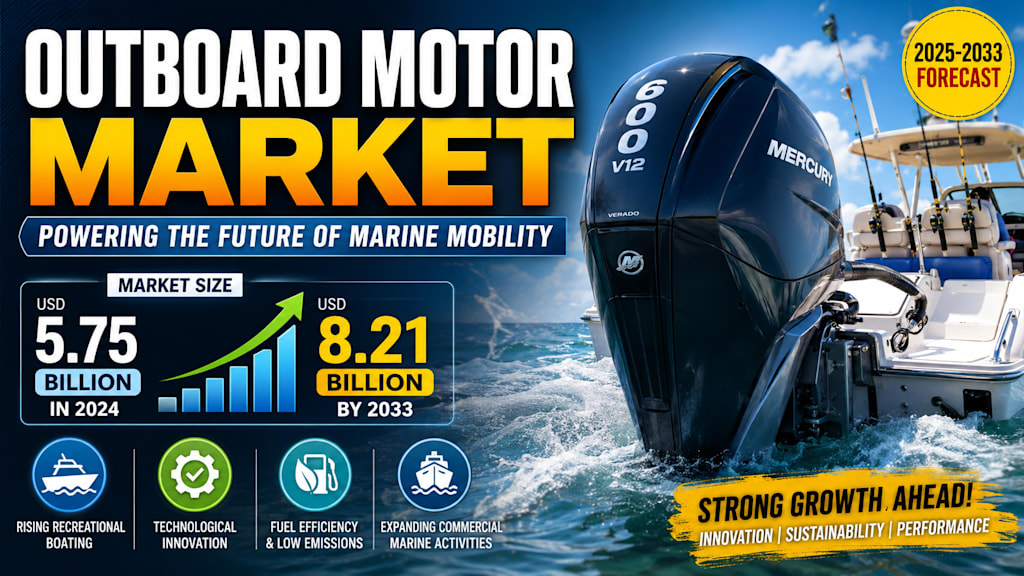
The global outboard motor market is entering a transformative growth phase as recreational boating, marine tourism, commercial fishing, and sustainable marine technologies continue expanding worldwide. According to Renub Research, the Global Outboard Motor Market is projected to grow from USD 5.75 billion in 2024 to USD 8.21 billion by 2033, registering steady growth during the forecast period from 2025 to 2033.
Outboard motors have become a critical part of modern marine transportation due to their flexibility, fuel efficiency, lightweight structure, and easy maintenance. These motors are widely used across recreational boating, fishing, patrol services, ferry operations, and water sports activities. As marine leisure becomes increasingly popular across both developed and emerging economies, demand for technologically advanced outboard motors is climbing rapidly.
Recreational Boating Boom Creating Massive Growth Opportunities
One of the biggest factors driving the global outboard motor market is the growing popularity of recreational boating activities. Consumers across North America, Europe, and Asia-Pacific are increasingly spending on leisure experiences such as fishing, sailing, cruising, and water sports.
The rise in disposable incomes, changing lifestyle preferences, and increased tourism investments are encouraging boat ownership and marine recreation participation. Coastal tourism destinations are also investing heavily in marinas, boating clubs, and water sports infrastructure, creating strong opportunities for outboard motor manufacturers.
The recreational segment remains the dominant application category in the market because outboard motors offer excellent maneuverability and operational convenience for leisure boats. Portable and mid-range motors are especially favored among recreational users because of their affordability and user-friendly operation.
Another major reason behind rising recreational demand is the growing influence of social media travel culture. Consumers are increasingly attracted to marine adventures, island tourism, luxury boating, and outdoor recreational experiences. This shift is encouraging greater adoption of recreational watercraft globally.
Technological Innovation Reshaping the Industry
Technology is playing a transformative role in the outboard motor market. Manufacturers are heavily investing in product innovation to improve fuel efficiency, reduce emissions, and enhance operational performance.
Modern outboard motors now feature advanced digital controls, smart monitoring systems, low-noise operation, and lightweight materials that significantly improve the boating experience. Manufacturers are also developing hybrid and electric outboard motors to comply with stringent environmental regulations and growing consumer demand for sustainability.
The introduction of electric propulsion systems is becoming one of the most important trends shaping the future of the marine industry. Governments worldwide are pushing for cleaner maritime technologies, encouraging companies to accelerate the development of zero-emission marine solutions.
In January 2024, Mercury Marine introduced its Verado 600 engine featuring enhanced fuel economy, sophisticated digital controls, and reduced emissions. The launch highlighted the growing competitive focus on environmentally friendly, high-performance marine propulsion systems.
Similarly, the maritime industry witnessed a major sustainability milestone in February 2022 when All American Marine and SWITCH Maritime introduced “Sea Change,” the world’s first commercial hydrogen fuel cell-electric passenger ferry in California. The project demonstrated the growing viability of zero-emission marine transportation technologies.
Commercial Marine Activities Supporting Long-Term Expansion
Beyond recreational usage, commercial marine operations are becoming increasingly important for the global outboard motor market. Industries such as commercial fishing, passenger transportation, coastal security, aquaculture, and marine patrol services continue to rely heavily on outboard-powered vessels.
In developing economies, small fishing boats powered by outboard motors are essential for livelihoods and local transportation. Governments in several coastal nations are supporting fisheries modernization and maritime infrastructure development, further increasing demand for durable marine engines.
Commercial users generally prioritize reliability, durability, fuel economy, and low operating costs. As a result, manufacturers are focusing on developing engines capable of operating efficiently under challenging marine conditions.
India, for example, is rapidly strengthening its marine infrastructure and sustainable transportation capabilities. In December 2023, India commissioned “Barracuda,” the country’s fastest solar-electric boat developed by Navalt. The vessel represents the growing adoption of sustainable marine technologies across emerging markets.
Environmental Regulations Pushing Industry Transformation
Environmental sustainability has become a defining issue for the marine industry. Governments and regulatory agencies across the world are introducing stricter emissions regulations aimed at reducing marine pollution and greenhouse gas emissions.
Compliance with EPA standards in the United States and EU environmental directives is forcing manufacturers to invest significantly in research and development. While these regulations create cost pressures for manufacturers, they are also accelerating innovation within the market.
Electric and hybrid outboard motors are expected to witness rapid adoption over the next decade, especially in environmentally sensitive regions where fuel-powered marine engines face increasing restrictions.
Consumers are also becoming more environmentally conscious. Boat owners are increasingly seeking quieter, cleaner, and fuel-efficient propulsion systems that minimize environmental impact without sacrificing performance.
Portable and Mid-Range Motors Witness Rising Demand
Portable outboard motors are gaining strong traction due to their compact design, ease of handling, and affordability. These motors are particularly popular among recreational users, small fishing operators, and entry-level boat owners.
Portable motors are widely preferred for dinghies, inflatable boats, and backup propulsion systems because they are lightweight and easy to transport. Their lower maintenance requirements also make them attractive for occasional users.
Mid-range outboard motors, generally ranging between 30 and 150 horsepower, are also experiencing robust demand. These engines provide a balance between performance, fuel efficiency, and affordability, making them suitable for fishing boats, leisure crafts, and small commercial vessels.
The combination of advanced digital controls and improved fuel efficiency technologies is helping manufacturers strengthen the appeal of mid-range engines globally.
High-Power Outboard Motors Driving Premium Marine Segment
High-power outboard motors exceeding 150 horsepower are becoming increasingly popular in offshore recreational boating, rescue operations, luxury boating, and commercial transportation.
Consumers in premium boating segments are demanding faster, more durable, and technologically advanced propulsion systems capable of delivering superior performance under demanding marine conditions.
Although these engines involve higher acquisition and maintenance costs, their performance advantages continue attracting professional users and affluent recreational consumers.
The rise in luxury marine tourism and offshore recreational activities is expected to support strong growth in the high-power outboard motor segment during the forecast period.
United States Leading Global Market Expansion
The United States remains one of the largest and most influential outboard motor markets globally. The country benefits from a strong boating culture, extensive coastlines, large freshwater lake systems, and advanced marine infrastructure.
Rising consumer spending on recreational activities, combined with technological innovation and environmental awareness, is driving significant demand for advanced marine propulsion systems in the U.S.
The country is also witnessing growing investments in electric marine mobility solutions. In October 2024, TEMO established its subsidiary “TEMO USA Inc.” in Delaware while expanding operations in Portland, Maine, to strengthen its North American presence and after-sales support network.
Europe Focusing on Sustainable Marine Mobility
European countries such as France, Germany, Italy, and the United Kingdom are embracing electric and hybrid marine propulsion technologies rapidly.
France remains a major regional market due to its strong sailing culture, extensive coastline, and growing environmental initiatives. Recreational boating and competitive sailing continue supporting regional demand for advanced marine engines.
In January 2025, Mercury Marine France appointed the Lethiec family company as the exclusive distributor for its Mercury Racing brand, strengthening its presence in the French competitive motorboat racing segment.
European consumers are increasingly prioritizing environmentally friendly propulsion systems, creating significant opportunities for electric outboard motor manufacturers.
India Emerging as a High-Potential Market
India’s outboard motor market is witnessing strong momentum due to the expansion of coastal trade, fisheries modernization, marine tourism, and water transportation infrastructure.
Traditional fishing communities are increasingly transitioning from manual boats to motorized vessels to improve operational efficiency and productivity. Government support for fisheries and maritime trade is also contributing to market expansion.
Additionally, the growing middle class and increasing interest in leisure boating activities are opening new opportunities for portable and mid-range outboard motors in India.
As marine tourism develops across coastal states such as Goa, Kerala, and Gujarat, recreational boating demand is expected to increase significantly over the coming years.
Competitive Landscape Intensifying
The global outboard motor market remains highly competitive with major companies focusing on technological advancement, strategic partnerships, product innovation, and regional expansion.
Leading players operating in the industry include DEUTZ Aktiengesellschaft, Parsun Power Machine Co. Ltd, Honda Motor Co. Ltd, Tohatsu Corporation, Brunswick Corporation, Yamaha Motor Co. Ltd, LEHR LLC, Suzuki Motor Corporation, Selva SpA, and Hidea Power Machinery Co. Ltd.
Manufacturers are increasingly investing in sustainable propulsion technologies, smart marine systems, lightweight materials, and digital integration to maintain competitive advantages.
10 Recent Developments in the Outboard Motor Industry
Mercury Marine launched the advanced Verado 600 outboard engine with improved fuel efficiency and reduced emissions in 2024.
All American Marine and SWITCH Maritime introduced the world’s first hydrogen fuel cell-electric passenger ferry.
India commissioned the solar-electric boat “Barracuda” to strengthen sustainable marine transportation.
TEMO expanded into North America by establishing TEMO USA Inc. in Delaware.
Mercury Marine France strengthened its racing engine distribution network in France.
Manufacturers are increasingly investing in electric outboard motor technologies to meet environmental standards.
Hybrid propulsion systems are gaining traction among commercial marine operators.
Smart digital engine monitoring systems are becoming standard features in modern outboard motors.
Lightweight composite materials are improving fuel efficiency and engine portability.
Growing marine tourism investments across Asia-Pacific and the Middle East are accelerating demand for recreational boating engines.
Final Thoughts
The global outboard motor market is moving toward a future shaped by sustainability, innovation, and recreational marine expansion. Increasing participation in water sports, growth in marine tourism, rising commercial marine activities, and technological advancements are collectively transforming the industry landscape.
As environmental regulations become stricter and consumers demand cleaner marine mobility solutions, electric and hybrid outboard motors are expected to dominate future innovation strategies. Meanwhile, emerging economies such as India, Saudi Arabia, and Mexico are creating substantial growth opportunities through investments in coastal infrastructure and maritime tourism.
With strong momentum across both recreational and commercial sectors, the global outboard motor market is well-positioned for long-term expansion through 2033.
About the Creator
Enjoyed the story? Support the Creator.
Subscribe for free to receive all their stories in your feed.
Comments
There are no comments for this story
Be the first to respond and start the conversation.