
Global LED Lighting Market to Reach US$193.74 Billion by 2034 as Energy Efficiency and Smart Infrastructure Drive Global Adoption
Rising demand for energy-efficient lighting, expanding smart city initiatives, supportive government regulations, and growing adoption of connected lighting systems are accelerating the global LED lighting market.

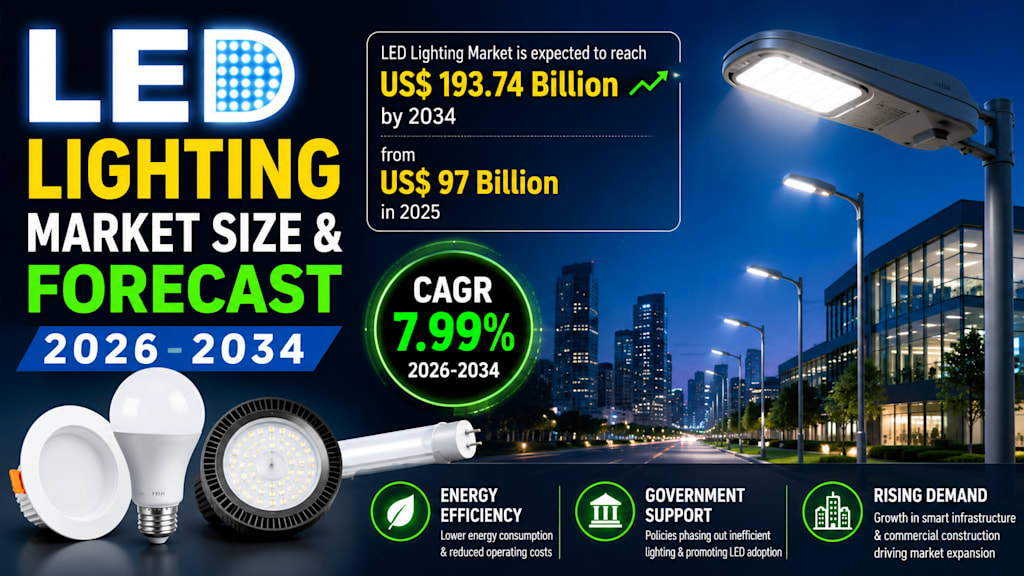
According to the latest market outlook, the Global LED Lighting Market is projected to grow from US$97.00 billion in 2025 to US$193.74 billion by 2034, registering a compound annual growth rate (CAGR) of 7.99% during 2026–2034. Rising demand for energy-efficient technologies, supportive government policies, smart infrastructure investments, and commercial construction continue driving long-term market expansion.
LED Lighting Delivers Superior Energy Efficiency
LED lighting utilizes semiconductor technology that converts electrical energy directly into light with minimal energy loss.
Unlike incandescent bulbs that waste a substantial portion of electricity as heat, LEDs provide significantly higher luminous efficiency while consuming far less power.
LEDs also offer longer operational life, instant illumination, excellent color quality, low maintenance requirements, and compatibility with advanced lighting controls.
These advantages make LED lighting suitable for homes, offices, factories, retail stores, hospitals, schools, stadiums, highways, and public infrastructure.
Energy Efficiency Continues Driving Market Growth
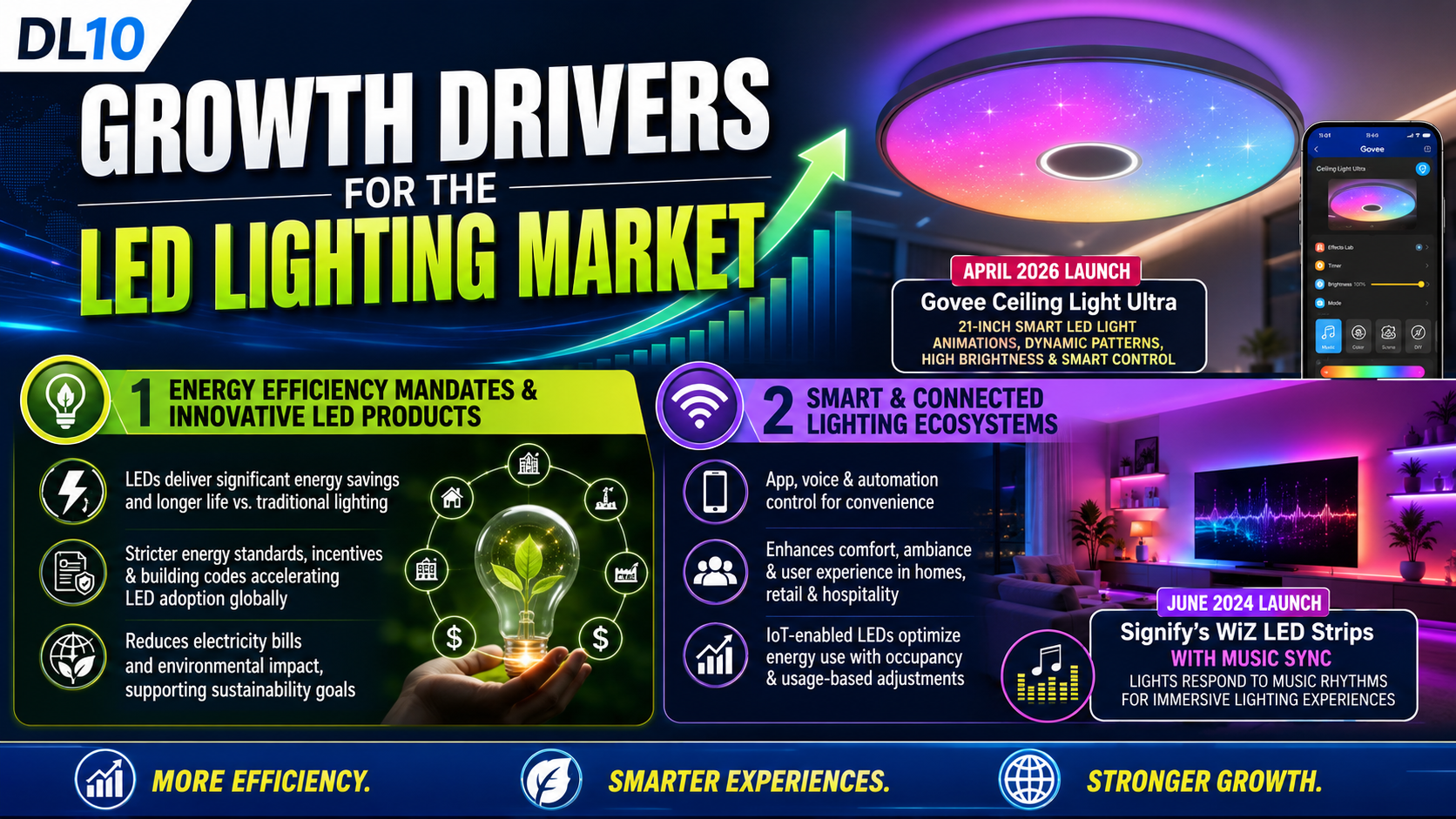
One of the strongest factors supporting market expansion is the global emphasis on reducing electricity consumption.
Governments continue implementing stricter energy-efficiency regulations while gradually phasing out inefficient incandescent and fluorescent lighting technologies.
Consumers and businesses increasingly recognize the long-term financial benefits of lower electricity bills and reduced maintenance costs associated with LED lighting.
Large-scale retrofit projects replacing conventional lighting with LED systems continue expanding across commercial buildings, industrial facilities, and municipal infrastructure.
Growing environmental awareness further strengthens demand for sustainable lighting solutions.
Smart Lighting Is Revolutionizing Modern Buildings
The rapid growth of smart homes and connected buildings has significantly expanded opportunities for LED lighting.
Modern LED systems integrate seamlessly with mobile applications, voice assistants, wireless communication platforms, and building automation systems.
Users can remotely adjust brightness, color temperature, scheduling, occupancy settings, and energy consumption through smart devices.
Artificial intelligence and IoT technologies further improve lighting efficiency by automatically responding to occupancy patterns, daylight availability, and user preferences.
Connected lighting ecosystems continue becoming standard features within modern residential and commercial developments.
Commercial Construction Expands LED Adoption
Commercial buildings remain one of the largest users of LED lighting technology.
Office complexes, hotels, shopping malls, airports, hospitals, educational institutions, and industrial facilities increasingly invest in LED systems to reduce operational expenses and improve lighting quality.
Advanced lighting controls including occupancy sensors, daylight harvesting, and centralized building management systems further enhance energy savings.
Growing investment in green buildings and sustainable architecture continues encouraging widespread LED deployment across commercial real estate.
Smart Cities Accelerate Infrastructure Modernization
Governments worldwide continue investing heavily in smart city initiatives that rely extensively on LED technology.
Municipalities increasingly replace traditional streetlights with intelligent LED systems capable of remote monitoring, adaptive brightness control, and predictive maintenance.
Smart street lighting improves public safety while reducing electricity consumption and maintenance costs.
Integrated lighting infrastructure also supports environmental monitoring, traffic management, and public Wi-Fi services within modern urban environments.
The expansion of smart city projects continues creating significant long-term growth opportunities.
LED Lamps Remain the Largest Product Category
LED lamps continue representing one of the largest segments within the global market.
Consumers increasingly replace conventional incandescent and compact fluorescent lamps with energy-efficient LED alternatives because they provide immediate compatibility with existing fixtures.
Continuous improvements in brightness, color rendering, dimming capabilities, and smart connectivity continue expanding consumer acceptance.
Government regulations promoting efficient lighting further accelerate replacement demand across residential and commercial markets.
Indoor LED Lighting Experiences Strong Demand
Indoor LED lighting remains one of the fastest-growing application segments.
Homes, offices, hospitals, schools, factories, and retail stores increasingly adopt LED systems because they provide excellent visual comfort while significantly reducing electricity consumption.
Human-centric lighting technologies that adjust brightness and color temperature throughout the day are becoming increasingly popular within workplaces and healthcare environments.
Smart indoor lighting systems also improve convenience through automation and wireless control.
Commercial End Users Lead Market Demand
Commercial organizations continue representing the largest end-user segment within the LED lighting market.
Businesses prioritize LED technology because of its ability to reduce electricity costs, minimize maintenance requirements, and improve workplace illumination.
Retail stores utilize LED lighting to enhance product displays, while warehouses benefit from high-efficiency industrial fixtures that improve operational safety.
Hotels, hospitals, and educational institutions also increasingly invest in LED systems to improve sustainability while lowering long-term operating expenses.
Retail and Warehouse Lighting Continues Expanding
Retailers and warehouse operators increasingly adopt specialized LED lighting systems designed to improve visibility and operational efficiency.
Retail environments utilize advanced lighting designs to enhance customer experiences and product presentation.
Warehouses rely on high-bay LED fixtures that provide consistent illumination while integrating occupancy sensors to reduce unnecessary energy consumption.
Growing logistics, e-commerce, and distribution activities continue strengthening demand for industrial LED lighting solutions.
Higher Initial Costs Remain a Challenge
Despite their long-term economic benefits, LED lighting systems often require higher initial investment compared with conventional lighting.
Large commercial projects may involve fixture replacement, electrical upgrades, control systems, and professional installation, increasing upfront expenses.
Small businesses and homeowners may postpone upgrades because of budget limitations despite potential long-term savings.
Government rebates, financing programs, and utility incentives continue helping reduce these financial barriers.
Compatibility and Integration Present Technical Challenges
Integrating LED systems into older buildings may require modifications to existing electrical infrastructure.
Legacy wiring, incompatible dimming controls, outdated fixtures, and older building automation systems can complicate installation.
Poor-quality products lacking proper certification may also reduce consumer confidence by causing performance inconsistencies or premature failure.
Manufacturers continue improving product compatibility while promoting industry standards and professional installation practices.
Regional Markets Continue Driving Growth
The United States remains one of the world's largest LED lighting markets because of strong energy-efficiency regulations, smart home adoption, commercial retrofitting projects, and widespread public infrastructure modernization.
Germany continues strengthening LED adoption through European Union energy-efficiency regulations, sustainability initiatives, and large-scale municipal street lighting upgrades.
China remains both the world's largest LED manufacturing hub and one of its largest consumer markets, supported by rapid urbanization, smart city development, and government investment in energy-efficient infrastructure.
Saudi Arabia continues accelerating LED deployment through Vision 2030, smart city initiatives, commercial development, and nationwide energy-efficiency programs focused on reducing electricity consumption.
Together, these regional markets continue shaping the future of the global LED lighting industry.
Innovation Will Define the Future of LED Lighting
The future of LED lighting will be driven by artificial intelligence, smart connectivity, human-centric lighting, and sustainable product innovation.
Manufacturers continue developing intelligent lighting systems featuring voice control, IoT integration, wireless connectivity, advanced sensors, and cloud-based lighting management platforms.
Future innovations are expected to improve energy efficiency even further while expanding applications across agriculture, healthcare, transportation, industrial automation, and smart cities.
As digital infrastructure continues evolving, LED lighting will become an increasingly important component of intelligent buildings and sustainable urban development.
Final Thoughts
The global LED lighting market continues experiencing strong growth as governments, businesses, and consumers increasingly prioritize energy efficiency, sustainability, and smart infrastructure.
The projected expansion from US$97.00 billion in 2025 to US$193.74 billion by 2034, supported by a 7.99% CAGR, reflects rising demand for intelligent lighting systems across residential, commercial, industrial, and public sectors.
Although higher initial costs and integration challenges remain important considerations, continued innovation in smart lighting, IoT connectivity, artificial intelligence, and energy-efficient technologies positions the LED lighting industry for sustained long-term growth. As countries pursue cleaner energy systems and smarter cities, LED lighting will remain one of the most important technologies shaping the future of global illumination.
About the Creator
Enjoyed the story? Support the Creator.
Subscribe for free to receive all their stories in your feed.
Comments
There are no comments for this story
Be the first to respond and start the conversation.