
Global Huntington's Disease Treatment Market to Reach US$2.44 Billion by 2034 as Gene Therapy Innovations Transform Rare Neurological Care
Advances in gene therapy, increasing awareness of rare neurological disorders, improved genetic diagnosis, and strong investment in precision medicine are driving remarkable growth in the global Huntington's disease treatment market.

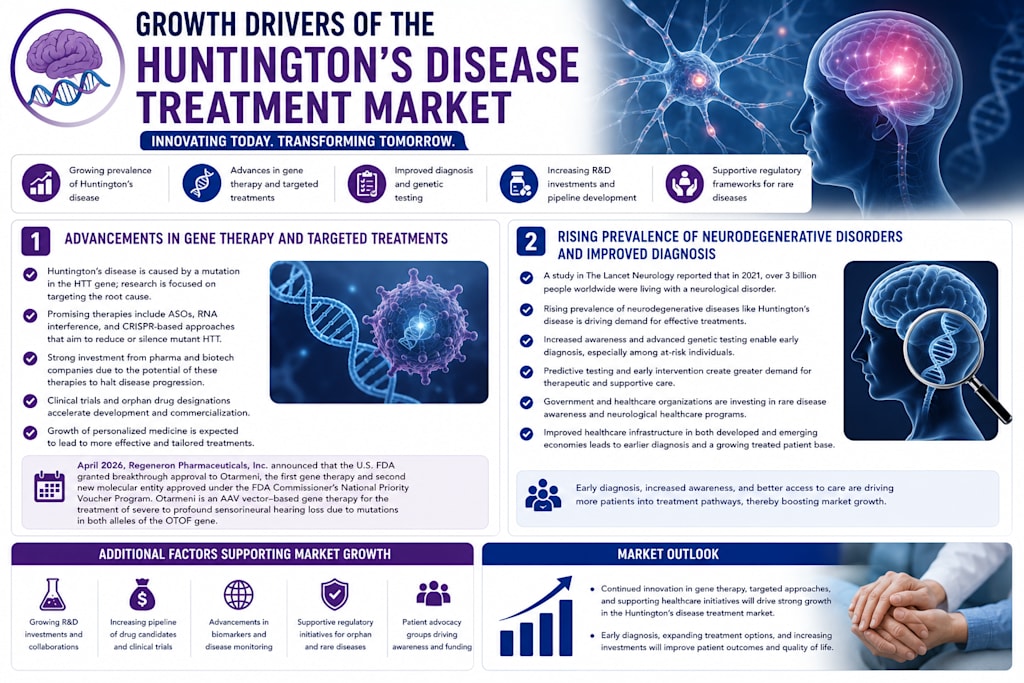
Breakthrough Therapies Are Reshaping Huntington's Disease Treatment
Huntington's disease is one of the most challenging neurodegenerative disorders, affecting movement, cognition, and mental health while progressively reducing patients' quality of life. As an inherited genetic condition caused by mutations in the HTT gene, Huntington's disease has long lacked therapies capable of slowing or stopping disease progression. Existing treatments have traditionally focused on managing symptoms rather than addressing the underlying cause.
However, recent advances in genetic medicine are transforming the treatment landscape. Gene therapy, RNA-based therapeutics, antisense oligonucleotides, and precision medicine are creating new opportunities to modify disease progression and improve long-term patient outcomes. Combined with earlier diagnosis and growing awareness of rare neurological diseases, these innovations are fueling significant market expansion.
According to the latest market outlook, the Global Huntington's Disease Treatment Market is projected to grow from US$512.88 million in 2025 to US$2,441.40 million by 2034, registering an impressive compound annual growth rate (CAGR) of 18.93% during 2026–2034. Rising research investment, favorable orphan drug regulations, expanding genetic testing, and advances in targeted therapies continue to support long-term market growth.

Understanding Huntington's Disease Treatment
Huntington's disease is an inherited neurological disorder that gradually damages nerve cells in the brain, resulting in uncontrolled movements, psychiatric symptoms, and progressive cognitive decline.
Although there is currently no permanent cure, treatment focuses on reducing symptoms, improving quality of life, and helping patients maintain independence for as long as possible.
Common treatment approaches include medications for chorea, antidepressants, antipsychotics, mood stabilizers, speech therapy, occupational therapy, physical rehabilitation, and psychological support.
Modern research increasingly aims to develop disease-modifying therapies capable of slowing or preventing neurological degeneration rather than simply managing symptoms.
Gene Therapy Is Revolutionizing Treatment Development
One of the strongest drivers of market growth is the rapid advancement of gene-based therapies.
Since Huntington's disease results from mutations in a single gene, researchers have concentrated on therapies that directly target the underlying genetic defect.
Innovative technologies including antisense oligonucleotides (ASOs), RNA interference (RNAi), CRISPR gene editing, and viral vector-based gene therapies are demonstrating encouraging clinical progress.
These next-generation therapies aim to reduce the production of harmful mutant huntingtin protein responsible for disease progression.
Pharmaceutical companies and biotechnology firms continue investing heavily in these promising treatment platforms, accelerating research and clinical development worldwide.
Earlier Diagnosis Expands Treatment Opportunities
Advances in genetic testing have significantly improved the early diagnosis of Huntington's disease.
Individuals with a family history of the condition increasingly undergo predictive genetic screening before symptoms become severe.
Earlier diagnosis enables physicians to begin symptom management sooner while allowing patients to participate in clinical trials evaluating innovative therapies.
Growing awareness campaigns and improved access to neurological specialists have further strengthened early detection rates across developed healthcare systems.
Improved diagnosis is expected to continue expanding the patient population receiving medical treatment.
Rising Investment Accelerates Innovation
Investment in rare neurological diseases has increased substantially during recent years.
Governments, pharmaceutical companies, biotechnology firms, nonprofit organizations, and patient advocacy groups continue funding research programs focused on Huntington's disease.
Supportive regulatory policies—including orphan drug designation, fast-track approval pathways, and research incentives—have encouraged greater private-sector participation.
These financial investments are accelerating clinical development while increasing the number of experimental therapies entering human trials.
Growing collaboration between academic institutions and industry partners further strengthens innovation throughout the market.
Precision Medicine Supports Personalized Care
Precision medicine is becoming increasingly important in Huntington's disease treatment.
Researchers are developing therapies tailored to individual genetic characteristics, disease progression, and patient-specific clinical needs.
Personalized treatment strategies may improve therapeutic effectiveness while reducing adverse effects compared with conventional approaches.
Artificial intelligence and genomic analysis also help researchers identify patients most likely to benefit from emerging therapies.
As precision medicine continues evolving, individualized treatment plans are expected to become increasingly common.
Approved Drugs Continue Supporting Patient Care
Approved medications remain the foundation of current Huntington's disease management.
Drugs such as tetrabenazine and deutetrabenazine are widely prescribed to control chorea, one of the disease's most recognizable movement disorders.
These medicines significantly improve daily functioning and quality of life by reducing involuntary body movements.
Healthcare providers often combine approved medications with psychiatric treatment, rehabilitation, and supportive therapies to provide comprehensive patient care.
Although these treatments do not stop disease progression, they remain essential components of current clinical practice.
Off-Label Therapies Address Complex Symptoms
Off-label medications also play an important role in Huntington's disease management.
Physicians frequently prescribe antidepressants, antipsychotics, mood stabilizers, anti-anxiety medications, and anticonvulsants to manage behavioral and psychiatric symptoms associated with the disease.
Because Huntington's disease affects multiple neurological pathways, individualized combinations of approved and off-label medications often provide the most effective symptom control.
Personalized treatment strategies continue improving patient comfort while enhancing long-term disease management.
Hospitals Remain the Primary Treatment Centers
Hospitals and specialized neurology centers continue representing the largest end-user segment within the Huntington's disease treatment market.
Comprehensive care typically involves neurologists, psychiatrists, genetic counselors, rehabilitation specialists, speech therapists, occupational therapists, and physiotherapists working together to address multiple aspects of the disease.
Hospitals also provide access to advanced diagnostic technologies, clinical trials, and emerging experimental therapies.
Growing investment in neurological healthcare infrastructure continues strengthening specialized treatment services worldwide.
Telemedicine Expands Access to Care
Digital healthcare has become increasingly valuable for patients living with Huntington's disease.
Telemedicine consultations, virtual rehabilitation, remote psychiatric care, medication management, and online counseling improve access for patients living in remote locations or experiencing mobility limitations.
Healthcare providers increasingly utilize digital platforms to monitor disease progression while reducing the burden of frequent hospital visits.
The expansion of telehealth services continues supporting more accessible long-term disease management.
High Treatment Costs Remain a Major Challenge
Despite remarkable scientific progress, treatment affordability remains an important challenge.
Advanced gene therapies, precision medicines, specialized neurological care, rehabilitation services, and lifelong patient management require substantial financial resources.
Limited insurance coverage and reimbursement barriers continue restricting patient access, particularly within developing healthcare systems.
Reducing treatment costs while maintaining innovation remains a key objective for healthcare policymakers and pharmaceutical companies.
Clinical Development Remains Complex
Developing effective Huntington's disease therapies presents significant scientific challenges.
The rarity of the disease makes patient recruitment for clinical trials difficult, while disease progression varies considerably among individuals.
Researchers must also demonstrate long-term safety and effectiveness before regulatory approval can be granted.
These factors contribute to lengthy development timelines and substantial research costs.
Nevertheless, continued scientific advances are steadily improving prospects for future disease-modifying treatments.
Regional Markets Continue Driving Innovation
The United States remains the largest Huntington's disease treatment market due to its advanced biotechnology industry, strong clinical research infrastructure, supportive orphan drug regulations, and extensive investment in gene therapy.
Germany continues strengthening the European market through advanced neurological research, well-developed healthcare infrastructure, and active participation in multinational clinical trials.
China is emerging as an important growth market as healthcare investment, genetic testing capabilities, biotechnology innovation, and rare disease awareness continue expanding.
Saudi Arabia is gradually strengthening its market through healthcare modernization, growing awareness of rare neurological disorders, expanding specialist care, and increased investment under national healthcare reform initiatives.
Together, these regional markets continue driving worldwide progress in Huntington's disease treatment.
Innovation Will Shape the Future of Huntington's Disease Care
The future of Huntington's disease treatment will be defined by gene editing, RNA-based therapeutics, precision medicine, artificial intelligence, and personalized neurological care.
Researchers continue exploring therapies capable of slowing, preventing, or potentially reversing disease progression by directly targeting genetic mutations.
Improved biomarkers, digital monitoring technologies, wearable neurological devices, and predictive analytics will further enhance clinical management.
As scientific understanding continues advancing, Huntington's disease treatment is expected to move beyond symptom management toward truly disease-modifying therapies.
Final Thoughts
The global Huntington's disease treatment market is entering a period of unprecedented innovation as advances in genetic medicine reshape the future of neurological care.
The projected expansion from US$512.88 million in 2025 to US$2,441.40 million by 2034, supported by an impressive 18.93% CAGR, reflects growing investment in gene therapy, precision medicine, and targeted neurological treatments.
Although high treatment costs, clinical development challenges, and the absence of a definitive cure remain significant obstacles, continuous progress in molecular medicine, regulatory support, and biotechnology innovation positions the Huntington's disease treatment market for exceptional long-term growth. As next-generation therapies continue advancing through clinical development, patients and healthcare providers alike are increasingly hopeful that meaningful disease-modifying treatments will soon become a reality.
About the Creator
Enjoyed the story? Support the Creator.
Subscribe for free to receive all their stories in your feed.
Comments
There are no comments for this story
Be the first to respond and start the conversation.