
Global Dishwasher Market Expands as Smart Kitchens, Energy Efficiency, and Urban Convenience Redefine Modern Living
Rising demand for connected appliances, eco-friendly dishwashing technologies, and premium kitchen automation is driving steady global growth across residential and commercial dishwasher markets.

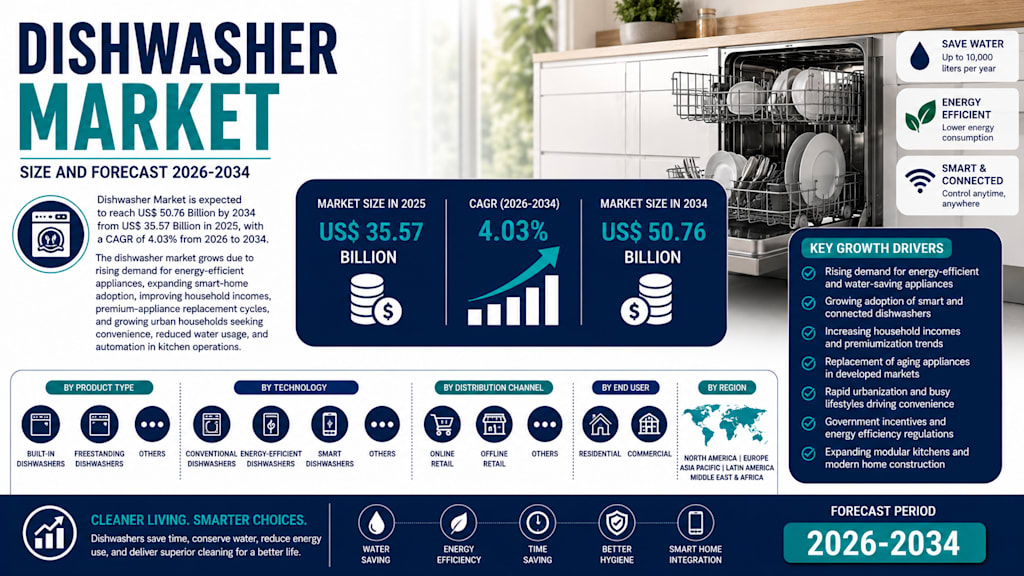
Global dishwasher market enters a new phase of smart appliance growth
The global dishwasher market is evolving steadily as consumers increasingly prioritize convenience, hygiene, automation, and energy efficiency in their kitchens. According to the latest market analysis, the Dishwasher Market is expected to grow from US$ 35.57 billion in 2025 to US$ 50.76 billion by 2034, registering a CAGR of 4.03% between 2026 and 2034.
The market’s growth reflects changing lifestyles across both developed and emerging economies. Urbanization, rising household incomes, dual-income families, and the expansion of smart homes are encouraging consumers to adopt appliances that reduce manual effort while improving operational efficiency.
Dishwashers are increasingly moving beyond luxury status and becoming essential kitchen appliances in many households and commercial establishments. Manufacturers are responding by introducing AI-enabled wash cycles, water-saving technologies, advanced drying systems, and smart connectivity features that align with modern consumer expectations.
Dishwashers are becoming essential in modern kitchens
A dishwasher is designed to automatically clean, rinse, and dry dishes, cookware, and utensils using pressurized water jets, detergent systems, and heat-based drying technologies. Modern dishwashers now offer multiple cleaning programs, noise-reduction systems, adjustable racks, eco-friendly wash cycles, and AI-powered optimization features.
The appeal of dishwashers extends beyond convenience. Consumers increasingly value them for:
- Better hygiene through high-temperature washing
- Reduced water consumption compared with manual washing
- Time savings for busy households
- Improved kitchen organization
- Integration with connected smart-home ecosystems
As awareness around sanitation, sustainability, and automation grows, dishwashers are becoming increasingly relevant in both residential and commercial kitchen environments.
Energy efficiency is becoming a major purchasing factor
One of the strongest drivers behind market growth is the increasing global demand for energy-efficient appliances. Consumers are becoming more conscious about water conservation, electricity consumption, and long-term utility savings. Governments are also tightening environmental standards and encouraging manufacturers to develop eco-compliant appliances.
Manufacturers are responding with advanced heat-pump drying systems, low-water wash cycles, eco-modes, and intelligent energy management technologies designed to minimize environmental impact.
The report highlights a major industry development from January 2025 when BSH Hausgeräte announced a EUR 150 million expansion of its Nauen manufacturing facility in Germany to increase built-in dishwasher production using heat-pump drying technology. The expansion is expected to boost production capacity by 20% by the fourth quarter of 2026 while helping the company align with upcoming EU ecodesign regulations.
This reflects a broader industry transition toward low-energy, sustainable appliance manufacturing.
Smart-home integration is reshaping premium appliance demand
The rapid rise of smart homes is significantly transforming the dishwasher industry. Consumers purchasing premium kitchen appliances increasingly expect remote operation, intelligent automation, predictive maintenance alerts, and integration with broader home ecosystems.
Modern smart dishwashers now include features such as:
- Wi-Fi connectivity
- Smartphone control
- AI-based wash optimization
- Voice-assistant compatibility
- Remote diagnostics
- Automated detergent management
- Predictive maintenance notifications
The report notes that LG Electronics launched its ThinQ-enabled dishwasher lineup in South Korea and Japan in November 2025. These dishwashers feature AI-powered cycle optimization, smartphone diagnostics, and integration with LG’s smart-home platform. Early usage data reportedly showed a 15% reduction in service calls because of predictive maintenance capabilities.
As smart-home penetration expands globally, connected dishwashers are expected to dominate premium appliance segments across North America, Europe, and Asia-Pacific.
Supply-chain integration is becoming strategically important
The dishwasher industry has faced growing pressure from raw-material volatility, semiconductor shortages, logistics disruptions, and geopolitical trade uncertainties. In response, manufacturers are strengthening supply-chain resilience and reducing dependency on imported components.
Vertical integration strategies are helping companies stabilize pricing, shorten production timelines, and secure access to essential dishwasher components such as motors, spray arms, electronic control systems, and pumps.
One notable development occurred in December 2025 when Whirlpool Corporation acquired a 35% stake in a Turkish appliance-component supplier for US$ 48 million. The move is expected to strengthen dishwasher component availability for European manufacturing operations while reducing exposure to tariff and logistics risks.
These supply-chain investments are increasingly important as manufacturers compete to maintain affordability and production efficiency.
Residential demand remains the market’s largest growth engine
Residential households continue representing the largest segment within the global dishwasher market. Urban lifestyles, busier work schedules, and rising disposable incomes are encouraging consumers to invest in appliances that reduce household workload and improve convenience.
Dual-income families in particular are driving dishwasher adoption because of time-saving benefits and growing interest in automated home solutions.
Consumers are also increasingly replacing older appliances with premium models offering quieter operation, improved water efficiency, and connected smart-home features. Replacement cycles are becoming an important source of revenue for appliance manufacturers, especially in mature markets.
At the same time, modular kitchen trends and premium home renovation projects are increasing demand for aesthetically integrated and built-in dishwasher designs.
Freestanding dishwashers continue expanding globally
Freestanding dishwashers remain highly popular because they offer installation flexibility, portability, and compatibility with various kitchen layouts. These units are especially attractive for renters, smaller homes, and urban apartments where built-in installation may not be practical.
Manufacturers are improving freestanding models through quieter operation, better rack flexibility, eco-wash programs, and smart connectivity features.
Competitive pricing compared with integrated models is also supporting adoption in emerging markets where affordability remains important.
The increasing popularity of modular and compact kitchen layouts globally is expected to sustain strong demand for freestanding dishwashers over the forecast period.
Commercial dishwasher demand continues rising
The commercial dishwasher market is expanding steadily due to rising demand from restaurants, hotels, hospitals, schools, and institutional kitchens that require rapid, hygienic, high-volume dishwashing solutions.
Strict sanitation regulations and operational efficiency requirements are pushing foodservice operators toward advanced commercial dishwashing systems capable of delivering:
- High-temperature sanitization
- Faster cleaning cycles
- Lower water consumption
- Improved durability
- Reduced downtime
The hospitality industry, quick-service restaurant expansion, and healthcare infrastructure growth are major contributors to this segment’s momentum.
Manufacturers are also integrating automation, IoT-based monitoring, predictive maintenance, and noise-reduction technologies to improve operational performance in commercial environments.
Online sales channels are reshaping consumer buying behavior
E-commerce is playing an increasingly important role in dishwasher sales globally. Consumers are turning to online platforms because they offer broader product comparisons, customer reviews, flexible financing options, and competitive pricing.
Digital platforms are also helping brands reach consumers in underserved regions while offering virtual product demonstrations, kitchen visualization tools, and installation guidance.
Seasonal online promotions, bundled warranties, and online-exclusive models are strengthening consumer preference for digital appliance purchasing channels.
As digital retail infrastructure continues improving globally, online dishwasher sales are expected to grow steadily.
High upfront costs continue limiting adoption in emerging markets
Despite increasing global awareness, dishwasher penetration remains relatively low in several developing countries because of affordability concerns. Many consumers still view dishwashers as premium or non-essential appliances compared with refrigerators or washing machines.
Additional challenges include:
- High installation costs
- Limited kitchen space
- Affordable domestic labor in some regions
- Inconsistent water pressure
- Weak after-sales service infrastructure
Although manufacturers are introducing smaller and more affordable models, reducing both financial and psychological adoption barriers remains difficult in many emerging economies.
Raw-material inflation and supply disruptions remain major concerns
The dishwasher industry remains heavily dependent on components such as stainless steel, motors, semiconductors, and plastic resins—all of which are vulnerable to price fluctuations and supply disruptions.
Logistics bottlenecks, geopolitical tensions, and changing tariff structures continue affecting manufacturing efficiency and pricing stability.
Manufacturers face ongoing pressure to balance cost management with innovation investment while maintaining competitive retail pricing.
These supply-side challenges are expected to remain influential across the global appliance sector over the next several years.
United States market driven by compact and smart appliances
The United States dishwasher market continues expanding because of strong household modernization trends and growing interest in compact, space-saving appliances.
A major development occurred in February 2025 when GE Profile introduced its Smart Compact Dishwasher designed for flexible installation across RVs, dormitories, home bars, and secondary kitchens.
The product reflects broader U.S. consumer trends favoring multifunctional, connected, and space-efficient home appliances.
Demand for premium smart dishwashers equipped with diagnostics, remote operation, and AI optimization continues rising strongly across the country.
Germany strengthens leadership in efficient compact appliances
Germany remains one of Europe’s strongest dishwasher markets because consumers highly value engineering efficiency, sustainability, and compact appliance design.
The report highlights Mabe’s launch of a compact dishwasher in March 2023 capable of washing dishes in under 40 seconds without requiring installation.
Such innovations align well with growing urban compact-living trends and demand for ultra-efficient household appliances.
India emerges as a fast-growing dishwasher market
India’s dishwasher market is expanding rapidly because of urbanization, larger households, rising disposable incomes, and growing awareness of kitchen hygiene and convenience.
Consumers increasingly prefer high-capacity dishwashers designed specifically for Indian cooking styles and larger families.
In August 2024, BSH Home Appliances launched new Bosch and Siemens dishwashers in India featuring 15-place settings, stainless-steel construction, and Home Connect technology enabling smartphone-based monitoring and operation.
Growing dual-income households and premium kitchen adoption are expected to continue driving strong long-term growth across India.
Saudi Arabia supports premium appliance expansion
Saudi Arabia’s dishwasher market is benefiting from rising disposable incomes, residential development projects, and increasing adoption of premium home appliances.
Consumers are increasingly upgrading kitchens with modern, high-performance appliances aligned with luxury housing and smart-home trends.
Strategic distribution partnerships and expanding retail infrastructure are also supporting broader appliance penetration across the Kingdom.
Key companies continue intensifying competition
The dishwasher market remains highly competitive with several multinational appliance manufacturers investing heavily in smart-home integration, manufacturing expansion, and sustainability innovation.
Key companies covered in the report include:
- Electrolux AB
- Panasonic
- Whirlpool
- Robert Bosch GmbH
- Samsung
- Siemens
- LG Electronics
- Haier
Ten notable developments shaping the dishwasher market
- Haier Smart Home opened a major dishwasher manufacturing facility in Hefei, China.
- Lufthansa introduced a new dishwasher series in India inspired by Milanese design.
- Bosch launched PowerControl spray arm technology for targeted cleaning efficiency.
- BSH Hausgeräte expanded production capacity for eco-friendly heat-pump dishwashers.
- Whirlpool strengthened supply-chain integration through strategic component investments.
- LG Electronics expanded ThinQ-enabled smart dishwasher offerings.
- GE Profile introduced compact smart dishwashers for flexible living environments.
- Mabe launched installation-free ultra-fast compact dishwashers.
- Smart-home integration is driving premium dishwasher replacement demand globally.
- Online appliance sales channels continue accelerating consumer adoption worldwide.
Final thoughts
The global dishwasher market is steadily evolving from a convenience-driven appliance category into a technologically advanced smart-kitchen ecosystem. Rising demand for energy efficiency, automation, hygiene, and connected living is reshaping both residential and commercial kitchen environments worldwide.
With the market projected to grow from US$ 35.57 billion in 2025 to US$ 50.76 billion by 2034, manufacturers are expected to intensify investment in smart connectivity, sustainable technologies, compact designs, and supply-chain resilience. The companies capable of balancing innovation, affordability, and environmental efficiency are likely to define the next phase of dishwasher market leadership globally.
About the Creator
Enjoyed the story? Support the Creator.
Subscribe for free to receive all their stories in your feed.
Comments
There are no comments for this story
Be the first to respond and start the conversation.