
Global Diagnostic Imaging Market to Reach US$68.81 Billion by 2034 as AI-Powered Technologies Revolutionize Early Disease Detection
Growing demand for early diagnosis, increasing prevalence of chronic diseases, rapid adoption of AI-assisted imaging systems, and expanding healthcare infrastructure are driving strong growth in the global diagnostic imaging market.

Diagnostic Imaging Is Transforming Modern Healthcare
Medical imaging has become one of the most essential pillars of modern healthcare, enabling physicians to diagnose diseases earlier, guide treatment decisions, and monitor patient outcomes with remarkable precision. From detecting fractures and internal injuries to identifying cancer, cardiovascular disease, and neurological disorders, diagnostic imaging technologies play a critical role across nearly every medical specialty.
Technological advances over the past decade have significantly improved imaging quality, scanning speed, patient comfort, and diagnostic accuracy. Artificial intelligence, automation, portable imaging systems, and high-resolution scanners are enabling healthcare providers to deliver faster and more reliable diagnoses while improving workflow efficiency across hospitals and diagnostic centers.
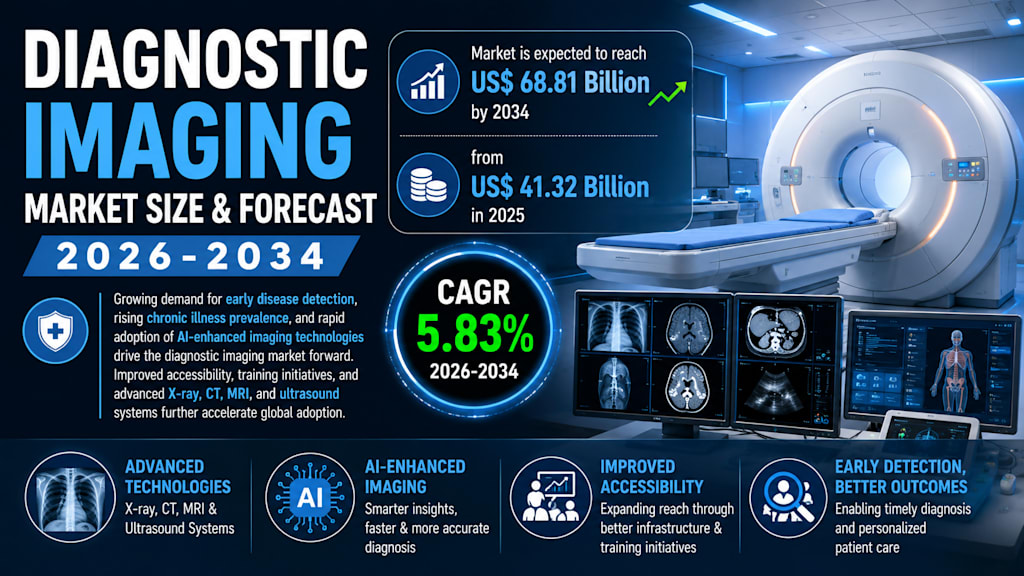
According to the latest market outlook, the Global Diagnostic Imaging Market is projected to grow from US$41.32 billion in 2025 to US$68.81 billion by 2034, registering a compound annual growth rate (CAGR) of 5.83% during 2026–2034. Rising chronic disease prevalence, increasing healthcare investments, expanding access to imaging technologies, and continuous innovation in AI-powered diagnostic systems continue supporting long-term market growth.
Diagnostic Imaging Supports Accurate Clinical Decision-Making
Diagnostic imaging refers to the use of advanced medical technologies that create detailed visual images of the body's internal structures.
Common imaging modalities include X-ray, computed tomography (CT), magnetic resonance imaging (MRI), ultrasound, positron emission tomography (PET), and other nuclear imaging systems.
These technologies assist physicians in diagnosing fractures, tumors, cardiovascular diseases, neurological disorders, infections, musculoskeletal injuries, and numerous other medical conditions.
Modern imaging systems also support treatment planning, image-guided interventions, surgical procedures, and long-term disease monitoring.
Early Disease Detection Continues Driving Market Growth
One of the strongest drivers of the diagnostic imaging market is the growing emphasis on early disease detection.
Healthcare providers increasingly recognize that identifying diseases during their earliest stages significantly improves treatment success and patient survival.
Imaging technologies are routinely used for cancer screening, cardiovascular risk assessment, neurological evaluation, orthopedic diagnosis, and preventive healthcare programs.
Growing awareness regarding preventive medicine continues encouraging patients to undergo routine imaging examinations before symptoms become severe.
This trend is expected to sustain long-term demand for advanced diagnostic imaging systems.
Artificial Intelligence Is Revolutionizing Radiology
Artificial intelligence has emerged as one of the most transformative innovations within diagnostic imaging.
AI-powered software assists radiologists by automatically identifying abnormalities, prioritizing urgent cases, improving image quality, and accelerating interpretation times.
Machine learning algorithms help detect cancers, fractures, cardiovascular disease, lung abnormalities, and neurological disorders with increasing precision.
AI also reduces radiologist workload while minimizing diagnostic variability across healthcare facilities.
Continuous improvements in artificial intelligence are expected to further strengthen diagnostic accuracy and workflow efficiency throughout the forecast period.
Healthcare Infrastructure Investment Expands Market Opportunities
Governments and private healthcare providers continue investing heavily in modern diagnostic imaging infrastructure.
Hospitals, diagnostic centers, specialty clinics, and outpatient facilities increasingly upgrade their imaging equipment to improve clinical capabilities and patient care.
Emerging economies are also expanding access to advanced imaging technologies by constructing new healthcare facilities and strengthening radiology services.
Growing healthcare expenditure worldwide continues creating favorable conditions for sustained market expansion.
Portable Imaging Improves Healthcare Accessibility
Portable imaging technologies are expanding access to diagnostic services beyond traditional hospital environments.
Compact X-ray systems, handheld ultrasound devices, mobile CT scanners, and portable imaging solutions allow physicians to perform examinations in emergency departments, ambulances, intensive care units, rural clinics, and remote healthcare settings.
Portable devices improve diagnostic speed while reducing patient transportation requirements.
The increasing popularity of point-of-care diagnostics continues supporting rapid adoption of portable imaging systems worldwide.
X-Ray Remains the Most Widely Used Imaging Modality
X-ray technology continues representing the largest segment of the diagnostic imaging market.
Its affordability, speed, and widespread availability make X-ray imaging the preferred first-line diagnostic tool for evaluating fractures, chest diseases, infections, orthopedic conditions, and dental disorders.
Digital radiography has significantly improved image quality while reducing radiation exposure and examination time.
Artificial intelligence is also enhancing X-ray interpretation by assisting physicians in detecting abnormalities more efficiently.
Ultrasound Continues Expanding Across Medical Specialties
Ultrasound remains one of the fastest-growing imaging technologies because it provides real-time visualization without exposing patients to ionizing radiation.
Ultrasound is extensively used in obstetrics, gynecology, cardiology, emergency medicine, abdominal imaging, and vascular examinations.
Recent advances including handheld ultrasound systems, wireless probes, and AI-assisted imaging continue expanding clinical applications.
Its portability and relatively low operating costs make ultrasound particularly valuable within primary healthcare settings.
Oncology Drives Significant Imaging Demand
Cancer diagnosis represents one of the largest application areas for diagnostic imaging.
CT, MRI, PET, ultrasound, and X-ray imaging play essential roles in detecting tumors, staging cancer, planning treatment, monitoring therapeutic response, and identifying recurrence.
Growing global cancer incidence continues increasing demand for advanced imaging systems capable of delivering high-resolution diagnostic information.
Early cancer detection through modern imaging technologies significantly improves treatment outcomes and patient survival rates.
Hospitals Remain the Largest End Users
Hospitals continue representing the largest end-user segment within the diagnostic imaging market.
Large healthcare institutions operate comprehensive radiology departments equipped with MRI, CT, PET, X-ray, ultrasound, and hybrid imaging systems capable of supporting diverse clinical specialties.
Hospitals increasingly integrate imaging technologies with artificial intelligence, digital health records, and picture archiving and communication systems (PACS) to improve workflow efficiency.
Growing inpatient admissions and expansion of tertiary healthcare facilities continue strengthening hospital demand for advanced imaging equipment.
Shortage of Skilled Radiologists Remains a Challenge
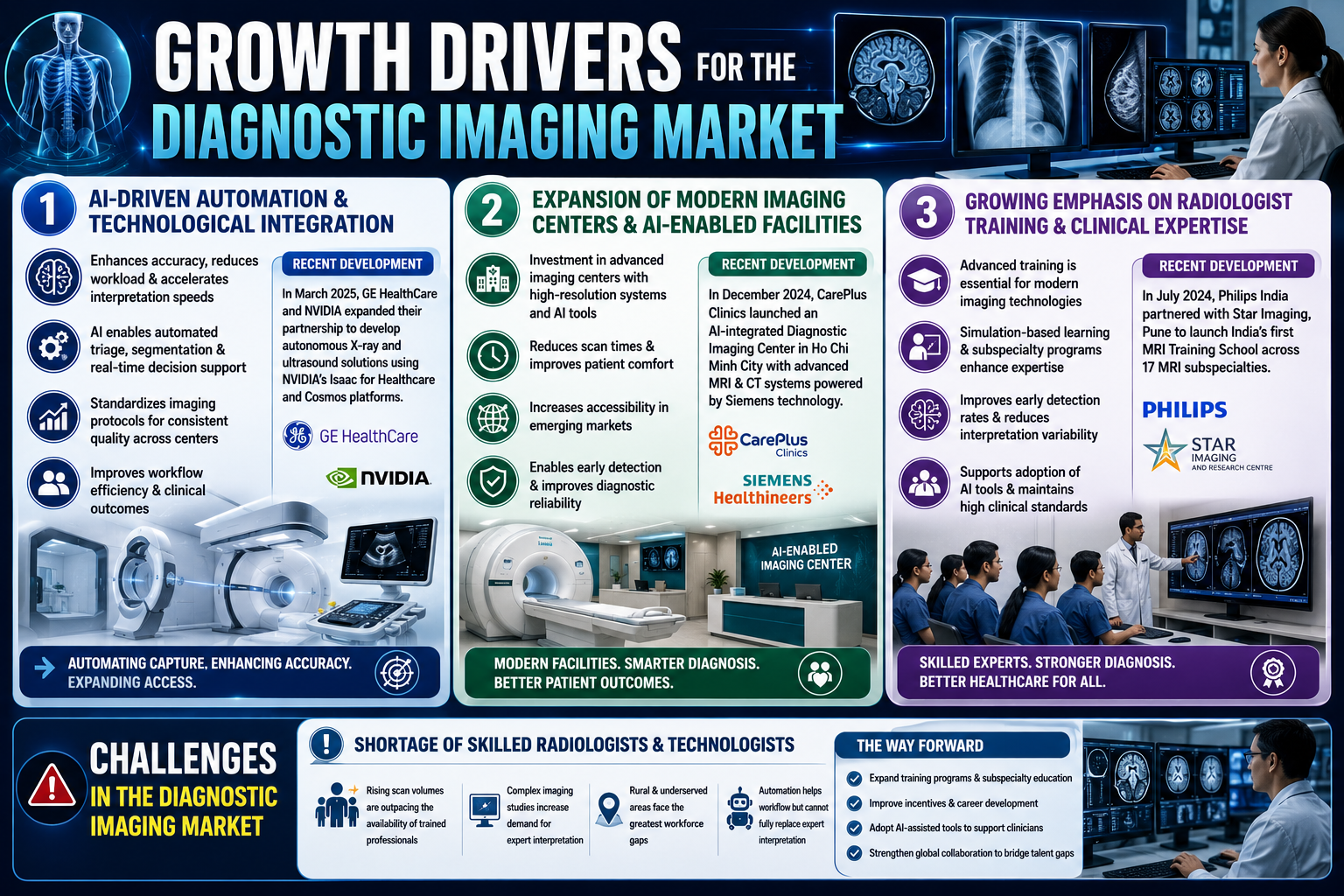
Despite rapid technological progress, many healthcare systems continue facing shortages of trained radiologists and imaging technologists.
Increasing imaging volumes place significant pressure on existing specialists, particularly within rural and underserved regions.
Although artificial intelligence helps improve workflow efficiency, expert clinical interpretation remains essential for complex medical cases.
Expanding radiology education, specialized training programs, and workforce development initiatives will remain critical for supporting continued market growth.
High Equipment Costs Limit Broader Adoption
Advanced imaging systems require substantial financial investment.
MRI scanners, CT systems, PET imaging equipment, installation, maintenance, software upgrades, and radiation safety infrastructure contribute to significant capital expenses.
Smaller hospitals and healthcare facilities in developing regions may delay equipment modernization because of budget limitations.
Manufacturers continue developing cost-effective technologies, financing programs, and portable imaging systems to improve accessibility.
Regional Markets Continue Driving Growth
The United States remains the world's largest diagnostic imaging market because of advanced healthcare infrastructure, widespread adoption of AI-assisted imaging, strong regulatory standards, and high utilization of MRI, CT, ultrasound, and X-ray technologies.
Germany continues leading the European market through its highly developed healthcare system, strong radiology expertise, extensive MRI and CT utilization, and ongoing healthcare digitization initiatives.
China has emerged as one of the fastest-growing markets due to expanding healthcare infrastructure, increasing investments in diagnostic technologies, rapid AI adoption, and growing demand for early disease detection across urban and rural healthcare systems.
Saudi Arabia continues strengthening its imaging capabilities through Vision 2030, healthcare modernization, expanding hospital infrastructure, standardized radiology services, and increased adoption of advanced diagnostic technologies.
Together, these regional markets continue shaping the future of the global diagnostic imaging industry.
Innovation Will Shape the Future of Medical Imaging
The future of diagnostic imaging will be driven by artificial intelligence, automation, cloud-based image management, portable diagnostics, and precision medicine.
Manufacturers continue developing autonomous imaging systems, AI-assisted interpretation software, advanced visualization technologies, and highly efficient digital workflows capable of improving diagnostic accuracy while reducing clinician workload.
Future innovations are expected to integrate seamlessly with electronic health records, predictive analytics, and personalized medicine platforms, enabling faster and more individualized patient care.
As healthcare systems increasingly emphasize early diagnosis and preventive medicine, diagnostic imaging will remain one of the most important technologies supporting modern clinical practice.
Final Thoughts
The global diagnostic imaging market continues experiencing steady growth as healthcare providers increasingly prioritize accurate diagnosis, early disease detection, and technology-driven patient care.
The projected expansion from US$41.32 billion in 2025 to US$68.81 billion by 2034, supported by a 5.83% CAGR, reflects rising demand for AI-powered imaging technologies, modern healthcare infrastructure, and advanced radiology services across hospitals and diagnostic centers.
Although workforce shortages and high equipment costs remain important challenges, continuous innovation in artificial intelligence, portable imaging systems, automation, and digital healthcare positions the diagnostic imaging industry for sustained long-term growth. As medical imaging continues evolving into an increasingly intelligent and connected healthcare solution, it will remain indispensable for improving patient outcomes worldwide.
About the Creator
Enjoyed the story? Support the Creator.
Subscribe for free to receive all their stories in your feed.
Comments
There are no comments for this story
Be the first to respond and start the conversation.