
Global Automotive Actuators Market Accelerates as Electric Vehicles, Smart Mobility, and Vehicle Automation Drive Industry Growth
Rising vehicle electrification, increasing adoption of advanced driver assistance systems, and growing consumer demand for comfort and safety features are fueling strong growth in the global automotive actuators market.

The automotive industry is undergoing one of the most significant transformations in its history. From electric vehicles and connected mobility to autonomous driving and intelligent vehicle systems, modern automobiles are becoming increasingly sophisticated. Behind many of these innovations lies a critical but often overlooked component: automotive actuators.
Automotive actuators serve as the muscles of modern vehicles, converting electrical, hydraulic, or pneumatic energy into mechanical movement. These devices power everything from braking systems and throttle control to seat adjustments, power windows, climate control systems, and advanced driver assistance technologies.
As consumers demand greater comfort, safety, efficiency, and automation, the role of actuators continues to expand. The shift toward electric vehicles (EVs), software-defined vehicles, and intelligent mobility solutions is creating substantial opportunities for actuator manufacturers worldwide.
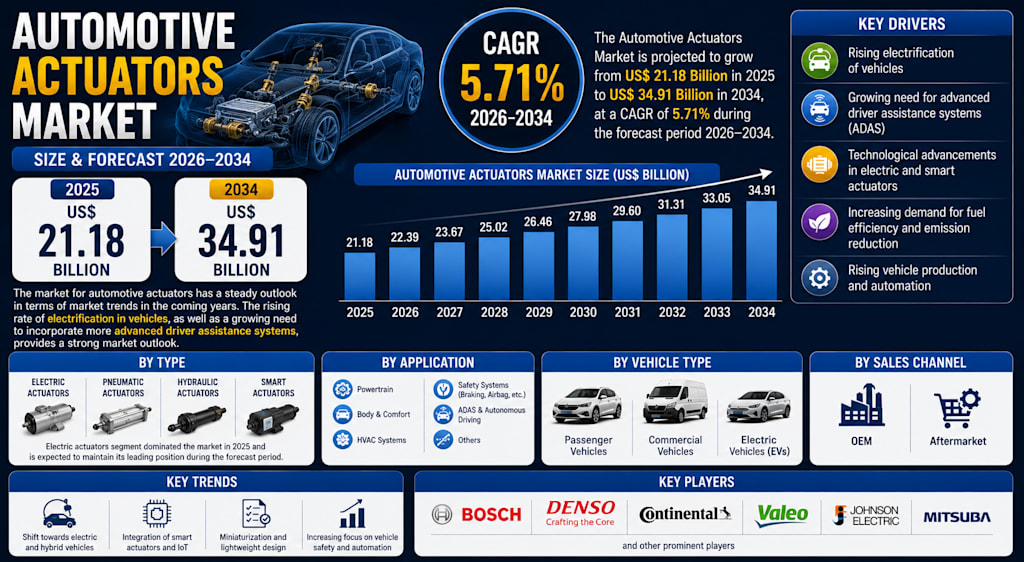
According to Renub Research, the Global Automotive Actuators Market is projected to grow from US$21.18 billion in 2025 to US$34.91 billion by 2034, registering a compound annual growth rate (CAGR) of 5.71% between 2026 and 2034. Rising vehicle electrification, increasing integration of advanced driver assistance systems (ADAS), and growing demand for comfort-oriented vehicle features are expected to drive long-term market expansion.
Automotive Actuators Are the Backbone of Modern Vehicle Functionality
Automotive actuators are mechanical or electromechanical devices that transform energy into controlled motion.
These components enable precise operation of numerous vehicle systems, including braking, steering, fuel injection, transmission control, HVAC systems, power windows, seat adjustment mechanisms, mirrors, and tailgates.
Without actuators, many of the automated features consumers now take for granted would not function.
As vehicles become increasingly electronic and software-driven, actuators are evolving into intelligent components capable of delivering greater accuracy, responsiveness, and efficiency.
Their growing importance reflects the broader transformation occurring throughout the global automotive industry.
Electric Vehicles Are Creating Massive Demand
One of the strongest drivers of automotive actuator demand is the rapid adoption of electric vehicles.
Unlike conventional internal combustion engine vehicles, electric vehicles rely heavily on electronically controlled systems that require multiple actuators to function efficiently.
Electric vehicles use actuators across battery systems, braking mechanisms, climate control systems, charging infrastructure, seat controls, steering functions, and energy management technologies.
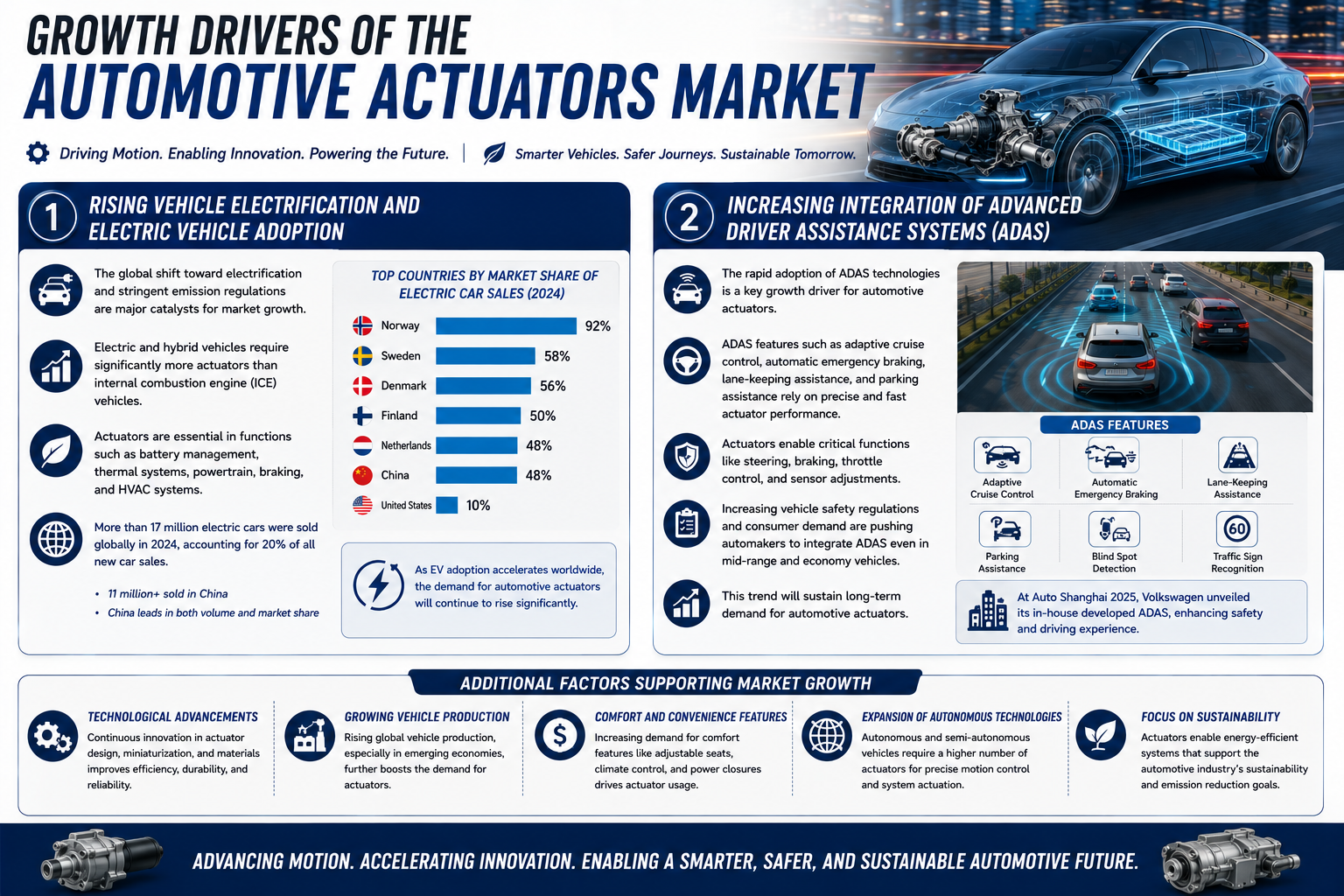
According to data referenced in the report, more than 17 million electric vehicles were sold globally in 2024, accounting for approximately 20% of all new vehicle sales worldwide. China alone represented around 11 million EV sales, maintaining its position as the world's largest electric vehicle market.
As governments continue promoting cleaner transportation and emissions reduction targets, EV adoption is expected to accelerate further, creating sustained demand for advanced automotive actuators.
Vehicle Electrification Is Transforming System Design
The broader shift toward vehicle electrification extends beyond battery-powered cars.
Hybrid vehicles, plug-in hybrids, and increasingly sophisticated electronic systems require highly efficient actuators to support numerous vehicle functions.
Traditional hydraulic and mechanical systems are gradually being replaced by electric alternatives that offer greater precision, improved efficiency, reduced weight, and easier integration with digital control systems.
Automakers increasingly favor electric actuators because they support modern vehicle architectures while helping improve energy efficiency.
This transition is expected to remain a major growth catalyst throughout the forecast period.
Advanced Driver Assistance Systems Fuel Growth
The growing adoption of Advanced Driver Assistance Systems (ADAS) is significantly expanding the role of automotive actuators.
ADAS technologies include adaptive cruise control, automatic emergency braking, lane-keeping assistance, collision avoidance systems, parking assistance, and traffic management functions.
These features rely on actuators to execute commands accurately and rapidly.
For example, actuators help control steering inputs, braking responses, throttle adjustments, and vehicle stabilization systems in real time.
As governments implement stricter vehicle safety regulations and consumers increasingly prioritize safety technologies, ADAS adoption continues expanding across both premium and mass-market vehicle categories.
This trend directly supports demand for high-performance automotive actuators.
Smart Mobility Is Driving Technological Innovation
The rise of connected and intelligent vehicles is reshaping actuator technology.
Modern vehicles increasingly integrate software-driven architectures, electronic control units (ECUs), sensors, and networked communication systems.
Actuators must now operate seamlessly within these complex ecosystems while delivering precise and reliable performance.
Software-defined vehicles rely on actuators that can communicate with onboard systems, provide diagnostic feedback, and adapt to changing driving conditions.
As smart mobility technologies become mainstream, actuator sophistication is expected to increase significantly.
Consumer Demand for Comfort Features Continues Rising
Beyond safety and efficiency, consumers increasingly expect vehicles to provide exceptional comfort and convenience.
Features such as power-adjustable seats, automatic tailgates, electric mirrors, climate control systems, sunroofs, and automated door mechanisms depend heavily on actuator technologies.
These features are no longer limited to luxury vehicles.
Many mid-range and entry-level models now include advanced comfort functions as manufacturers compete to attract buyers.
Growing consumer expectations regarding personalization and convenience continue driving actuator adoption across virtually all vehicle segments.
Premium Vehicle Growth Supports Market Expansion
The global premium vehicle segment remains an important contributor to actuator demand.
Luxury vehicles often feature a larger number of automated systems than standard passenger cars.
Advanced seat adjustment mechanisms, active suspension systems, intelligent climate control technologies, and sophisticated safety features require multiple actuators to operate effectively.
As premium vehicle ownership increases in both developed and emerging economies, manufacturers continue investing in advanced actuator solutions to enhance user experiences.
Electric Actuators Gain Market Share
Electric actuators are becoming the preferred choice across many automotive applications.
Compared to hydraulic and pneumatic alternatives, electric actuators offer several advantages, including higher efficiency, lower maintenance requirements, improved precision, and easier integration with digital systems.
They are particularly well-suited for electric vehicles and advanced driver assistance applications.
As automakers continue transitioning toward electrified platforms, electric actuators are expected to capture a growing share of the overall market.
Their compatibility with software-controlled vehicle architectures positions them as critical components of future mobility solutions.
Hydraulic Actuators Maintain Importance in High-Force Applications
Despite the growing popularity of electric actuators, hydraulic systems continue playing a crucial role in applications requiring substantial force and durability.
Hydraulic actuators are commonly used in braking systems, clutch systems, heavy-duty suspensions, and commercial vehicle applications.
These systems remain valuable because of their ability to generate high levels of force under demanding operating conditions.
Safety-critical applications often continue relying on hydraulic technologies due to their proven performance and reliability.
As a result, hydraulic actuators are expected to maintain an important position within the market.
Passenger Cars Represent the Largest Vehicle Segment
Passenger cars account for the largest share of automotive actuator demand globally.
Modern passenger vehicles utilize actuators throughout multiple systems, including doors, windows, mirrors, brakes, climate controls, seating mechanisms, and powertrain functions.
Consumers increasingly expect advanced convenience and safety features regardless of vehicle price category.
The rapid expansion of electric passenger vehicles further strengthens actuator demand.
As automotive manufacturers compete to differentiate products through technology and comfort, actuator integration is expected to continue increasing across the passenger vehicle segment.
Intelligent Vehicle Architectures Require Advanced Actuation
The evolution toward intelligent vehicles is increasing actuator complexity.
Modern passenger cars increasingly feature drive-by-wire systems, adaptive suspension technologies, and semi-autonomous driving capabilities.
These systems require highly responsive actuators capable of interacting with onboard sensors, control units, and software platforms.
Automotive manufacturers are increasingly integrating actuators into vehicle networks to enable predictive diagnostics, performance monitoring, and remote updates.
This evolution is creating new opportunities for innovation throughout the actuator industry.
Seat Adjustment Actuators Benefit from Comfort Trends
The automotive seat adjustment actuator segment is experiencing strong growth as consumers prioritize ergonomic comfort and customization.
Electric seat adjustment systems allow drivers and passengers to personalize seating positions, improving comfort during long journeys.
Demand is particularly strong in mid-range and premium vehicle categories.
Manufacturers increasingly incorporate memory settings, lumbar support adjustments, heating functions, and massage capabilities into modern seating systems.
These features require advanced actuator technologies capable of delivering smooth and precise movement.
As vehicle interiors become more sophisticated, seat adjustment actuators are expected to remain a significant growth segment.
Brake Actuators Play a Critical Safety Role
Brake actuators represent one of the most important safety-related applications within the automotive industry.
These components support systems such as Anti-lock Braking Systems (ABS), Electronic Stability Control (ESC), Automatic Emergency Braking (AEB), and brake-by-wire technologies.
As vehicle safety regulations become increasingly stringent, automakers continue investing heavily in advanced braking technologies.
Electric and hybrid vehicles also require sophisticated brake actuation systems capable of supporting regenerative braking functions.
The growing emphasis on accident prevention and vehicle safety ensures sustained demand for brake actuators.
Supply Chain Challenges Remain a Concern
Despite strong growth prospects, the automotive actuators market faces several challenges.
One of the most significant concerns involves supply chain disruptions and raw material dependency.
Actuator production requires electronic components, semiconductors, rare earth materials, specialized metals, and precision manufacturing processes.
Global supply chain disruptions, geopolitical tensions, transportation bottlenecks, and material shortages can significantly affect production schedules and costs.
Manufacturers must continually balance innovation, quality, and cost competitiveness while maintaining supply chain resilience.
High Development Costs Can Limit Market Entry
Developing advanced automotive actuators requires substantial investment in research, engineering, testing, and regulatory compliance.
Modern actuators must meet rigorous standards related to durability, reliability, safety, and performance.
Smaller manufacturers often face challenges competing with larger industry players that possess greater financial resources and technological expertise.
These development costs can create barriers to entry while increasing pressure on profit margins.
United States Leads Through Innovation
The United States remains one of the world's most important automotive actuator markets.
Strong vehicle production capabilities, advanced automotive research, and growing electrification initiatives continue supporting demand.
Automotive OEMs and suppliers in the United States are investing heavily in precision engineering, software-defined vehicles, and advanced mobility solutions.
In October 2025, Nexteer Automotive introduced its Direct Drive Hand Wheel Actuator (DD-HWA), designed for steer-by-wire applications and compatible with both 12V and 48V vehicle platforms.
This innovation highlights the industry's ongoing commitment to next-generation vehicle technologies.
United Kingdom Benefits from Electrification Trends
The United Kingdom's automotive actuator market is benefiting from increasing adoption of electric and hybrid vehicles.
Government regulations promoting lower emissions and enhanced vehicle safety are encouraging manufacturers to integrate more advanced electronic systems.
In January 2026, KnitMesh Technologies introduced PyroCore Pyrotechnic Actuator Mesh, reflecting ongoing innovation within the country's automotive technology sector.
The UK's focus on sustainability and smart mobility continues supporting long-term market opportunities.
India Emerges as a Fast-Growing Market
India's automotive actuator market is expanding rapidly due to rising vehicle production, increasing disposable incomes, and growing demand for advanced automotive features.
The country's electric vehicle initiatives and manufacturing expansion programs are creating favorable conditions for market growth.
In June 2024, Vitesco Technologies introduced its Rotor Lock Actuator platform, designed specifically for electric vehicle applications and integrating multiple functions within electric axles.
Such developments demonstrate India's growing importance within the global automotive ecosystem.
Saudi Arabia Strengthens Automotive Ambitions
Saudi Arabia's automotive actuator market is supported by rising vehicle ownership, growing demand for premium features, and increasing investment in automotive infrastructure.
Climate conditions also contribute to demand for HVAC-related actuator systems.
In December 2025, Saudi Arabia signed a memorandum of understanding with Petromin Corporation and STELLANTIS to explore establishing a full-scale automobile manufacturing facility within the country.
These initiatives could further stimulate future demand for automotive components and technologies.
Final Thoughts
The global automotive actuators market is entering a period of sustained growth driven by vehicle electrification, advanced driver assistance systems, intelligent mobility solutions, and rising consumer expectations.
As automobiles become increasingly connected, automated, and software-driven, actuators will play an even more critical role in enabling vehicle functionality, safety, and comfort.
With the market projected to grow from US$21.18 billion in 2025 to US$34.91 billion by 2034, substantial opportunities exist for component manufacturers, automotive suppliers, technology developers, and investors.
Although challenges related to supply chains, raw material costs, and technological complexity remain significant, ongoing innovation and strong demand for advanced vehicle technologies provide a solid foundation for future expansion.
As the automotive industry moves toward an electrified and autonomous future, automotive actuators will remain among the most important enabling technologies powering the next generation of mobility.
About the Creator
Enjoyed the story? Support the Creator.
Subscribe for free to receive all their stories in your feed.
Comments
There are no comments for this story
Be the first to respond and start the conversation.