
Global Autoimmune Disease Diagnostics Market Expands as Early Detection and Precision Testing Become Healthcare Priorities
Rising prevalence of autoimmune disorders, technological advancements in diagnostic testing, and growing awareness of early disease detection are driving steady growth across the global autoimmune disease diagnostics industry.

Autoimmune diseases have emerged as one of the fastest-growing categories of chronic illnesses worldwide, affecting millions of people across all age groups. These disorders occur when the body's immune system mistakenly attacks healthy tissues, leading to inflammation, organ damage, and a wide range of often-overlapping symptoms. Conditions such as rheumatoid arthritis, systemic lupus erythematosus, multiple sclerosis, type 1 diabetes, and autoimmune thyroid diseases continue to place increasing pressure on healthcare systems globally.
As awareness of autoimmune conditions grows, healthcare providers are emphasizing the importance of early and accurate diagnosis. Because many autoimmune diseases share similar symptoms and may remain undetected for years, advanced diagnostic technologies are becoming essential tools for improving patient outcomes and enabling timely treatment interventions.
The growing focus on personalized medicine, preventive healthcare, and precision diagnostics is creating significant opportunities for manufacturers, laboratories, and healthcare providers operating within this sector. As diagnostic technologies continue evolving, the global autoimmune disease diagnostics market is expected to experience sustained expansion throughout the next decade.
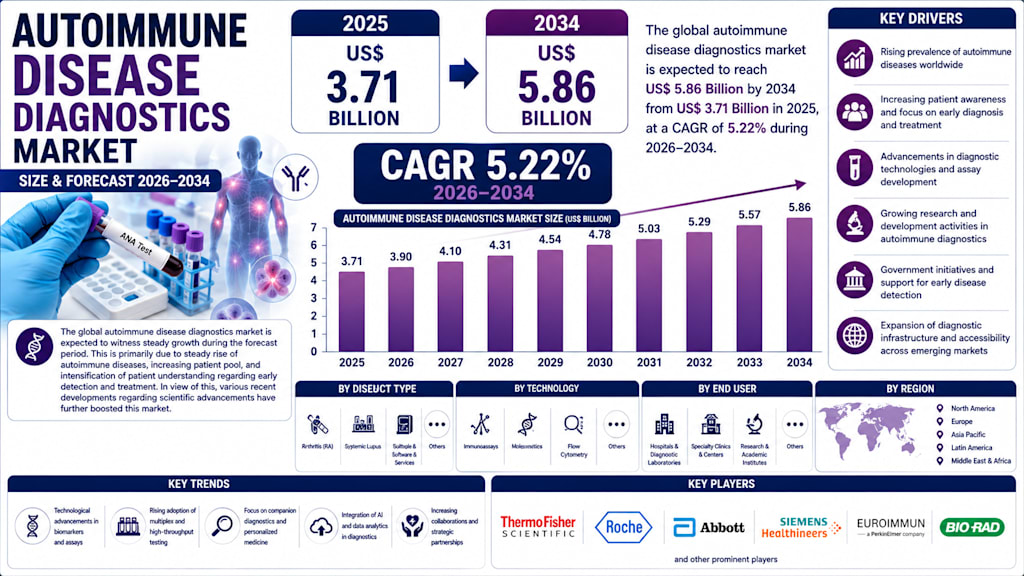
According to Renub Research, the Global Autoimmune Disease Diagnostics Market is projected to grow from US$3.71 billion in 2025 to US$5.86 billion by 2034, registering a compound annual growth rate (CAGR) of 5.22% between 2026 and 2034. Rising autoimmune disease prevalence, advancements in laboratory technologies, and growing emphasis on early diagnosis are expected to drive long-term market growth.
Autoimmune Disease Diagnostics Play a Critical Role in Modern Healthcare
Autoimmune disease diagnostics involve a wide range of laboratory tests and medical evaluations designed to identify disorders in which the immune system attacks healthy tissues and organs.
These diagnostic procedures often include blood tests, immunological assays, autoantibody detection, enzyme-linked immunosorbent assays (ELISA), antinuclear antibody (ANA) testing, and advanced molecular diagnostic techniques.
Because autoimmune diseases frequently present with complex and overlapping symptoms, accurate diagnostic testing is essential for confirming diagnoses and guiding treatment decisions.
Early detection enables healthcare providers to initiate therapies sooner, helping reduce disease progression, prevent organ damage, and improve quality of life for patients.
As healthcare systems increasingly prioritize preventive care and personalized treatment strategies, autoimmune disease diagnostics have become a vital component of modern medical practice.
Rising Autoimmune Disease Prevalence Continues to Fuel Demand
One of the most significant drivers of market growth is the increasing prevalence of autoimmune diseases worldwide.
Conditions such as rheumatoid arthritis, lupus, multiple sclerosis, autoimmune thyroid disorders, inflammatory bowel disease, and type 1 diabetes are being diagnosed at higher rates across many countries.
Researchers attribute this trend to a combination of genetic susceptibility, environmental influences, lifestyle factors, and improved disease recognition.
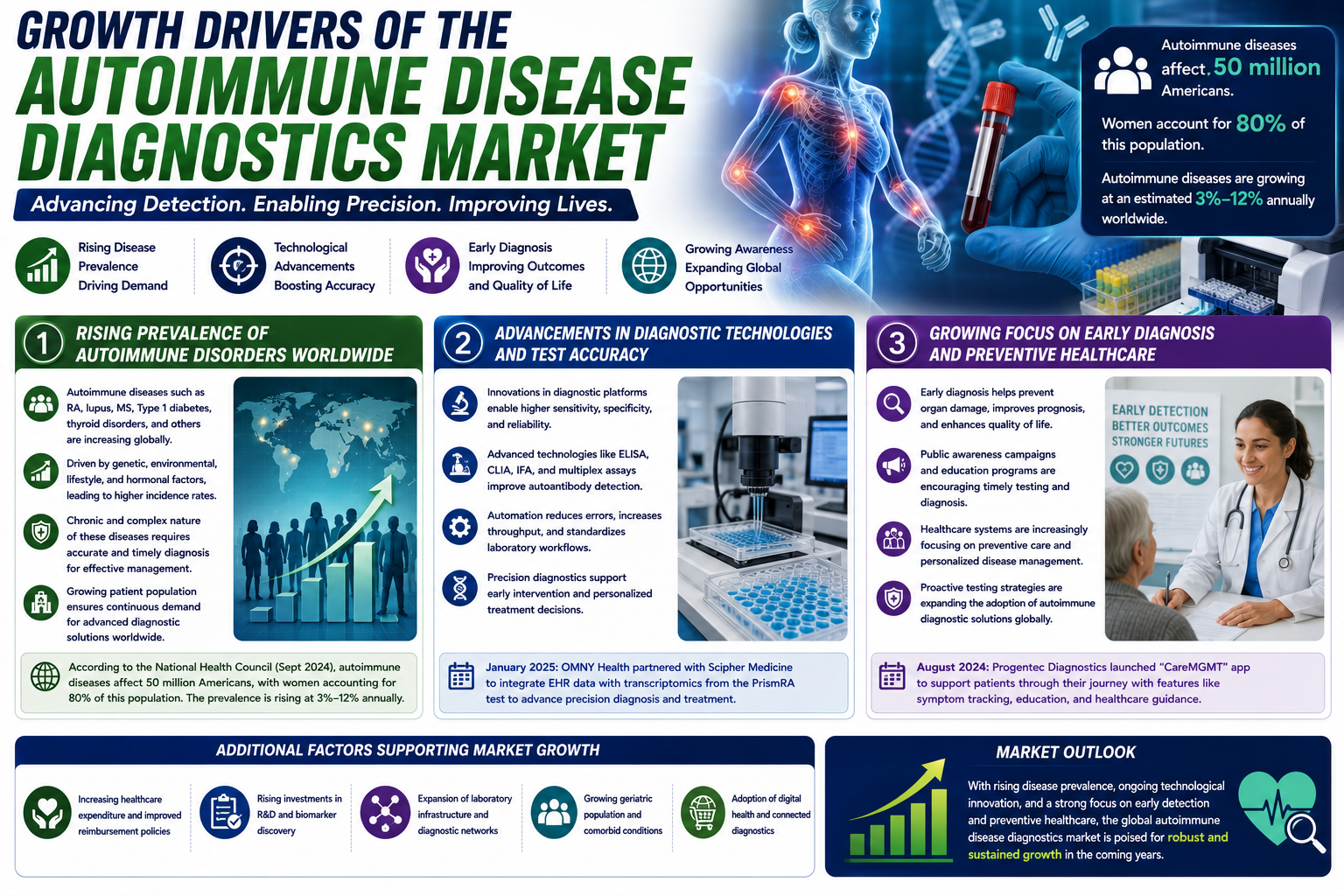
According to information cited in the report, autoimmune diseases affect approximately 50 million Americans, with women accounting for nearly 80% of diagnosed cases. Studies also suggest that autoimmune disease incidence is growing at an annual rate ranging between 3% and 12%.
As the patient population continues expanding, healthcare providers require increasingly sophisticated diagnostic solutions capable of identifying diseases accurately and efficiently.
Early Diagnosis Is Becoming a Healthcare Priority
Healthcare systems around the world are placing greater emphasis on early diagnosis and preventive medicine.
For autoimmune diseases, early detection is particularly important because delayed diagnosis can result in irreversible tissue damage, organ complications, and reduced treatment effectiveness.
Patients diagnosed during the early stages of disease often experience better long-term outcomes and improved quality of life.
Healthcare organizations, advocacy groups, and public awareness campaigns continue educating patients about recognizing symptoms and seeking medical evaluation sooner.
This growing focus on proactive healthcare management is strengthening demand for advanced diagnostic testing services worldwide.
Technological Innovation Is Transforming Diagnostic Accuracy
Rapid technological advancements have significantly improved the capabilities of autoimmune disease diagnostics.
Modern laboratory platforms offer greater sensitivity, specificity, and automation than previous generations of diagnostic tools.
Technologies such as ELISA, chemiluminescence immunoassays, indirect immunofluorescence assays, and multiplex testing systems enable clinicians to identify disease-specific biomarkers with greater precision.
Automation reduces human error while improving consistency and efficiency across laboratory workflows.
Enhanced testing accuracy helps clinicians make more informed treatment decisions and supports the growing trend toward personalized medicine.
As laboratory technologies continue evolving, diagnostic capabilities are expected to become even more sophisticated and accessible.
Precision Medicine Supports Market Expansion
The rise of precision medicine is creating additional opportunities within the autoimmune diagnostics market.
Healthcare providers increasingly seek diagnostic solutions capable of identifying specific disease pathways, biomarkers, and patient characteristics.
These insights help clinicians tailor treatment strategies to individual patient needs.
Advanced diagnostic testing also supports disease monitoring, treatment optimization, and long-term patient management.
As personalized healthcare continues gaining momentum globally, demand for specialized autoimmune diagnostic solutions is expected to increase substantially.
Digital Healthcare Integration Enhances Patient Management
Digital health technologies are becoming increasingly important in autoimmune disease management.
Mobile applications, patient monitoring platforms, and electronic health record integration are helping improve communication between patients and healthcare providers.
Digital tools enable symptom tracking, treatment monitoring, appointment management, and access to educational resources.
In August 2024, Progentec Diagnostics introduced the CareMGMT application, designed to support patients through symptom monitoring, healthcare information access, and disease management resources.
Such innovations demonstrate how digital health solutions are complementing traditional diagnostic services and improving patient engagement.
Diagnostics Equipment Segment Continues Growing
The diagnostics equipment segment represents a significant portion of the autoimmune disease diagnostics market.
Products such as immunological analyzers, ELISA readers, fluorescence microscopes, and chemiluminescence analyzers play critical roles in identifying autoantibodies and inflammatory biomarkers.
As laboratories seek greater efficiency, accuracy, and automation, demand for advanced diagnostic equipment continues increasing.
Investments in laboratory modernization, particularly in emerging markets, are creating new opportunities for equipment manufacturers.
The ongoing need for reliable and high-performance testing platforms is expected to support sustained growth within this segment.
Systemic Autoimmune Disease Diagnostics Remain a Major Segment
Systemic autoimmune diseases affect multiple organs and body systems, making diagnosis particularly challenging.
Conditions such as systemic lupus erythematosus, systemic sclerosis, and Sjögren's syndrome often present with diverse symptoms that overlap with other disorders.
Accurate diagnosis requires specialized testing, including antinuclear antibody screening and extractable nuclear antigen assays.
Growing awareness among physicians and patients regarding the importance of early detection continues driving demand for systemic autoimmune disease diagnostics.
As disease prevalence rises globally, this segment is expected to remain a major contributor to overall market growth.
Autoimmune Diabetes Diagnostics Gain Importance
The autoimmune diabetes diagnostics segment focuses primarily on type 1 diabetes and latent autoimmune diabetes in adults (LADA).
These conditions result from immune-mediated destruction of insulin-producing pancreatic beta cells.
Diagnostic testing involves identifying autoantibodies such as GAD antibodies, IA-2 antibodies, insulin autoantibodies, and ZnT8 antibodies.
Early and accurate diagnosis is critical because timely treatment can significantly improve disease management and patient outcomes.
Increasing incidence among children, adolescents, and young adults continues strengthening demand for specialized autoimmune diabetes diagnostic tests worldwide.
Multiple Sclerosis Diagnostics Continue Advancing
Multiple sclerosis remains one of the most complex autoimmune neurological disorders.
Because the disease affects the central nervous system and presents with varied symptoms, diagnosis often requires a combination of laboratory testing, imaging studies, and clinical evaluation.
Advances in neurological diagnostics and biomarker identification are improving clinicians' ability to diagnose multiple sclerosis earlier and more accurately.
As awareness and disease recognition improve, the multiple sclerosis diagnostics segment is expected to experience continued growth.
Hospitals Lead End-User Demand
Hospitals represent the largest end-user segment within the autoimmune disease diagnostics market.
Advanced laboratory infrastructure, specialized medical expertise, and comprehensive patient care capabilities make hospitals central providers of autoimmune diagnostic services.
Patients with complex or severe autoimmune conditions often require extensive testing and ongoing monitoring within hospital environments.
Growing healthcare investments and expanding diagnostic capabilities continue strengthening hospitals' role in market development.
As demand for autoimmune testing rises, hospitals are expected to remain key contributors to overall market growth.
Diagnostic Complexity Remains a Major Challenge
Despite significant technological progress, autoimmune disease diagnosis remains inherently challenging.
Many autoimmune conditions produce nonspecific symptoms such as fatigue, joint pain, inflammation, and general discomfort.
These symptoms often overlap with those of other chronic diseases, making differential diagnosis difficult.
Additionally, certain autoantibodies may appear in healthy individuals or multiple disease states, complicating interpretation.
These complexities can delay diagnosis, increase healthcare costs, and create challenges for both patients and clinicians.
Improving diagnostic precision remains a major focus for researchers and healthcare providers.
High Testing Costs Limit Accessibility
The cost of advanced autoimmune diagnostic testing represents another significant challenge.
Sophisticated immunopathology, molecular diagnostics, and specialized laboratory analyses often require expensive equipment and highly trained personnel.
In low-income and middle-income countries, limited healthcare infrastructure and affordability concerns may restrict access to advanced testing services.
Reducing costs while maintaining diagnostic accuracy remains an important priority for industry stakeholders seeking broader global adoption.
United States Leads the Global Market
The United States remains one of the largest and most advanced autoimmune disease diagnostics markets globally.
A large patient population, sophisticated healthcare infrastructure, and strong investment in medical research support widespread adoption of advanced testing technologies.
The country benefits from a well-established network of hospitals, diagnostic laboratories, and specialty care centers.
Continued innovation in immunology, molecular diagnostics, and precision medicine further strengthens market growth.
Growing public awareness and physician expertise continue supporting demand across the U.S. market.
United Kingdom Benefits from Strong Healthcare Infrastructure
The United Kingdom's autoimmune disease diagnostics market is supported by the National Health Service and a strong emphasis on standardized healthcare delivery.
Diagnostic laboratories increasingly utilize advanced immunoassays and automated testing platforms to improve disease detection capabilities.
Growing awareness among clinicians and patients has contributed to higher testing volumes.
Continued investments in laboratory modernization and digital pathology solutions are expected to support market expansion despite healthcare budget constraints.
India Emerges as a High-Growth Market
India's autoimmune disease diagnostics market is expanding rapidly due to rising disease awareness, healthcare modernization, and growing diagnostic infrastructure.
Private diagnostic laboratories and hospital networks continue investing in advanced testing technologies that improve access to specialized autoimmune diagnostics.
Urbanization, increasing healthcare spending, and greater patient awareness are driving demand across metropolitan and tier-two cities.
Although affordability challenges remain, local manufacturing and cost-effective testing solutions are helping improve accessibility.
India's growing focus on early diagnosis positions the country as an important growth market for the industry.
Saudi Arabia Strengthens Diagnostic Capabilities
Saudi Arabia's autoimmune disease diagnostics market continues developing as healthcare modernization efforts accelerate.
Government investments in hospitals, specialty clinics, and diagnostic laboratories are improving access to advanced testing services.
Growing awareness of autoimmune disorders and increasing emphasis on preventive healthcare are supporting demand.
The expansion of private healthcare services and national healthcare quality initiatives are expected to create additional opportunities for market participants throughout the coming years.
Recent Industry Developments Highlight Innovation
The autoimmune disease diagnostics industry continues experiencing significant innovation and strategic collaboration.
In January 2025, OMNY Health partnered with Scipher Medicine to integrate electronic health record data with transcriptomics information from the PrismRA test, supporting more personalized autoimmune disease treatment approaches.
In March 2025, Savara Inc. launched the aPAP ClearPath Dried Blood Spot Test in the United States, enabling diagnosis of Autoimmune Pulmonary Alveolar Proteinosis through a simple finger-prick sample.
These developments demonstrate the industry's ongoing commitment to improving diagnostic accessibility, accuracy, and patient outcomes.
Final Thoughts
The global autoimmune disease diagnostics market is entering a period of sustained growth driven by rising disease prevalence, expanding healthcare awareness, and continuous technological innovation.
As healthcare systems increasingly prioritize early detection, personalized medicine, and preventive care, advanced diagnostic solutions are becoming essential tools for managing complex autoimmune disorders.
With the market projected to grow from US$3.71 billion in 2025 to US$5.86 billion by 2034, substantial opportunities exist for diagnostic laboratories, healthcare providers, technology developers, and investors.
While challenges related to diagnostic complexity and testing affordability remain important considerations, continued advances in laboratory science and healthcare infrastructure provide a strong foundation for future growth.
As awareness of autoimmune diseases continues increasing worldwide, accurate and timely diagnostics will remain at the center of improving patient outcomes and transforming long-term disease management.
About the Creator
Enjoyed the story? Support the Creator.
Subscribe for free to receive all their stories in your feed.
Comments
There are no comments for this story
Be the first to respond and start the conversation.