
Global Agricultural Micronutrients Market Poised for Strong Growth as Sustainable Farming and Precision Agriculture Gain Momentum
Rising Soil Nutrient Deficiency, High-Yield Crop Demand, and Smart Farming Technologies Are Reshaping the Future of Global Agriculture

Healthy soil is the foundation of global food production, but years of intensive farming, nutrient depletion, and increasing demand for agricultural output have significantly reduced soil fertility across many regions of the world. As farmers strive to produce more food using limited farmland, agricultural micronutrients have emerged as one of the most effective solutions for improving crop health, enhancing yields, and maintaining long-term soil productivity.
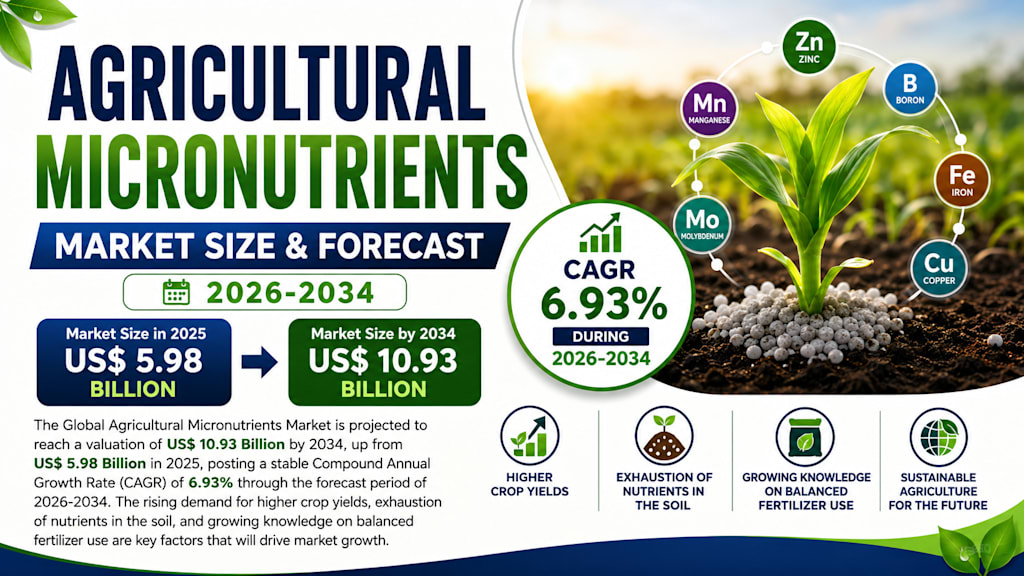
According to Renub Research, the Global Agricultural Micronutrients Market is expected to grow from US$5.98 Billion in 2025 to US$10.93 Billion by 2034, registering a compound annual growth rate (CAGR) of 6.93% between 2026 and 2034. The market's expansion is being driven by increasing soil nutrient depletion, rising demand for high-quality crops, widespread adoption of precision agriculture, and growing awareness of balanced fertilizer application.
As agriculture becomes increasingly technology-driven, micronutrients are no longer viewed as optional supplements. Instead, they are becoming an essential component of modern crop nutrition strategies designed to maximize productivity while protecting valuable natural resources.
What Are Agricultural Micronutrients?
Agricultural micronutrients are essential minerals that plants require in relatively small quantities but are vital for healthy growth and development. These include zinc, boron, iron, manganese, copper, molybdenum, and chlorine.
Although crops consume much smaller amounts of these nutrients than primary macronutrients such as nitrogen, phosphorus, and potassium, their importance cannot be overstated. Micronutrients regulate enzyme activity, support photosynthesis, improve nutrient absorption, strengthen plant immunity, encourage flowering and fruit development, and contribute to overall crop quality.
Even a minor deficiency of one micronutrient can significantly reduce crop yields, delay plant growth, and lower product quality. As global food demand continues increasing, maintaining balanced soil nutrition has become a priority for farmers worldwide.
Soil Nutrient Depletion Is Accelerating Market Growth
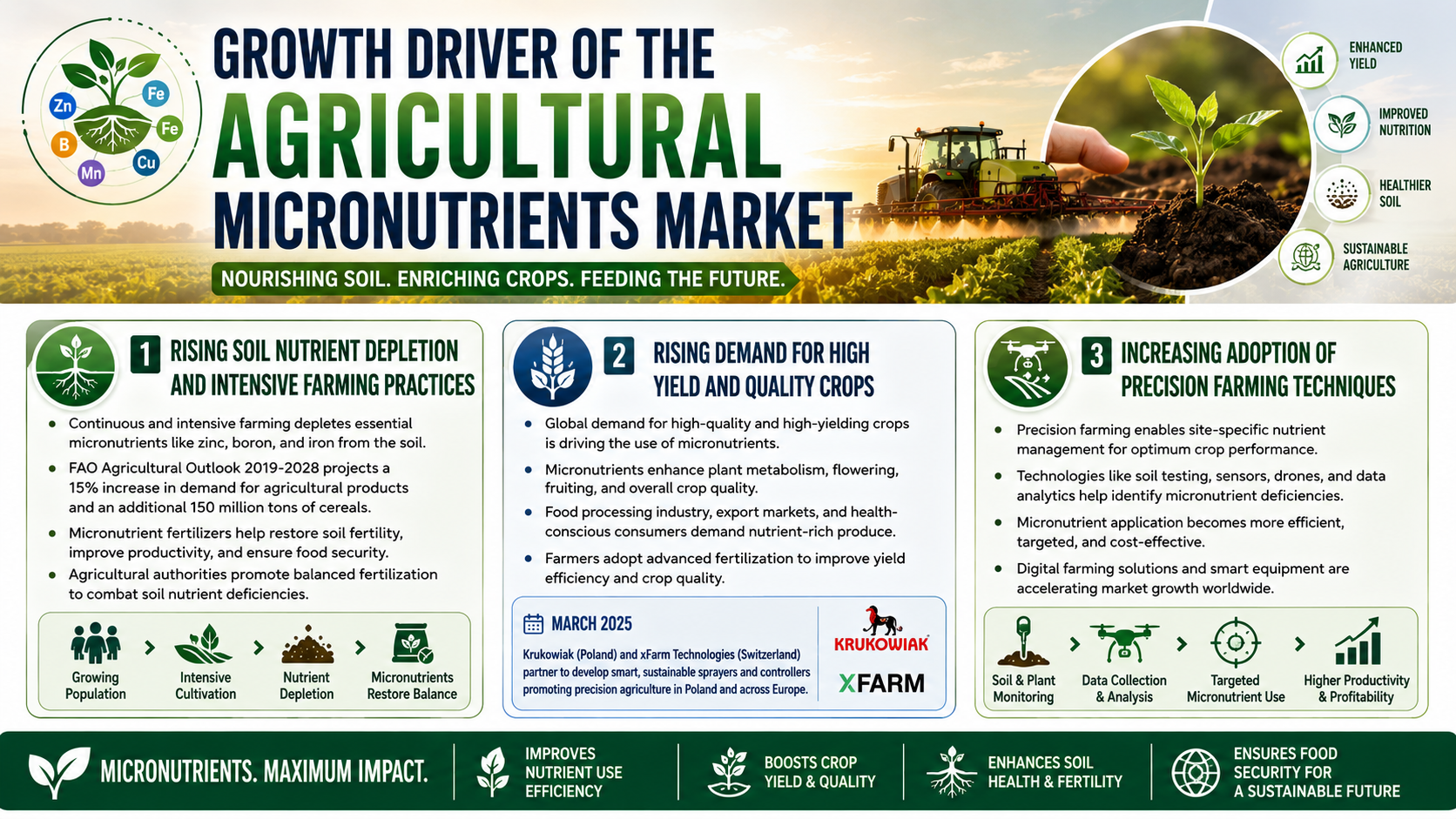
One of the strongest drivers behind the agricultural micronutrients market is the continuous depletion of nutrients from agricultural soils.
Decades of intensive cultivation have gradually exhausted naturally occurring micronutrients, particularly in regions where crops are harvested repeatedly without adequate soil replenishment. Many farmers traditionally focus on applying nitrogen, phosphorus, and potassium fertilizers while overlooking essential trace elements required for healthy plant development.
According to agricultural forecasts, food demand will continue rising steadily as the global population grows. Producing more food from the same amount of arable land requires healthier soils capable of supporting higher yields.
Micronutrient fertilizers help restore nutrient balance, improve soil fertility, and enhance agricultural productivity, making them increasingly valuable in modern farming systems.
Demand for High-Quality Crops Continues to Rise
Consumer expectations are changing rapidly across global food markets.
Today's consumers expect fruits, vegetables, cereals, and other agricultural products that are nutritious, visually attractive, and consistently high in quality. Food processors, exporters, supermarkets, and retailers also maintain strict quality standards, encouraging farmers to adopt more advanced nutrient management practices.
Agricultural micronutrients directly influence important crop characteristics including fruit size, color, shelf life, nutritional value, and disease resistance.
Farmers increasingly recognize that investing in balanced nutrition generates higher yields while producing crops capable of meeting premium market requirements.
Growing interest in healthy diets and nutrient-rich foods further supports demand for agricultural micronutrient products worldwide.
Precision Agriculture Is Revolutionizing Nutrient Management
Technological innovation has transformed the way farmers manage crop nutrition.
Precision agriculture combines GPS technology, soil testing, satellite imagery, drones, sensors, artificial intelligence, and digital farm management systems to monitor field conditions with exceptional accuracy.
Instead of applying fertilizers uniformly across entire fields, farmers can now identify nutrient deficiencies in specific locations and apply micronutrients precisely where needed.
This targeted approach improves fertilizer efficiency, reduces unnecessary application, minimizes environmental impact, and lowers production costs.
Governments and agricultural technology companies continue promoting precision farming through education programs, digital platforms, and financial incentives, accelerating the adoption of micronutrient fertilizers worldwide.
Sustainable Agriculture Is Becoming a Global Priority
Environmental sustainability has become one of agriculture's defining objectives.
Farmers are under increasing pressure to improve productivity while reducing fertilizer waste, protecting water resources, and maintaining long-term soil health.
Balanced fertilization supports these goals by ensuring crops receive essential nutrients without excessive chemical application.
Micronutrients contribute to stronger root systems, improved nutrient utilization, better water efficiency, and greater resilience against environmental stress.
As sustainable farming practices expand globally, agricultural micronutrients are becoming an integral part of environmentally responsible crop management.
Challenges Continue to Limit Market Expansion
Despite positive market prospects, several challenges remain.
One significant obstacle is limited awareness among farmers, particularly in developing countries. Many producers continue relying exclusively on conventional fertilizers without understanding the importance of micronutrients for crop performance.
Limited access to soil testing services, agricultural education, and technical guidance often prevents farmers from identifying nutrient deficiencies accurately.
Government extension programs, agricultural universities, and private companies are therefore increasing educational initiatives designed to improve farmer awareness and encourage balanced fertilizer use.
Product Costs Affect Adoption
Higher prices remain another important challenge.
Micronutrient fertilizers often cost more than conventional fertilizers due to specialized manufacturing processes, advanced formulations, and distribution expenses.
Small-scale farmers operating with limited financial resources may hesitate to invest despite the long-term productivity benefits.
Expanding subsidy programs, affordable product development, and improved financing options could significantly accelerate adoption across emerging agricultural markets.
Chelated Micronutrients Continue Gaining Popularity
Chelated micronutrients represent one of the fastest-growing product categories within the market.
These fertilizers combine mineral nutrients with organic compounds that protect them from reacting with soil elements that would otherwise reduce nutrient availability.
Because chelated products remain more stable, plants absorb nutrients more efficiently, even in challenging soil conditions.
High-value crops such as fruits, vegetables, flowers, and horticultural plants particularly benefit from chelated formulations due to their precise nutritional requirements.
Their ability to maximize nutrient efficiency while reducing losses continues driving global demand.
Fruits and Vegetables Lead Market Consumption
Among all crop categories, fruits and vegetables account for one of the largest shares of micronutrient consumption.
These crops require balanced nutrition throughout their growth cycle to achieve desirable size, appearance, flavor, and nutritional quality.
Boron contributes to flowering and fruit development, zinc supports enzyme activity, while calcium and iron improve structural strength and photosynthesis.
Growing global demand for fresh produce, combined with expanding export markets, encourages farmers to invest in comprehensive nutrient management programs.
Oilseeds and Pulses Present Growing Opportunities
Oilseeds and pulse crops are becoming increasingly important consumers of agricultural micronutrients.
These crops supply essential proteins and edible oils that support global food security.
Micronutrients including zinc, iron, and molybdenum promote nitrogen fixation, root development, and protein formation, leading to healthier plants and improved yields.
As plant-based diets gain popularity worldwide, demand for high-quality oilseeds and pulses continues supporting micronutrient market growth.
Zinc Remains the Most Widely Used Micronutrient
Among individual micronutrients, zinc occupies a leading market position.
Zinc plays a critical role in chlorophyll formation, enzyme activation, protein synthesis, and plant growth regulation.
Deficiencies frequently result in stunted growth, delayed maturity, and lower crop productivity.
Because zinc deficiencies are widespread across agricultural soils in many countries, zinc-based fertilizers remain among the most commonly applied micronutrient products globally.
Iron Supports Healthy Crop Development
Iron is another essential micronutrient supporting photosynthesis, respiration, and energy transfer within plants.
Iron deficiencies frequently cause chlorosis, a condition where leaves become yellow due to reduced chlorophyll production.
Modern iron chelates provide effective nutrient availability even under alkaline soil conditions where conventional iron fertilizers perform poorly.
Their effectiveness has encouraged widespread adoption across numerous crop categories.
Soil Application Continues Leading Fertilizer Practices
Although multiple application methods exist, soil application remains the dominant delivery system for agricultural micronutrients.
Applying nutrients directly into the soil helps replenish depleted fertility while supporting root development and long-term crop health.
Growing interest in soil testing enables farmers to apply nutrients more accurately according to specific field requirements, improving productivity while reducing waste.
Fertigation Is Transforming Modern Agriculture
Fertigation, which delivers fertilizers through irrigation systems, represents one of agriculture's fastest-growing nutrient application methods.
This technique ensures precise nutrient delivery directly into plant root zones while minimizing fertilizer runoff and improving water efficiency.
Fertigation has become particularly valuable in greenhouse production, hydroponics, drip irrigation systems, and high-value crop cultivation where precise nutrition significantly influences productivity.
Regional Markets Continue Expanding
The United States remains one of the world's largest agricultural micronutrients markets due to advanced farming technologies, precision agriculture adoption, and strong farmer awareness.
France continues emphasizing balanced nutrition to support premium-quality vineyards, grains, and fruit production while expanding sustainable agriculture initiatives.
India represents one of the fastest-growing markets as government awareness campaigns, widespread zinc deficiencies, and increasing drone-based fertilizer applications accelerate adoption.
Brazil's agricultural sector also presents significant opportunities because nutrient-deficient tropical soils require balanced fertilization to sustain soybean, coffee, sugarcane, and grain production.
Competitive Landscape Encourages Innovation
Leading agricultural input companies continue investing heavily in research and development.
Manufacturers are introducing advanced formulations with improved nutrient stability, enhanced absorption, environmentally responsible ingredients, and compatibility with precision farming technologies.
Digital agriculture platforms, artificial intelligence, remote sensing, and automated nutrient management systems are expected to create additional opportunities for product innovation during the coming decade.
Future Outlook
The future of the agricultural micronutrients market appears highly promising as global agriculture continues evolving toward greater sustainability, efficiency, and technological sophistication.
Growing populations, changing dietary preferences, shrinking arable land, climate uncertainty, and increasing environmental concerns all reinforce the need for smarter nutrient management.
Precision farming, soil analytics, artificial intelligence, satellite monitoring, and sustainable fertilizer technologies will continue improving nutrient efficiency while helping farmers maximize productivity with fewer resources.
Final Thoughts
Agricultural micronutrients have become an indispensable component of modern farming. Their ability to restore soil fertility, improve crop quality, increase yields, and support sustainable agricultural practices makes them essential for meeting future global food requirements.
Supported by rising awareness, technological innovation, expanding precision agriculture, and increasing investments in sustainable farming, the market is positioned for steady long-term growth.
With the Global Agricultural Micronutrients Market projected to reach US$10.93 Billion by 2034 from US$5.98 Billion in 2025, growing at a CAGR of 6.93%, micronutrients will continue playing a central role in helping farmers produce healthier crops while protecting the world's agricultural resources for future generations.
About the Creator
Enjoyed the story? Support the Creator.
Subscribe for free to receive all their stories in your feed.
Comments
There are no comments for this story
Be the first to respond and start the conversation.