
Global 4K Medical Imaging Market Accelerates as Healthcare Providers Prioritize Precision Diagnostics and Minimally Invasive Surgery
Rising demand for ultra-high-definition imaging, rapid advances in surgical visualization technologies, and increasing healthcare investments are driving strong expansion across the global 4K medical imaging industry.

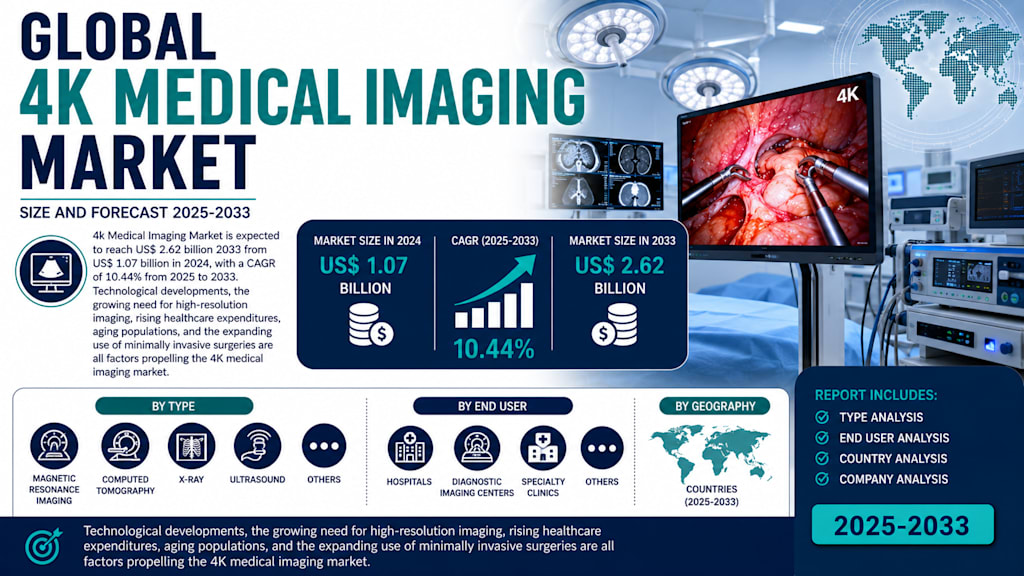
Global 4K medical imaging market enters a high-growth innovation cycle
The global 4K medical imaging market is witnessing rapid transformation as hospitals, diagnostic centers, and surgical facilities increasingly adopt ultra-high-definition imaging technologies to improve precision, visualization, and patient outcomes. According to the latest market analysis, the 4K Medical Imaging Market is projected to grow from US$ 1.07 billion in 2024 to US$ 2.62 billion by 2033, expanding at a CAGR of 10.44% between 2025 and 2033.
This impressive growth reflects a broader shift in modern healthcare toward more accurate diagnostics, minimally invasive procedures, and digitally advanced surgical environments. Healthcare providers are investing heavily in next-generation imaging systems that provide sharper detail, enhanced visualization, and better clinical decision-making capabilities.
At the center of this transformation is 4K imaging technology, which delivers a resolution of 3840 × 2160 pixels—four times the clarity of standard high-definition imaging. This enhanced resolution is improving the ability of physicians and surgeons to visualize tissues, blood vessels, organs, and abnormalities with far greater accuracy.
What makes 4K medical imaging important in modern healthcare?
4K medical imaging refers to the use of ultra-high-definition visualization systems in medical diagnostics and surgical procedures. Compared to traditional imaging technologies, 4K systems provide dramatically improved image sharpness, color depth, and anatomical detail.
This level of precision is especially valuable in fields where visual clarity directly impacts patient outcomes, including:
- Radiology
- Endoscopy
- Minimally invasive surgery
- Neurosurgery
- Orthopedics
- Urology
- Gynecology
Improved visualization allows healthcare professionals to identify abnormalities earlier, navigate delicate anatomical structures more precisely, and perform procedures with greater confidence.
The technology also supports better surgical accuracy, lowers the likelihood of procedural errors, and improves treatment planning. As healthcare systems continue prioritizing precision medicine and minimally invasive interventions, demand for high-resolution imaging solutions is increasing rapidly.
Demand for better visualization is driving industry growth
One of the strongest growth drivers for the 4K medical imaging market is the increasing need for enhanced visualization in clinical environments. Hospitals and surgical centers are seeking advanced imaging platforms that provide more detailed views during diagnostics and operations.
The report highlights several notable innovations that reflect this trend. In September 2024, Stryker introduced its 1788 advanced imaging platform in India, offering 4K high-resolution imaging designed to improve surgical visualization and fluorescence-guided surgery.
The system incorporates OLED display technology, high dynamic range imaging, and expanded color gamut support, enabling surgeons to view anatomy and tissue perfusion more clearly during procedures.
Such innovations are becoming increasingly important in modern operating rooms where procedural precision and real-time imaging quality directly influence patient safety and surgical efficiency.
Minimally invasive surgery continues to boost adoption
The growing global preference for minimally invasive surgical procedures is another major factor accelerating adoption of 4K imaging technologies. Surgeons performing minimally invasive procedures rely heavily on imaging systems because operations are conducted through small incisions using cameras and specialized instruments.
4K imaging significantly improves visibility during these procedures by providing highly detailed views of internal anatomy. This helps surgeons perform delicate interventions with greater precision while reducing risks associated with tissue damage or incomplete visualization.
The report notes that Olympus introduced the 4K CH-S700-08-LB camera head in September 2024 specifically for gynecological and urological applications. The system combines 4K white light imaging, narrow-band imaging (NBI), and blue light imaging technologies to improve detection and treatment outcomes, particularly in bladder cancer procedures.
As minimally invasive surgery becomes more common across specialties such as orthopedics, gastrointestinal surgery, urology, and cardiology, demand for high-performance imaging systems is expected to increase steadily.
Advanced video recording and data management are reshaping workflows
Modern healthcare facilities increasingly require integrated imaging systems capable of recording, storing, and managing large amounts of surgical and diagnostic video data efficiently. 4K medical imaging systems are therefore evolving beyond visualization tools into comprehensive digital workflow platforms.
The report highlights the launch of MediCapture’s MVR 4K surgical recording system in July 2024. The compact platform supports dual 4K inputs, multi-input recording, advanced data management, and 1TB storage capacity for digital operating rooms.
These capabilities help healthcare providers improve operational efficiency, enhance surgical documentation, and maintain secure patient imaging archives.
The integration of advanced recording systems also supports medical education, remote consultation, surgical review, and AI-assisted healthcare applications.
Aging populations and chronic disease prevalence support demand
Global demographic trends are also supporting long-term market growth. Aging populations worldwide are increasing the demand for advanced diagnostic imaging and surgical procedures.
Older populations are more likely to develop chronic conditions requiring detailed imaging and surgical intervention, including cardiovascular disease, cancer, orthopedic disorders, and neurological conditions.
As healthcare systems work to improve early diagnosis and treatment precision, high-resolution imaging technologies are becoming increasingly valuable across multiple specialties.
The growing burden of chronic diseases is therefore expected to sustain strong demand for advanced imaging infrastructure over the coming decade.
Hospitals remain the largest end-user segment
Hospitals continue to dominate the global 4K medical imaging market because they perform the majority of complex diagnostic and surgical procedures requiring advanced visualization systems.
Large hospitals are increasingly investing in technologically advanced operating rooms equipped with UHD monitors, high-performance imaging cameras, and integrated digital recording systems.
Diagnostic imaging centers and specialty clinics are also emerging as important growth segments as outpatient and specialized care services expand globally.
Healthcare providers increasingly view advanced imaging capabilities as a competitive advantage that enhances patient trust, clinical outcomes, and operational efficiency.
High maintenance costs remain a significant obstacle
Despite strong growth momentum, the market faces challenges related to cost and infrastructure requirements. One of the biggest barriers is the high maintenance expense associated with sophisticated 4K imaging systems.
These systems require specialized technical support, regular calibration, software upgrades, and infrastructure compatibility management. For smaller healthcare providers or facilities in resource-constrained regions, ongoing maintenance costs can be financially burdensome.
Additionally, rapid technological advancement creates pressure for healthcare institutions to continuously upgrade equipment to remain competitive and compliant with evolving standards.
Integration challenges slow adoption in some regions
Integration with existing healthcare infrastructure is another major challenge affecting the market. Many healthcare facilities still operate older imaging systems and electronic health record platforms that may not easily integrate with newer 4K technologies.
Implementing advanced UHD imaging solutions often requires significant infrastructure upgrades, including improved storage systems, network capabilities, display technologies, and compatibility with hospital information systems.
These integration complexities can slow adoption, particularly in smaller healthcare facilities or emerging markets with limited digital infrastructure.
North America leads the global market
North America currently dominates the global 4K medical imaging industry due to advanced healthcare infrastructure, high healthcare spending, and strong adoption of cutting-edge medical technologies.
The United States remains the leading market globally, supported by substantial investments in healthcare modernization and minimally invasive surgical technologies.
The report highlights a major development from August 2023, when Viseon Inc. commercialized the 4K MaxView System for minimally invasive spine surgery. The system represented the first clinical application of this advanced visualization platform and demonstrated the growing role of 4K imaging in specialized surgical procedures.
Germany strengthens Europe’s advanced imaging leadership
Germany continues to play a major role in Europe’s 4K medical imaging market due to its strong healthcare system, aging population, and leadership in medical technology innovation.
The country’s hospitals and diagnostic facilities are increasingly adopting 4K imaging technologies across radiology, surgery, and endoscopy applications to improve diagnostic accuracy and treatment outcomes.
Germany’s well-developed medical device manufacturing ecosystem also supports ongoing innovation and adoption within the region.
India emerges as a fast-growing adoption market
India’s 4K medical imaging market is growing rapidly because of rising healthcare expenditures, increasing private hospital investments, and expanding awareness regarding advanced diagnostic technologies.
Demand is especially strong in specialties such as radiology, minimally invasive surgery, and advanced diagnostics where image clarity significantly improves procedural outcomes.
India’s expanding healthcare infrastructure and increasing burden of chronic disease are expected to make the country one of Asia’s most important future growth markets for 4K imaging technologies.
Saudi Arabia accelerates healthcare modernization
Saudi Arabia is also witnessing increasing adoption of advanced medical imaging systems due to large-scale healthcare investments and modernization initiatives linked to Vision 2030.
The country’s focus on precision medicine, advanced diagnostics, and high-quality patient care is encouraging healthcare providers to invest in sophisticated visualization technologies.
Demand is particularly strong in radiology, surgery, and minimally invasive procedural applications.
Key companies continue competing through innovation
The competitive landscape includes several major healthcare technology and medical device companies investing heavily in imaging innovation, surgical visualization, and UHD platform development. Key companies covered in the report include:
- Stryker Corporation
- Zimmer Biomet Holdings Inc.
- Smith & Nephew Plc
- Conmed Corporation
- Medtronic plc
- Sony Group Corporation
- Fujifilm Holdings Corporation
- Hitachi Ltd.
Ten recent developments shaping the 4K medical imaging market
- Stryker launched its 1788 advanced 4K imaging platform in India.
- Olympus introduced the 4K CH-S700-08-LB camera head for urological and gynecological procedures.
- MediCapture launched the MVR 4K surgical recording system for digital operating rooms.
- Viseon commercialized the 4K MaxView System for minimally invasive spine surgery.
- Growing use of OLED displays and HDR technology in surgical imaging systems.
- Increasing integration of advanced data management and recording capabilities.
- Rising adoption of 4K imaging in minimally invasive surgery worldwide.
- Hospitals continue investing in next-generation digital operating room infrastructure.
- Demand for high-resolution imaging is increasing in radiology and diagnostics.
- Governments and healthcare providers are expanding investments in advanced imaging technologies.
Final thoughts
The global 4K medical imaging market is entering a powerful expansion phase fueled by technological innovation, rising healthcare investment, and growing demand for precision medicine. As healthcare providers prioritize minimally invasive procedures and advanced diagnostics, ultra-high-definition imaging technologies are becoming essential tools across modern clinical environments.
With the market projected to grow from US$ 1.07 billion in 2024 to US$ 2.62 billion by 2033, competition is expected to intensify among manufacturers focused on visualization quality, workflow integration, surgical efficiency, and imaging intelligence. Companies capable of delivering high-performance, cost-effective, and seamlessly integrated imaging systems are likely to shape the next generation of global healthcare innovation.
About the Creator
Enjoyed the story? Support the Creator.
Subscribe for free to receive all their stories in your feed.
Comments
There are no comments for this story
Be the first to respond and start the conversation.