
Geo for Healthcare Brands: Accuracy and AI-Generated Answers
Healthcare data is often considered more useful than data from other industries for feeding into a generative system.

Healthcare data is often considered more useful than data from other industries for feeding into a generative system. When a product comparison is wrong, or information is outdated in any industry, it can frustrate patients. This is also true in healthcare, where an incorrect dosage or misinterpretation can misguide a patient, and an incorrect contraindication can increase a company's risk exposure through the patient's next actions. As a result, GEO is a unique subject in the healthcare industry, even though both share the same principles for retrieval and referencing.
Why Healthcare Content Faces a Higher Bar?
Generic engines already pay more attention to health-related issues than to other kinds of issues. They generally favor brands with a reputation for trustworthiness and lower risk, backed by solid proof. This is also true for health-related brands. They set the standard higher for the kind of content utilized by focusing on specific, accurate, reliable, and checked information in an effective marketing campaign. The error could have a devastating impact on the person who was impacted and the company that is now bound to a synthesized decision that it didn't write and is not able to rectify.
Where Accuracy Risk Actually Shows Up
Outdated Clinical or Regulatory Information
Guidelines, acceptable uses, and the approvals of regulators can change often, and information that isn't maintained regularly can be in circulation for years after being updated. The computer which calculates the data from an older website isn't able to determine if the guidelines have been updated in the event that the information or an indication elsewhere of the updated information indicates it has been updated.
Oversimplified Claims Stripped of Necessary Context
Health claims typically are only valid for specific conditions, requirements, populations, and other conditions that need not be used for all. A generative engine that analyses claims to provide an answer can eliminate the context in which the claim is pertinent, changing the exact and well-crafted claim into an untrue and misinterpreted claim.
Attribution Gaps That Obscure the Source of a Claim
If the claim cannot be provided with proper credit to a source with credentials that include the person who made the claim, a doctor, a regulatory agency, or a peer-reviewed research study, the person who reads the claim and the business cannot validate or modify the assertion. The risk is greater in the field of healthcare than in other areas because the credibility of the person who made it is often the most important factor in determining the legitimacy of the claim. Being a source of trust is not a guarantee.
What Accurate Geo Practice Looks Like for Healthcare Brands
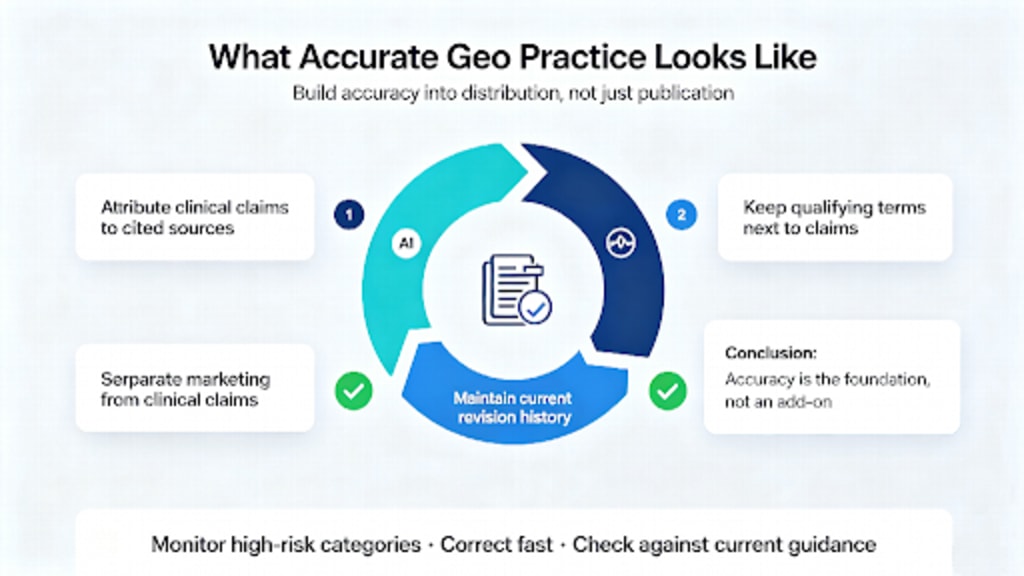
Make sure that you make claims about the source you referenced, regardless of whether the source is an internal panel for medical treatment, a research study, or another source that is used as a reference point in regulations, and do not make statements that seem to be regarding the brand.
Incorporate the qualifying words immediately in the claim or in the context of dosage, populations, or any interactions that are recognized instead of creating a separate disclaimer that is less likely to be included in the claim in its entirety.
Make sure you have clear, up-to-date revision information on regulatory and clinical information. Evidence of recurrence will be particularly crucial when quoting health information.
The language used in marketing should be separated from the clinical claims as far as you can in the same document, as mixing different languages can make it difficult for actors and readers to distinguish between an advertisement and a real.
Establishing a Monitoring Discipline for Healthcare Content
Because of the dangers of healthcare, businesses cannot depend on the same regular review of information that is appropriate for a less hazardous subject. Certain methods have the potential to cause the most impact:
It is vital to prioritize the monitoring of the most hazardous types of material first. This includes following the dosage guidelines of treatment advice as well as safety alerts rather than considering all content released as equally risky.
Establish a very basic procedure to remedy an artificial intelligence-generated error immediately upon knowledge of it because there is no structured method for escalation of the problem to facilitate rapid correction of problems involving the use of artificial intelligence.
Compare claims with the most current guidelines for use in clinical and regulatory settings within a time frame that is clearly defined, and not after any changes to the guidelines are made.
Conclusion: Accuracy as a Foundation and Not an Extra Add-On
In any industry, Geo strategy focuses primarily on visibility. Especially for health-related companies, visibility without the assurance of correctness should be a disadvantage instead of a beneficial factor. For companies implementing the Geo strategy, it is not a good implementation but rather a second part of the review of reviews based on the clinical setting. Geo is becoming a method of distribution that enables users to act in response to information, without having to go to the source through the search engine.
About the Creator
Enjoyed the story? Support the Creator.
Subscribe for free to receive all their stories in your feed.
Comments
There are no comments for this story
Be the first to respond and start the conversation.