
GCC Smart Home Market Growth Accelerates as Smart Cities and IoT Adoption Reshape Modern Living
Renub Research highlights strong momentum in the GCC smart home market as governments, real estate developers, and consumers embrace connected living technologies across the Gulf region.

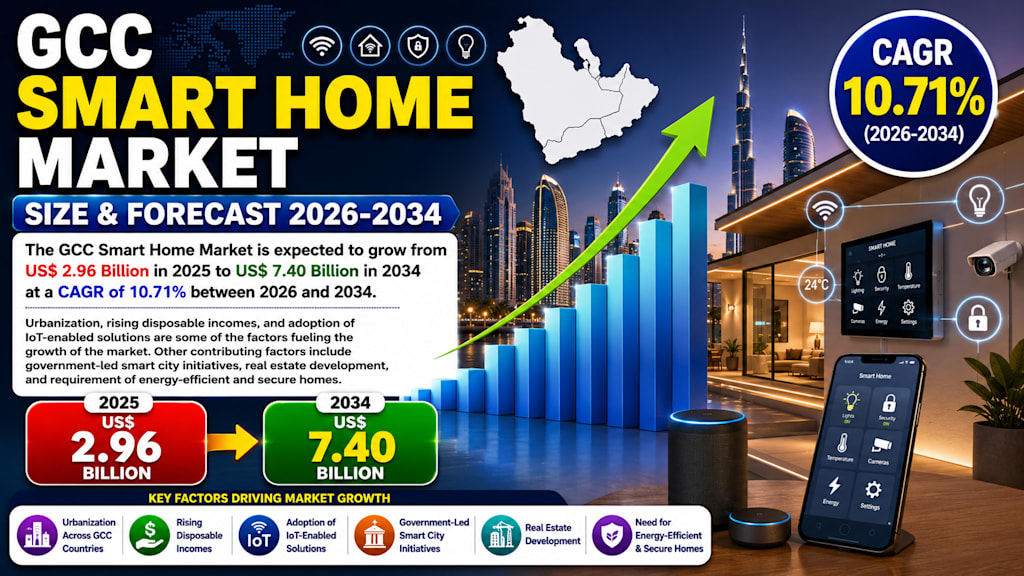
GCC Smart Home Market Overview
The GCC smart home market is entering a new phase of expansion as connected living technologies become increasingly integrated into residential developments across the Gulf region. According to Renub Research, the GCC Smart Home Market is expected to grow from US$ 2.96 Billion in 2025 to US$ 7.40 Billion by 2034, registering a CAGR of 10.71% between 2026 and 2034. The report identifies urbanization, rising disposable incomes, IoT-enabled technologies, smart city initiatives, real estate expansion, and growing demand for energy-efficient and secure homes as the key growth drivers behind the industry’s rapid transformation.
Smart homes are increasingly becoming part of everyday life across GCC nations. These homes use internet-connected devices and systems that can be remotely controlled through smartphones, tablets, or voice assistants. Technologies such as smart lighting, smart thermostats, surveillance systems, automated locks, entertainment systems, and AI-powered assistants are helping homeowners improve convenience, security, and energy management. The combination of IoT, artificial intelligence, and cloud computing is making connected homes more practical and attractive for consumers across the region.
The GCC region presents a particularly favorable environment for smart home adoption. Rapid urbanization, growing luxury housing developments, digitally connected consumers, and harsh climate conditions have created strong demand for automation technologies. In countries such as Saudi Arabia and the UAE, governments are investing heavily in smart city projects like NEOM and Smart Dubai, encouraging developers to integrate advanced smart technologies into residential infrastructure.
Growth Drivers of the GCC Smart Home Market
Government-backed smart city initiatives remain one of the strongest catalysts for market growth. GCC governments are actively investing in digital infrastructure, sustainable urban planning, and connected ecosystems to improve quality of life and diversify their economies. Programs such as Saudi Vision 2030, Smart Dubai, and NEOM are accelerating the deployment of IoT-enabled residential solutions. These projects encourage the use of intelligent lighting systems, automated climate control, integrated security systems, and smart energy management technologies.
In November 2025, GSMA published a report titled “Accelerating Digital Industries in the GCC and Wider MENA Region” during MWC25 Doha, reinforcing the region’s focus on digital transformation and connected technologies. The increasing government support for digital ecosystems is expected to create long-term opportunities for smart home solution providers across the Gulf.
Another major growth factor is the rise of luxury real estate and increasing disposable income levels. Affluent consumers across the GCC increasingly prefer technology-enabled homes that offer convenience, comfort, security, and energy efficiency. Developers of luxury villas, premium apartments, and gated communities are integrating smart home systems into their projects to attract modern buyers and investors. Cities such as Dubai, Riyadh, and Doha are witnessing strong demand for automated lighting, intelligent cooling systems, remote-controlled appliances, and smart surveillance technologies.
The need for energy efficiency is also driving adoption. GCC countries experience extremely hot climatic conditions, making cooling systems essential throughout most of the year. Smart thermostats, automated air-conditioning systems, energy management solutions, and intelligent lighting controls help reduce electricity consumption and lower energy bills. Governments across the region are also encouraging sustainability and green building practices, further increasing interest in energy-efficient home technologies.
Security concerns are another major contributor to market growth. Consumers are increasingly investing in smart cameras, motion sensors, biometric access systems, smart locks, video doorbells, and remote monitoring solutions. The popularity of smartphone-based home management systems and voice assistants has made security automation more accessible to homeowners across the region.
Challenges Facing the GCC Smart Home Market
Despite strong momentum, the market still faces several challenges. One of the most important barriers is the high initial cost of installation and integration. Smart home systems require significant investment in IoT devices, software platforms, sensors, networking equipment, and installation services. This can make adoption difficult for middle-income households, limiting penetration beyond premium housing segments.
Integration complexity also remains a concern. Consumers often struggle with compatibility issues between products from different manufacturers. Devices operating on separate platforms or communication protocols may not function smoothly together, particularly in older residential buildings where retrofitting can be technically difficult and expensive.
Cybersecurity and data privacy concerns continue to affect consumer confidence as well. Since smart home devices rely heavily on internet connectivity and cloud services, they may become vulnerable to cyberattacks, hacking, or data breaches. Consumers worry about the security of surveillance footage, personal information, and remote-access systems. In addition, the lack of standardization among IoT products creates uncertainty regarding interoperability and long-term reliability.
GCC Smart Comfort and Lighting Market
The GCC Smart Comfort and Lighting segment is experiencing rapid growth because of the increasing demand for automation and efficient energy usage. Products such as smart thermostats, automated cooling systems, smart curtains, and intelligent lighting solutions are becoming increasingly popular among homeowners. Given the region’s hot climate, climate-control automation plays a vital role in improving comfort while minimizing energy consumption.
Smart lighting systems equipped with dimming features, motion detection, remote access, and automated scheduling are gaining popularity in both luxury and mid-range housing projects. Government sustainability programs and rising environmental awareness are further encouraging the adoption of energy-efficient lighting technologies across GCC countries.
GCC Smart Control and Connectivity Market
The Smart Control and Connectivity segment forms the backbone of the GCC smart home ecosystem. This segment includes smart home hubs, gateways, controllers, sensors, and communication technologies such as Wi-Fi, Zigbee, Bluetooth, Z-Wave, and cloud connectivity. These technologies enable different smart devices to communicate and operate together efficiently.
The expansion of 5G infrastructure across GCC nations is supporting the rapid growth of connected devices and home automation systems. Consumers increasingly prefer centralized control of lighting, entertainment, security, and appliances through mobile applications and virtual assistants. This growing demand for integrated digital ecosystems is expected to drive significant investment in connectivity solutions over the coming years.
GCC Smart Home Security Market
The GCC Smart Home Security Market is witnessing strong growth due to rising concerns around safety, monitoring, and remote access. Product categories in this segment include surveillance cameras, video doorbells, smart locks, biometric access systems, motion sensors, and alarm systems. The increase in luxury housing developments and the growing expatriate population are helping fuel demand for advanced security technologies.
Consumers are increasingly adopting cloud-based monitoring systems that can be accessed through smartphones and tablets. AI-powered technologies such as facial recognition and predictive monitoring are also improving the effectiveness of home security systems. Governments in the GCC are promoting secure digital infrastructure as part of their smart city ambitions, which further supports growth in this category.
GCC Smart Home Appliance Market
Smart home appliances are rapidly gaining traction across GCC countries as consumers prioritize convenience and energy savings. Smart refrigerators, washing machines, robotic vacuum cleaners, air purifiers, dishwashers, and ovens are becoming more common in urban households. These devices can be remotely controlled through smartphones or voice commands, making them highly attractive to busy professionals and tech-savvy consumers.
Artificial intelligence and predictive maintenance technologies are further improving the functionality of smart appliances. Online retail channels and e-commerce platforms are also helping accelerate product availability and market penetration throughout the region.
Smart Home Market in the United Arab Emirates
The UAE remains one of the most advanced smart home markets in the Middle East. Cities such as Dubai and Abu Dhabi have embraced digital transformation strategies through programs like Smart Dubai and UAE Vision 2031. The growing demand for luxury real estate, combined with high internet penetration and consumer interest in AI-powered technologies, has created strong opportunities for smart home adoption.
Voice assistants are becoming increasingly popular in UAE households. According to the report, Alexa performed more than 24 million lighting-related actions in homes across the UAE and Saudi Arabia in 2023. More than 9 million users also used Alexa to control air-conditioning systems through voice commands. These figures highlight the growing integration of voice-enabled home automation in daily life.
Smart Home Market in Saudi Arabia
Saudi Arabia is witnessing rapid expansion in the smart home market due to major infrastructure projects and digital transformation initiatives under Vision 2030. Projects such as NEOM, Qiddiya, and The Red Sea Project are promoting the integration of smart home technologies into residential and mixed-use developments.
Urbanization, increasing consumer awareness, and the growth of the middle-income population are driving demand for smart lighting, intelligent cooling systems, energy management devices, and home security technologies. The widespread rollout of 5G networks and IoT infrastructure is also strengthening the country’s connected home ecosystem.
Smart Home Market in Qatar
Qatar’s smart home market is benefiting from strong digital infrastructure, high living standards, and sustainability-focused government initiatives aligned with Qatar National Vision 2030. Luxury apartments and villas are increasingly adopting smart technologies designed to improve convenience, energy efficiency, and security.
In February 2024, Qatar’s Investment Promotion Agency and the Ministry of Communications and Information Technology released a report titled “Smarter Qatar: Embracing Emerging Technologies and Innovation, Improving Lives and Driving a Sustainable Digital Economy.” This initiative reflects the country’s broader commitment to digital transformation and smart living solutions.
Recent Developments from Key Companies
Johnson Controls continued expanding its smart building and energy management portfolio across the Middle East, focusing on connected HVAC and intelligent infrastructure solutions for residential and commercial projects.
Schneider Electric strengthened its presence in smart home automation by promoting sustainable energy management technologies and connected home ecosystems across GCC markets.
Emerson Electric expanded investments in intelligent automation and climate-control technologies to improve energy efficiency and remote monitoring solutions.
LG increased its focus on AI-powered smart appliances and connected home products in GCC countries, particularly targeting premium residential developments.
Legrand SA expanded its smart wiring devices and connected lighting solutions portfolio designed for luxury homes and modern residential infrastructure.
Siemens AG continued strengthening its smart infrastructure business through digital building technologies, smart energy systems, and IoT-enabled automation solutions.
Honeywell promoted advanced home security and automation technologies, including smart sensors, remote monitoring platforms, and intelligent climate systems.
Apple continued expanding the adoption of HomeKit-enabled smart home ecosystems, allowing users to integrate and control connected devices across Apple platforms.
Tuya Smart signed an agreement with InfraX in November 2024 to support smart city development initiatives in the UAE.
ST Engineering secured a US$ 60 million smart city contract in Qatar involving AI, machine learning, and big data technologies for Lusail City.
Final Thoughts
The GCC smart home market is evolving from a luxury concept into a mainstream component of modern urban living. Strong government support, smart city development, rising technology adoption, and increasing demand for energy efficiency are transforming residential infrastructure across the Gulf region. While challenges such as cybersecurity risks and high installation costs remain, the long-term outlook for connected homes in the GCC appears highly promising. As IoT ecosystems mature and digital lifestyles continue to expand, smart home technologies are expected to become an essential part of future housing developments throughout the region.
About the Creator
Enjoyed the story? Support the Creator.
Subscribe for free to receive all their stories in your feed.
Comments
There are no comments for this story
Be the first to respond and start the conversation.