
Game On America: Why the U.S. Video Game Industry Is Entering a New Golden Age
From cloud gaming and esports to mobile entertainment and immersive technologies, video games are becoming one of America's most powerful entertainment industries.

Video games have evolved far beyond simple entertainment. What was once considered a niche hobby has transformed into one of the largest and most influential industries in the United States. Today, gaming reaches millions of Americans across every age group, creating a digital ecosystem that combines entertainment, technology, social interaction, and business innovation.
Whether playing competitive multiplayer games on consoles, streaming content on mobile devices, exploring virtual worlds on personal computers, or watching professional esports tournaments, Americans are spending more time and money on gaming than ever before. The industry continues to expand through technological breakthroughs, new business models, and changing consumer preferences that make gaming more accessible and engaging.
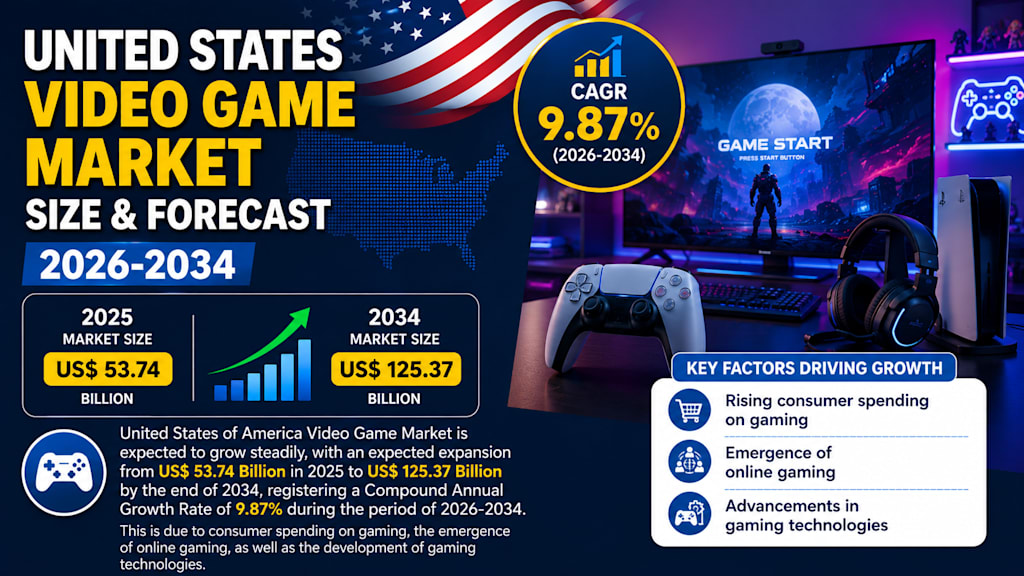
According to Renub Research, the United States Video Game Market is expected to grow from US$53.74 billion in 2025 to US$125.37 billion by 2034, registering a compound annual growth rate (CAGR) of 9.87% between 2026 and 2034. This strong growth reflects increasing consumer spending, the rapid expansion of online gaming, and continuous advancements in gaming technology.
The future of gaming is no longer confined to dedicated consoles or gaming PCs. Instead, it is becoming an integrated part of everyday entertainment, social interaction, and digital culture.
Gaming Has Become Mainstream Entertainment
The perception of video games has changed dramatically over the past two decades. Gaming is no longer limited to teenagers spending hours in front of a television screen. Today, gamers come from virtually every demographic group, including students, working professionals, parents, and retirees.
The accessibility of gaming across multiple platforms has played a major role in this transformation. Consumers can enjoy games on smartphones, tablets, personal computers, consoles, smart televisions, and cloud-based platforms. This flexibility allows players to engage with games whenever and wherever they choose.
The growing popularity of gaming reflects broader shifts in entertainment consumption. Unlike passive forms of media such as television or film, video games offer interactive experiences that place users directly at the center of the action. Players can compete, collaborate, create, and explore virtual worlds that evolve continuously through updates and community participation.
As a result, gaming has become one of the most engaging forms of digital entertainment available today.
Consumer Spending Continues to Drive Growth
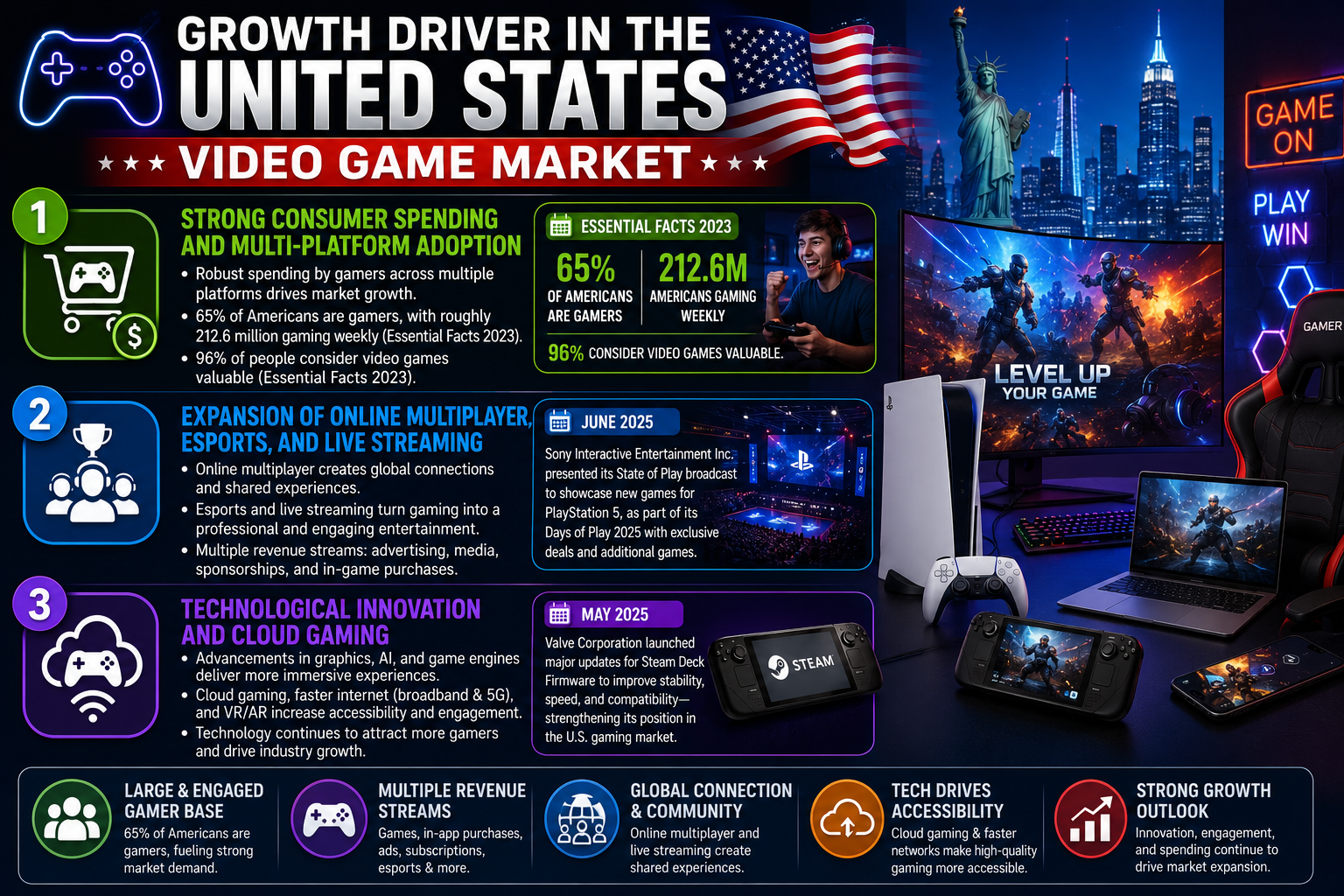
One of the strongest factors supporting the expansion of the U.S. gaming market is robust consumer spending.
American gamers consistently invest in new games, downloadable content, subscriptions, virtual goods, gaming hardware, and premium experiences. Unlike previous generations of gaming, where revenue primarily came from one-time purchases, modern gaming generates income through multiple channels.
Subscription services provide access to extensive game libraries, while in-game purchases allow players to customize characters, unlock content, and enhance gameplay experiences. Downloadable expansions keep games relevant for years after release, creating ongoing revenue streams for publishers.
Consumers increasingly view gaming as a valuable source of entertainment and social connection, making them more willing to spend money on products and services that enhance their experiences.
This strong spending culture has helped establish the United States as one of the world's most important gaming markets.
Online Gaming Has Changed Everything
The rise of online gaming has fundamentally transformed the industry.
In the past, gaming was often a solitary activity or limited to local multiplayer experiences. Today, millions of players connect online daily to compete, cooperate, and communicate with others around the world.
Online multiplayer games have created vibrant digital communities where players form friendships, join teams, and participate in shared experiences. Popular titles attract millions of active users who spend countless hours engaging with virtual environments and social networks built around gaming.
The social aspect of gaming has become one of its most powerful attractions. For many players, games serve as platforms for communication and interaction rather than simply entertainment products.
As internet infrastructure continues improving across the United States, online gaming is expected to remain a major driver of industry growth.
Esports Is Becoming a Major Entertainment Force
Esports has emerged as one of the fastest-growing segments of the gaming industry.
Professional gaming competitions now attract audiences comparable to traditional sporting events. Millions of viewers watch tournaments featuring elite players competing for substantial prize pools, sponsorship deals, and global recognition.
The growth of esports has transformed gaming into a spectator activity. Fans follow teams, watch live broadcasts, attend events, and engage with gaming personalities through social media and streaming platforms.
Major companies increasingly invest in esports through sponsorships, advertising partnerships, and event production. Universities have established esports programs, while professional organizations continue expanding competitive leagues.
As esports becomes more mainstream, it is helping elevate gaming's cultural significance and creating new economic opportunities throughout the industry.
Live Streaming Is Reshaping Gaming Culture
Live streaming has become one of the most influential developments in modern gaming.
Platforms that allow gamers to broadcast their gameplay in real time have created entirely new forms of entertainment. Millions of viewers tune in daily to watch streamers play games, share strategies, and interact with audiences.
Content creators have become influential figures within gaming communities, often shaping purchasing decisions and popularizing new titles. Their ability to build loyal audiences has created additional revenue opportunities through advertising, subscriptions, sponsorships, and merchandise sales.
Live streaming has also strengthened the social dimension of gaming. Viewers can participate in conversations, support creators, and engage with communities centered around shared interests.
This interactive entertainment model continues to attract new audiences and expand the overall reach of the gaming industry.
Cloud Gaming Is Breaking Traditional Barriers
Cloud gaming represents one of the most exciting technological developments in the industry.
Traditionally, enjoying high-quality games required expensive gaming consoles or powerful computers. Cloud gaming changes this equation by allowing games to be streamed directly from remote servers to virtually any compatible device.
Consumers can now access premium gaming experiences through smartphones, tablets, smart televisions, and standard computers without investing in advanced hardware.
The expansion of high-speed internet networks and 5G connectivity has made cloud gaming increasingly practical. Reduced latency and improved streaming quality allow players to enjoy immersive experiences with minimal technical limitations.
Cloud gaming also lowers barriers to entry for new players, making high-quality games accessible to broader audiences.
As infrastructure continues improving, cloud gaming is expected to become a major force within the future gaming ecosystem.
Technology Continues to Push Boundaries
Innovation remains at the heart of the gaming industry's growth.
Advances in graphics processing, artificial intelligence, game engines, and network technologies are enabling developers to create increasingly immersive experiences. Modern games feature realistic environments, intelligent non-player characters, dynamic storytelling, and sophisticated multiplayer systems.
Virtual reality and augmented reality technologies are introducing entirely new ways to interact with digital worlds. These innovations blur the line between physical and virtual experiences, creating opportunities for deeper engagement.
Artificial intelligence is also playing a growing role in game development by enhancing character behavior, personalizing gameplay experiences, and streamlining production processes.
As technology continues evolving, developers will gain new tools for creating richer and more interactive gaming environments.
Mobile Gaming Expands the Audience
Mobile gaming has become one of the largest segments of the U.S. gaming market.
Smartphones have transformed gaming into an activity that can be enjoyed anywhere. Casual games, competitive titles, and social experiences are now available directly through mobile devices, attracting audiences that may never have considered themselves traditional gamers.
The convenience of mobile gaming has helped broaden the industry's demographic reach. Consumers can engage with games during commutes, breaks, travel, or leisure time without requiring dedicated gaming hardware.
Free-to-play business models, supported by optional purchases and advertising, have further accelerated adoption.
As mobile technology continues advancing, this segment is expected to remain a major contributor to overall market growth.
Challenges Facing the Industry
Despite its strong growth prospects, the gaming industry faces several challenges.
Development costs continue rising as consumers demand increasingly sophisticated experiences. Creating modern games often requires large teams, advanced technologies, and multi-year development cycles, increasing financial risk for publishers.
Market saturation presents another challenge. Thousands of new games enter the market each year, making it difficult for developers to capture consumer attention.
Concerns regarding player wellbeing have also attracted greater scrutiny. Issues related to excessive screen time, gaming addiction, online safety, and in-game spending practices continue generating discussion among regulators, parents, and industry leaders.
Successfully addressing these concerns will be essential for maintaining sustainable growth and consumer trust.
Regional Markets Fuel Innovation
Several states play important roles in shaping the future of gaming in America.
California remains one of the most influential gaming hubs in the world. Home to major technology companies, game developers, and entertainment organizations, the state serves as a center for innovation and content creation.
Texas has emerged as a rapidly growing gaming market supported by strong technology ecosystems, expanding esports communities, and a large player base.
New York benefits from its dense population, digital connectivity, and active participation in esports, streaming, and indie game development.
Washington State continues to influence the industry through its strong technology infrastructure and history of innovation in software and online services.
Together, these regions contribute significantly to the growth and evolution of the national gaming market.
Final Thoughts
The United States video game industry is experiencing a period of extraordinary growth and transformation. Driven by technological innovation, strong consumer spending, expanding online communities, and new forms of digital entertainment, gaming has become one of the country's most dynamic industries.
With the market projected to grow from US$53.74 billion in 2025 to US$125.37 billion by 2034, the future looks exceptionally bright for developers, publishers, content creators, and players alike. Cloud gaming, esports, live streaming, artificial intelligence, and mobile platforms are opening new opportunities while redefining how people experience entertainment.
As gaming continues to evolve, it is becoming more than a pastime. It is a cultural force, a social platform, and a technological frontier that will shape the future of digital entertainment for years to come.
About the Creator
Enjoyed the story? Support the Creator.
Subscribe for free to receive all their stories in your feed.
Comments
There are no comments for this story
Be the first to respond and start the conversation.