
From Static Halls to Smart Institutions: Why Museums Need a Digital Experience Agency Now
AI is changing what visitors expect from cultural spaces. Museums that align with this shift will grow their audiences. Those who don't will find recovery increasingly difficult.

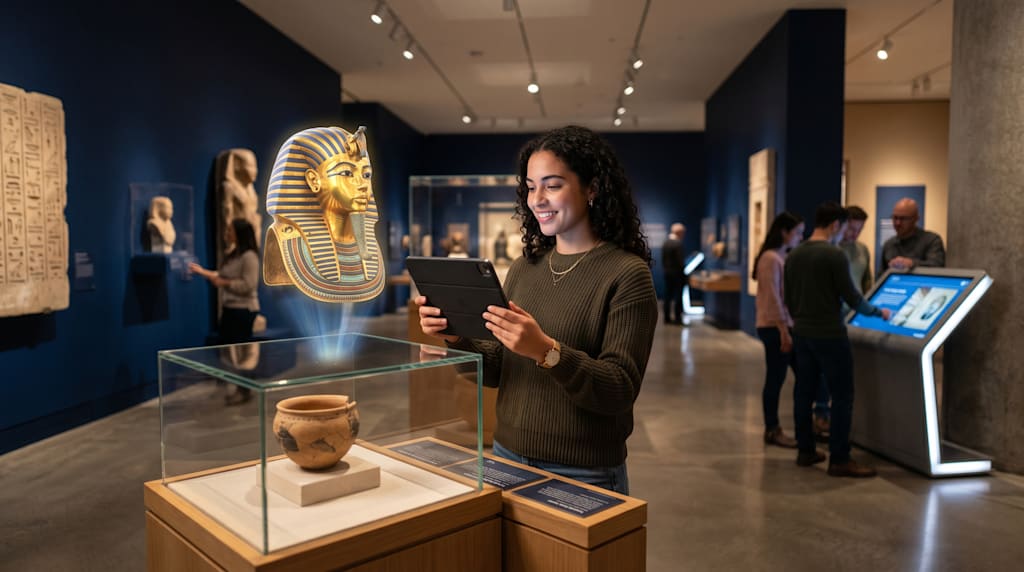
Walk into most museums today, and the experience follows a familiar pattern. Placards. Glass cases. A printed map at the entrance. For older audiences, this works. For a 22-year-old who navigates life through personalized apps, real-time recommendations, and interactive digital environments, it often falls flat.
This is not a criticism of museums. It is a description of a structural mismatch between what cultural institutions currently offer and what digital-native audiences now expect.
Closing that gap requires more than installing a few touchscreens. It requires technical infrastructure, behavioral data systems, and immersive content pipelines that most museums are not equipped to build on their own. This is why the role of a digital experience agency in the museum sector has shifted from optional to essential.
Gen Z Is Not Ignoring Museums. Museums Are Ignoring Gen Z.
Research from the Pew Research Center shows that younger adults remain interested in cultural and educational institutions. The issue is the engagement format. Gen Z processes information through interactive platforms, short-form video, spatial audio, and personalized content feeds. A museum experience that delivers none of these things registers as outdated, regardless of the quality of its collection.
AI-powered smart museums solve this by mapping the visitor journey to individual behavior. A teenage visitor who spends time at a space exploration exhibit gets audio content adjusted to their interest level. A history enthusiast gets a deeper archival context than a casual browser. The experience changes based on who is actually present, not who the museum imagined would show up.
This is AI-powered personalization applied to physical space. It is already in use at institutions like the Smithsonian, which has piloted AI-based recommendation systems across its Washington D.C. campuses. The outcomes include longer visit times, stronger emotional engagement, and measurable increases in return visits.
Immersive Technology Is Moving From Experiment to Expectation
Three years ago, AR/VR installations in museums were headline features. Visitors noticed them because they were rare. Today, a museum without any interactive exhibition format feels incomplete.
Augmented reality allows a visitor to point a device at a Roman coin and watch a merchant transaction from 100 AD play out in 3D. Virtual reality transports a school group into the interior of the Pantheon before the roof collapsed. These are not gimmicks. They are pedagogical tools that create memory-anchored learning experiences that static displays cannot replicate.
Building this kind of experience requires spatial computing expertise, 3D asset pipelines, real-time rendering, and hardware integration — competencies that sit well outside curatorial training. A digital experience consulting company with dedicated AR/VR teams bridges this gap directly. Museums define what they want visitors to understand. The agency builds the environment that makes that understanding stick.
Accessibility Is Not a Feature. It Is a Reach Multiplier.
The physical museum serves visitors who can travel to it. A digitally extended museum serves everyone else.
A visitor with a hearing impairment in São Paulo can access a sign-language-enabled tour of the Louvre's Egyptian antiquities through a web application. A visitor with low vision in Seoul can receive screen-reader-optimized content paired with spatial audio narration. A student in rural Indonesia can walk through a virtual gallery of impressionist paintings before she ever boards a plane to Paris.
Digital experience services make these outcomes achievable at an institutional scale. This is not charity work. It is audience expansion. According to the American Alliance of Museums, U.S. museums alone receive over 850 million visits annually. Digital accessibility infrastructure multiplies the reach of every physical exhibit without requiring physical expansion.
Data Turns Visitor Behavior Into Institutional Intelligence
Museums collect far more behavioral data than they realize. Entry times. Exhibit dwell times. Audio guide drop-off points. Gift shop conversion rates. Ticketing patterns by age group and season.
Without the right analytical architecture, this data sits unused. With it, museum administrators can answer practical questions: Which exhibits are losing visitor attention after the first five minutes? Which gallery layouts cause crowding that shortens visit time? Which marketing campaigns drive attendance among first-time visitors versus repeat visitors?
AI-powered digital experience solutions turn raw behavioral signals into operational decisions. Curatorial teams stop relying on intuition and start making exhibit investments based on documented visitor engagement patterns. This improves both the visitor experience and the institution's financial sustainability.
Why Technical Execution Requires a Specialized Partner
Cultural institutions operate under constraints that general technology vendors rarely understand: grant funding cycles, preservation mandates, public accountability requirements, and curatorial authority structures. A vendor who treats a museum like a retail deployment will design for the wrong priorities.
Companies offering digital experience consulting and services with specific cultural sector experience understand these constraints. They design AI integrations that respect archival systems. They build AR content pipelines that accommodate low-bandwidth environments. They develop visitor data frameworks that meet institutional privacy obligations.
ViitorCloud's work in this space reflects this kind of sector-aware approach. Their digital experience consulting and services framework treats museums as institutions with distinct operational needs, rather than as generic enterprise clients. The difference shows in the implementation.
The Window for Early Adoption Is Still Open
Museums that invest in AI-powered infrastructure now will define what the cultural institution experience looks like for the next generation of visitors. The tools exist. The visitor expectations are already in place.
A capable digital experience agency does not replace what museums do. It extends the reach of what museums have always done—preserve, educate, and connect people to history—into environments where those people already live their digital lives.
The question is not whether to make this transition. It is how quickly the institution is willing to move.
About the Creator
ViitorCloud Technologies
As a leading software development company, we’ve empowered 500+ startups, SMBs, and enterprises to transform their operations. Upgrade your business with our AI-First Software and Platforms that automate and scale, keeping you future-ready.
Enjoyed the story? Support the Creator.
Subscribe for free to receive all their stories in your feed.
Comments
There are no comments for this story
Be the first to respond and start the conversation.