
From Dots and Dashes to Words: How to Decode Morse Code into Readable Text
Discover how a communication system invented nearly two centuries ago can still be decoded, understood, and explored using modern online tools.

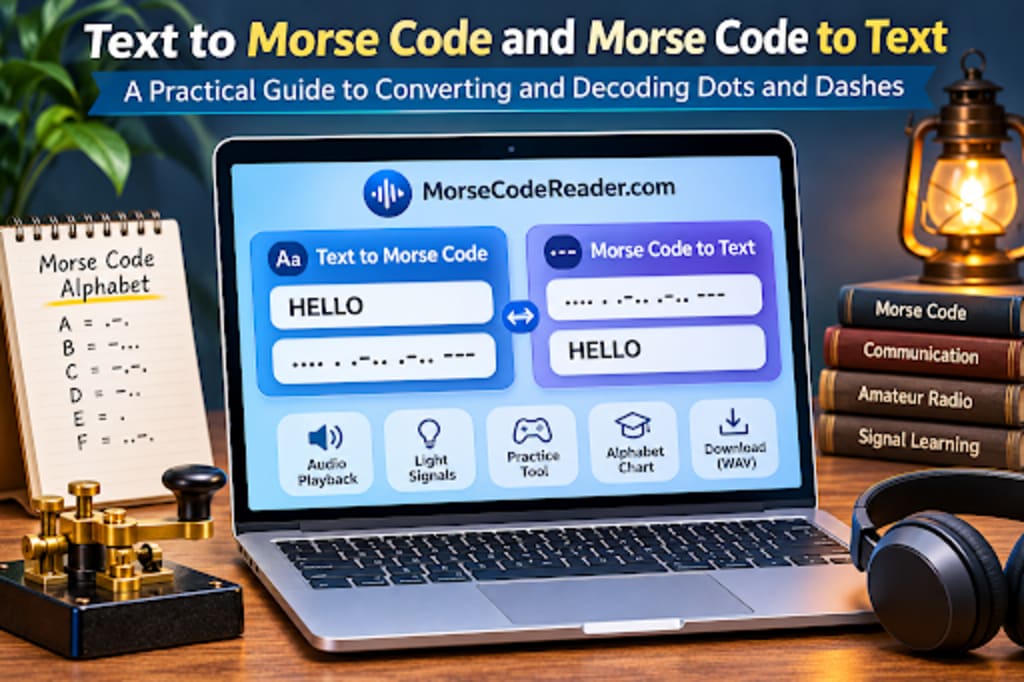
Discover how a communication system invented nearly two centuries ago can still be decoded, understood, and explored using modern online tools.
Imagine receiving a message that looks like this:
.... . .-.. .-.. --- / .-- --- .-. .-.. -..
At first glance, it might look like a random collection of dots, dashes, and spaces. But hidden inside those symbols is a familiar greeting: HELLO WORLD.
This is Morse code, one of the most recognizable communication systems in history. Although it originated in the age of telegraphs, Morse code continues to attract students, amateur radio enthusiasts, puzzle solvers, and people interested in alternative communication methods.
Today, you don't need a telegraph machine or specialized equipment to understand these messages. Learning a few basic rules and using an online decoding tool can turn seemingly mysterious signals into readable words.
Understanding the Language of Dots and Dashes
Morse code represents letters, numbers, and certain punctuation marks through combinations of short and long signals.
These signals are commonly written as:
Dot (.) — A short signal, also called a dit.
Dash (-) — A longer signal, also called a dah.
Every supported character has its own pattern. For example:
Character
Morse Code
A
.-
B
-...
C
-.-.
E
.
H
....
O
---
S
...
The internationally recognized distress signal SOS is represented by:
... --- ...
One of the interesting aspects of Morse code is that the same information can be communicated through different mediums. A message can be transmitted using sound, light, radio signals, or written symbols.
The underlying character patterns remain recognizable regardless of how the signals are delivered.
How to Convert Morse Code into Readable Text
Decoding Morse code involves identifying individual signal patterns and matching them to their corresponding characters.
Consider this example:
- .... . / -.-. .- -
To decode it manually, separate the groups of dots and dashes:
- represents T.
.... represents H.
. represents E.
-.-. represents C.
.- represents A.
- represents T.
The complete message reads THE CAT.
The process is straightforward when the message is short. However, longer messages become more challenging, especially when they contain numbers, punctuation, or unfamiliar combinations.
This is where digital decoding tools become useful.
Instead of consulting a Morse code chart for every character, users can enter a sequence and receive the corresponding text almost immediately.
Decoding Morse Code with an Online Tool
Modern browser-based tools have made Morse code more accessible to people who have never studied telecommunications.
For example, Morse code to text conversion is available through Morse Code Reader, an online tool that supports converting written Morse sequences into readable text and translating ordinary text into Morse code.
Users can enter a message, explore its corresponding symbols, and listen to audio playback to understand how the written patterns relate to sound.
This approach is particularly helpful for beginners because it connects three important aspects of Morse code learning:
Visual recognition: Seeing the dots and dashes that represent each character.
Text interpretation: Understanding the letters and words represented by those symbols.
Audio familiarity: Hearing the difference between short and long signals.
Rather than memorizing an entire alphabet before attempting a message, learners can experiment with familiar words and gradually recognize recurring patterns.
Why Spacing Matters When Decoding Morse Code
One of the most common mistakes beginners make is overlooking spacing.
Unlike ordinary written language, Morse code relies on pauses to distinguish individual characters and words.
For instance:
... --- ...
This represents SOS when interpreted as three separate characters.
But combining or dividing the signals incorrectly can produce a different interpretation.
In written Morse code, spaces commonly separate letters, while a forward slash is often used to indicate a word boundary.
Consider:
.... .. / - .... . .-. .
This translates to HI THERE.
The slash separates the two words, while the spaces identify the individual letters.
In transmitted Morse code, timing serves the same purpose. A dot lasts one timing unit, a dash lasts three units, the gap between elements of one character lasts one unit, the gap between letters lasts three units, and the gap between words lasts seven units.
Understanding these distinctions helps learners decode messages more accurately.
Can Morse Code Be Decoded from Sound?
Yes. Morse code was designed for signaling, so audio is one of the most natural ways to experience it.
In traditional telegraphy and amateur radio, operators learn to recognize patterns of short and long sounds.
For beginners, however, listening can initially be more difficult than reading written symbols.
A useful learning method is to start with a written message, play its audio representation, and follow along as each character is transmitted.
Over time, repeated exposure can help learners associate familiar sound patterns with particular letters.
For example, the letter A consists of a short signal followed by a long one, while N reverses that sequence.
Adjustable playback speed can also make practice more manageable. Beginners can start slowly and increase the speed as their recognition improves.
It's important to distinguish audio playback from automatic audio decoding. A tool that plays Morse code sounds does not necessarily interpret a live microphone or radio recording. Those tasks require additional signal-processing capabilities.
What About Morse Code Sent Through Light?
Morse code isn't limited to sound.
A flashlight, signaling lamp, or other controlled light source can communicate the same short and long patterns.
A brief flash can represent a dot, while a longer flash can represent a dash.
This makes light signaling an interesting way to demonstrate Morse code in classrooms, educational activities, and controlled experiments.
For example, someone could use a flashlight to transmit:
.... ..
A person familiar with the patterns would recognize the message as HI.
The challenge is identifying the duration of each flash and the pauses separating characters.
When learning light-based Morse code, it's helpful to begin with short messages and maintain consistent timing.
Why People Still Learn Morse Code Today
Learning Morse code also works in reverse. With a text to Morse code converter, beginners can turn familiar words into dots and dashes, listen to their audio patterns, and practice recognizing individual characters. Its continued appeal comes from several areas.
Amateur Radio
Morse code remains part of amateur radio culture, where continuous-wave communication is practiced by enthusiasts around the world.
Some operators value its simplicity and the ability to communicate using relatively narrow-band signals.
Education and STEM Activities
Morse code provides an approachable introduction to encoding, signaling, timing, and communication protocols.
Students can explore how information is represented using a limited set of symbols and how that information can be reconstructed by a receiver.
Puzzles and Recreational Learning
Morse code frequently appears in escape rooms, treasure hunts, mystery games, and online puzzles.
A sequence of dots and dashes can become a clue that participants must decode to progress.
Accessibility and Alternative Input
Morse-code-based input methods have also been explored in assistive technology.
By using a small number of distinct inputs, some systems can provide alternative ways to enter characters. Their usefulness depends on the person's needs and the design of the interface.
Five Tips for Learning to Read Morse Code
If you're new to Morse code, the following techniques can make the learning process more manageable.
1. Start with common letters. Begin with simple patterns such as E (.), T (-), A (.-), and N (-.).
2. Practice short words. Decode familiar words before attempting entire paragraphs.
3. Combine visual and audio practice. Listening while examining written Morse code helps connect the symbols with their sounds.
4. Check your work. Compare your manual decoding attempts with the output of a reliable conversion tool.
5. Practice consistently. A few minutes of focused practice can be more useful than an occasional lengthy session.
As your confidence increases, try decoding messages without looking at the alphabet chart.
Try Decoding This Message
Before finishing, test what you've learned with this short exercise:
.-.. . .- .-. -. / -- --- .-. ... .
Start by identifying the individual characters.
Remember that spaces separate letters and the slash separates words.
If you decode the message correctly, you'll discover a phrase that describes exactly what you've been doing throughout this article.
Answer: LEARN MORSE.
Final Thoughts
Morse code demonstrates that meaningful information doesn't always require complex technology.
A small collection of short and long signals can represent letters, numbers, and complete messages. What once traveled through telegraph wires can now be explored through browsers, audio playback, and interactive learning tools.
Whether you're interested in amateur radio, solving puzzles, teaching communication concepts, or simply learning something new, understanding how to decode Morse code is a rewarding place to begin.
The best way to appreciate the system is to experiment with it: write a short message, translate it into dots and dashes, listen to its rhythm, and see whether you can decode it again.
Sometimes, the simplest signals carry the most interesting stories.
About the Creator
Enjoyed the story? Support the Creator.
Subscribe for free to receive all their stories in your feed.
Comments
There are no comments for this story
Be the first to respond and start the conversation.